
Download a free, customisable landscaping contract template, then fill in the client details, scope of work, price, dates, and licence and insurance information before you send it. That covers most jobs. For large or ongoing contracts, have a lawyer check the wording against your state’s licensing and consumer protection rules before you rely on it.
TL;DR:
- Clear scope descriptions should be broken into detailed, measurable tasks with attached sketches or plans to prevent disputes over work expectations.
- Payment schedules must be milestone-based, with deposits, staged draws, and final payment aligned to visible progress rather than fixed dates to maintain cash flow.
- Materials and permits require explicit specification by name, size, and provider, along with clear ownership transfer and substitution rules to avoid conflicts.
- Listing licensing, insurance coverage, and liability limits plainly in the contract builds trust and provides legal protection if claims arise later.
- Using automated forms that populate contracts, collect signatures, and deposit payments simultaneously streamlines workflows and reduces errors.
Table of Contents
- What every landscaping contract template must include
- How do you write an unambiguous scope of work?
- Structuring payment terms without starving your cashflow
- Documenting materials and permits to avoid disputes
- Insurance, licence disclosures and liability limits
- Handling change orders and unexpected site conditions
- Termination, warranties and what arbitration clauses actually mean
- Where to get the template and how to customise it fast
- A practical workflow: forms, contract, signature, payment
- Why the standard advice on landscaping contracts misses the point
- Turn your landscaping contract into a faster payment
- Sources
What every landscaping contract template must include
A landscaping contract earns its keep the moment a job goes sideways. Weather delays a planting schedule, a client wants three more garden beds mid-job, or a dispute arises over who was supposed to supply the mulch. The contract is what decides who’s right. Miss a clause, and you’re arguing from memory against someone else’s version of events.
Every functional landscape maintenance agreement or one-off construction contract needs the same backbone, regardless of whether you’re mowing lawns weekly or building a retaining wall. Here’s the checklist to run your template against:
- Parties and property: full legal names, business name, contact details, and the exact property address where work happens.
- Scope of work: a specific, measurable description of every task, not “general landscaping.”
- Timeline: start date, estimated completion date, and a weather delay allowance stated in days, not “as needed.”
- Compensation: total contract price, deposit amount, staged payment amounts, and final retention terms.
- Materials: what’s specified, by name and grade, and who’s paying for it.
- Permits and approvals: who pulls them and who pays the fees.
- Insurance and licence disclosures: policy types, coverage limits, and your licence number.
- Warranties: plant establishment period, workmanship guarantee, and what voids them.
- Change orders: the process for approving and pricing extra work.
- Termination and dispute resolution: notice periods, refund treatment, and how disagreements get resolved.
- Signatures: both parties, dated, with contact information current at signing.
State regulators build their own model contracts around this same structure. The Oregon Landscape Contractors Board’s sample contract requires licence disclosure, a payment schedule, guaranties, and an explicit explanation of arbitration rights and cancellation notice, which tells you how seriously consumer protection regulators treat these fields even on residential jobs.
How do you write an unambiguous scope of work?
Vague scope is where most landscaping disputes start. “Install garden beds” means one thing to you and something else entirely to a client who watched a home renovation show last weekend. Break the job into discrete line items and attach numbers to each one.
- List each work category separately: site prep, excavation, irrigation, planting, hardscaping. Don’t bundle them into one paragraph.
- Attach measurable detail to every item: turf area in square metres, mulch depth in centimetres, paver area and edging length, plant species and pot sizes on a numbered list.
- Reference drawings as an exhibit: rather than describing a garden bed layout in prose, attach a sketch or plan as “Exhibit A” and write “as shown in Exhibit A, attached and incorporated by reference” in the body of the contract.
- Note exclusions explicitly: if you’re not removing existing tree stumps or connecting to the mains water line, say so in writing.
This exhibit-based approach isn’t unique to landscaping. Sample contracts across trades, including pest control service agreements, attach plans, treatment maps, or plant lists rather than cramming specifications into the main body. It keeps the contract readable and makes the exhibit easy to update if the scope shifts.
Pro Tip: Photograph the site before you start and attach the photos as a dated exhibit. If a client later claims you damaged an existing garden bed, you’ve got a timestamped record showing its condition before your crew touched it.
Structuring payment terms without starving your cashflow
Most landscaping businesses run on thin margins and tight cashflow, so the payment schedule in your contract matters as much as the scope. A common structure is a deposit at signing, one or two staged draws tied to visible progress, and a final payment on completion.
- Deposit: a portion of the total price, collected at signing to cover initial materials and scheduling.
- Staged draws: tie each payment to an observable milestone, like “irrigation installed and tested” or “hardscape base compacted,” not a calendar date.
- Final payment: due on completion and client walkthrough, sometimes with a small retention held for 30 days to cover plant establishment issues.
- Hourly versus fixed-price work: state clearly which line items are fixed and which are billed hourly, so nobody assumes the whole job is one or the other.
- Late fees and accepted payment methods: specify the fee percentage or flat amount for late payment, and list which payment methods you accept.
- Change orders and payment: link every approved variation to an updated invoice, so a verbal “sure, add that” never becomes an unpaid extra.
Staged payments built around milestones rather than dates give both sides a shared, observable trigger. If you want more detail on structuring draws for larger jobs, this guide to staged payment approvals in construction walks through common milestone structures.
Documenting materials and permits to avoid disputes
Materials disagreements are one of the most common sources of friction on landscaping jobs, usually because the contract described them too loosely. “Quality mulch” or “standard pavers” leaves too much room for interpretation once the invoice lands.
- Specify by name, size and grade: “Grade A river pebble, 20mm to 40mm, 4 cubic metres” leaves no room for argument.
- State lead times and substitution rules: note what happens if a specified plant variety isn’t available, and who approves a substitute.
- Clarify who buys and when ownership transfers: most contracts specify materials become the client’s property once delivered to site, not once installed.
- Assign permit responsibility clearly: state who applies for permits, who pays the fees, and who schedules any required inspections.
Insurance, licence disclosures and liability limits
Clients hire trades partly on trust, and a contract that states your credentials plainly builds that trust faster than a sales pitch ever could. It also protects you if a claim arises later.
- List required coverage: workers’ compensation and commercial general liability (CGL), stated with minimum coverage limits.
- State your licence number and issuer: put it near your business name, where consumers expect to find it, not buried in fine print.
- Write a plain-English indemnity clause: describe who’s responsible for damage caused by negligence, and state any reasonable limitation of liability.
State-level model contracts consistently list licence number, bond information, and board contact details as mandatory disclosures rather than optional extras. Clear licensing statements and readable payment terms reduce a buyer’s hesitation before signing, which is a practical reason to put this information front and centre rather than treating it as compliance boilerplate.
Handling change orders and unexpected site conditions
Every landscaping job eventually hits a surprise, whether it’s rock two centimetres under the topsoil or a client who wants a fire pit added mid-project. The fix isn’t avoiding change, it’s having a process ready before it happens.
- Client or contractor proposes the change verbally or in writing.
- Contractor issues a written quote covering labour, materials, and any waste removal costs.
- Client signs or initials the change order before work proceeds.
- Contract and invoice are updated to reflect the new total and revised timeline.
Subsurface surprises, like unexpected rock or old construction debris, deserve their own line in the contract stating that additional excavation is billed as a change order at a stated hourly or per-cubic-metre rate. A ready-made change order template makes this step quick rather than something you draft from scratch under time pressure.
Termination, warranties and what arbitration clauses actually mean
Termination clauses should spell out notice periods, how deposits and staged payments are treated if the job ends early, and whether either party owes a payment for work completed to that point.
- Warranties: plant establishment periods usually last several weeks, and workmanship warranties often last about one year, both usually excluding damage from neglect or extreme weather.
- Governing law: name which state’s law applies to the contract, since this determines which court or process handles a dispute if one arises.
- Arbitration or mediation: if your contract includes one, explain in plain language what rights the client gives up by agreeing to it, rather than burying it in a single dense paragraph.
Governing law clauses are standard in most service contracts precisely because they remove ambiguity about which court’s rules apply. If you include arbitration, some state boards scrutinise clauses that aren’t clearly disclosed, so make the language conspicuous rather than hidden in a footnote.
Where to get the template and how to customise it fast
Editable landscaping contract templates, available as Word and PDF downloads, already carry the core clause set: scope, timeline, payment, insurance, and warranty. Structure yours around a main body plus an “Exhibit A” for drawings, plant lists, and material specifications, so the legal language stays stable while the job-specific detail lives in an attachment you can swap per project.
Before you send any template to a client, edit these fields first:
- Client name and property address
- Your business name, licence number and issuer
- Scope of work (reference Exhibit A)
- Total price and deposit amount
- Start date and estimated completion date
- Payment schedule and milestone triggers
- Insurance coverage and limits
- Warranty period and exclusions
- Termination notice period
- Signature and date fields for both parties
| Format | Best for | Signing method |
|---|---|---|
| Word document | Heavy customisation per client | Print and sign, or convert to PDF |
| Standard jobs with minor edits | Print and sign, or e-signature tool | |
| Auto-generated from form | Recurring job types, high volume | Built-in e-signature and deposit collection |
Save your finished version as a PDF, collect an e-signature, and take the deposit at the same time the client signs. That single step removes the awkward follow-up call asking someone to pay after they’ve already agreed to the job.
A practical workflow: forms, contract, signature, payment
The businesses that spend the least time chasing paperwork tend to follow the same sequence: an online form captures the job details, those answers auto-populate the contract and Exhibit A, then the client signs and pays the deposit in one sitting. Fewer manual entries mean fewer transcription errors, and a signed, timestamped record gives you an audit trail if a dispute ever surfaces.
- Fewer errors: job details flow straight from the client’s answers into the contract, with nothing retyped.
- Faster payment: the deposit is collected at the moment of signing, not chased afterward.
- Cleaner records: every signed agreement and payment sits in one place, searchable later.
Pro Tip: Ask for deposit authorisation as part of the signing step itself, not a separate follow-up email. Clients who’ve just reviewed and agreed to the scope are far more likely to pay immediately than a week later.
Why the standard advice on landscaping contracts misses the point
Most guides treat a landscaping contract like a legal document you fill out once and file away. That’s backwards for a small landscaping business. The contract is a working tool that should move at the same pace as your sales conversation, not sit behind it.

The conventional advice, get a lawyer to draft a comprehensive contract, then reuse it forever, breaks down in practice because most disputes trace back to vague scope language, not missing legal boilerplate. A client who’s unhappy about mulch depth doesn’t care about your arbitration clause. They care that “quality mulch, spread appropriately” meant something different to each of you.
Prioritise the scope language and the exhibit attachments before you worry about anything else. Get those specific and measurable, and most disputes never happen. Then build the signing step into the same moment as the deposit request, because a contract that sits in someone’s inbox unsigned protects nobody. The businesses getting paid fastest aren’t the ones with the most exhaustive legal language. They’re the ones who’ve made signing and paying the easiest possible action for a client to take.
— Josh
Turn your landscaping contract into a faster payment
Some platforms are built for landscaping businesses that want the contract, the signature, and the deposit handled in one sitting rather than three separate follow-ups. Instead of emailing a Word template, waiting on a signed PDF, then chasing a bank transfer, you send one guided form. The client’s answers auto-populate the contract, they sign electronically, and the deposit lands in the same step.
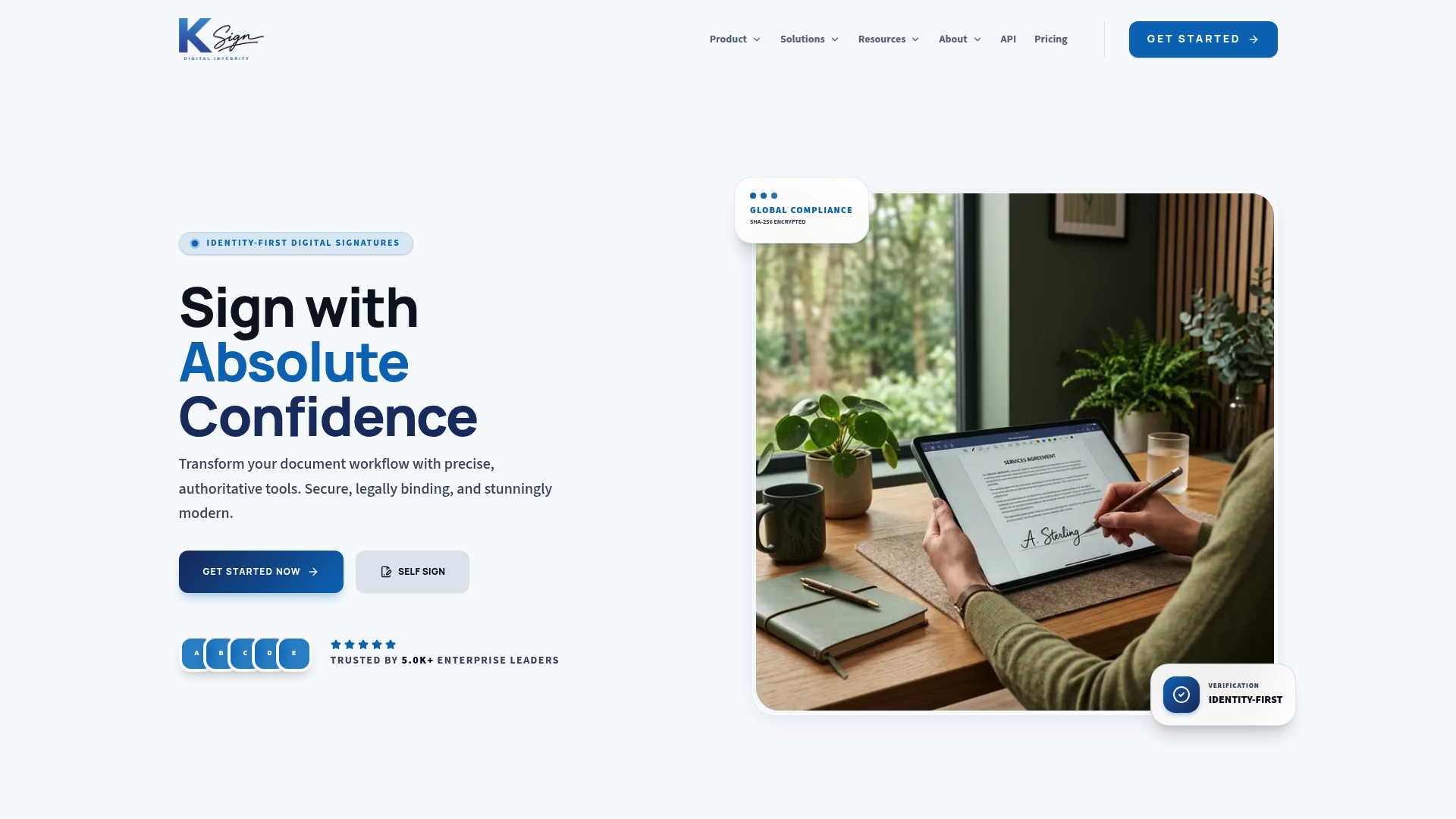
That matters most for the jobs this article has been walking through: scope details, plant lists, and payment schedules that need to be accurate every time, not retyped from memory. Ksign’s contract automation pulls job details straight from your intake form into the contract, and embedded payments collect the deposit the moment the client signs, so there’s no separate invoice to send later. If you’re still emailing PDFs back and forth, start a free trial at Ksign and send your next contract as a form instead.