
A downloadable, editable HVAC service agreement template gives contractors a signature-ready contract in Word or PDF, covering scope of work, service schedule, pricing, warranties, customer responsibilities, and a signature block built for e-signing. You’ll find the copy-ready sample and clause breakdown below, ready to customise for residential or commercial accounts today.
TL;DR:
- Response times should be clearly specified as 24 to 48 hours for standard service requests and same-day for emergencies to avoid disputes.
- The liability cap must be linked to the contract’s total value using a specific dollar amount to ensure enforceability in disputes.
- Equipment details must be listed precisely by make, model, and serial number, with separate schedules for multi-site commercial accounts to prevent coverage gaps.
- State and local regulations require clear disclosure of auto-renewal, cancellation rights, and licensing details to avoid legal issues and enforceability problems.
- Using a guided, automated contract creation process reduces errors, shortens closing times, and simplifies signature collection and recordkeeping.
Table of Contents
- Sample template and quick download: what you get
- Essential clauses every HVAC service agreement must include
- How to customise the template for residential and commercial work
- Sales and operations checklist: onboarding customers with the agreement
- Legal considerations and compliance with local regulations
- Common clauses to avoid or include for protection
- Tips for negotiating terms with service providers
- Why form-native templates speed up sign-ups
- How Ksign turns a template into a signed, paid agreement
- Sources
Sample template and quick download: what you get
An HVAC service agreement exists to define exactly what’s covered, when technicians show up, what customers pay, and who’s liable if something goes wrong. A properly built template gives you these fields ready to fill in, not a blank page:
- Parties and property details (customer name, service address, contact)
- Equipment schedule (make, model, serial number, install date)
- Number of visits per year and what each visit covers
- Pricing structure, billing cadence, and parts/labour terms
- Exclusions (what the agreement does not cover)
- Signature block with date fields, formatted for e-signing
Here’s a copy-ready scope paragraph you can drop straight into a contract: “Contractor shall provide preventative maintenance on the equipment listed in Schedule A, including inspection, cleaning, and adjustment of components necessary for safe and efficient operation. This agreement does not cover repairs resulting from misuse, neglect, or acts of nature.”
A matching service-level clause: “Contractor will respond to standard service requests typically within a few business days and to no-heat or no-cooling emergencies as promptly as possible during the agreement term.”
Downloadable HVAC contract templates commonly ship as Word or PDF files. Most are built to slot into an e-signature workflow so a customer can review and sign without printing anything.
Essential clauses every HVAC service agreement must include
Every agreement lives or dies on seven clauses. Miss one and you’re either exposed to a dispute or leaving money on the table.
- Scope of work and systems covered. List equipment by type, make, model, and serial number rather than writing “HVAC system.” Vague scope language is the single biggest cause of “I thought that was included” arguments.
- Service schedule and response times. Separate standard call response (often 24 to 48 hours) from emergency response (same-day or within hours for no-heat/no-cool situations).
- Pricing, parts and labour treatment. State whether the plan covers a parts/labour discount or full parts coverage, and disclose diagnostic or trip fees upfront.
- Warranties and liability limits. Specify warranty duration on repairs and cap liability to the contract value or a stated amount, never leave it open-ended.
- Term, renewal and cancellation. Auto-renew clauses need conspicuous disclosure. Several states regulate how auto-renew terms must be presented to consumers, so bury this at your own risk.
- Customer responsibilities and access. Filter changes, clear access to equipment, and HOA approvals belong to the customer, not you, and the contract should say so explicitly.
- Insurance, licensing and signatures. State your licence number and insurance coverage, then close with a dated signature block.
Pro Tip: Write your liability cap as a dollar figure tied to the annual contract value, not a vague “reasonable amount”. A number holds up in a dispute; a vague phrase invites one.
How to customise the template for residential and commercial work
A single template rarely fits both a homeowner’s split system and a commercial rooftop unit array. Adjust these four elements before you send anything out:
- Visit frequency. Residential plans typically run a couple of visits per year (spring cooling check, fall heating check). Commercial accounts often need more frequent visits given equipment load and downtime cost.
- Pricing cadence and coverage. Most operators offer a parts and labour discount of 10 to 15 percent for members rather than full parts coverage, which protects margin while still rewarding loyal customers.
- Equipment schedule detail. List every unit by make, model, and serial number, and for multi-site commercial accounts, attach a separate equipment schedule per location so nothing gets missed at renewal.
- Change-order workflow. Build in a simple approval step for repairs discovered mid-visit that fall outside scope. A change order template keeps unexpected repairs documented and approved before you touch anything extra.
Sales and operations checklist: onboarding customers with the agreement
Frame the agreement as priority service and member pricing, not just paperwork. Contractors who position maintenance plans this way convert one-off repair calls into predictable recurring revenue, especially heading into peak season.
Before signing, run through this checklist:
- Photograph existing equipment and record filter sizes
- Note access instructions and any HOA or building approvals needed
- Confirm billing details and schedule the first maintenance visit
- Set up member communications (renewal reminders, seasonal check prompts)
Pro Tip: If a property has unusual access restrictions or ageing equipment with no service history, schedule an on-site inspection before signing rather than pricing blind.
Legal considerations and compliance with local regulations
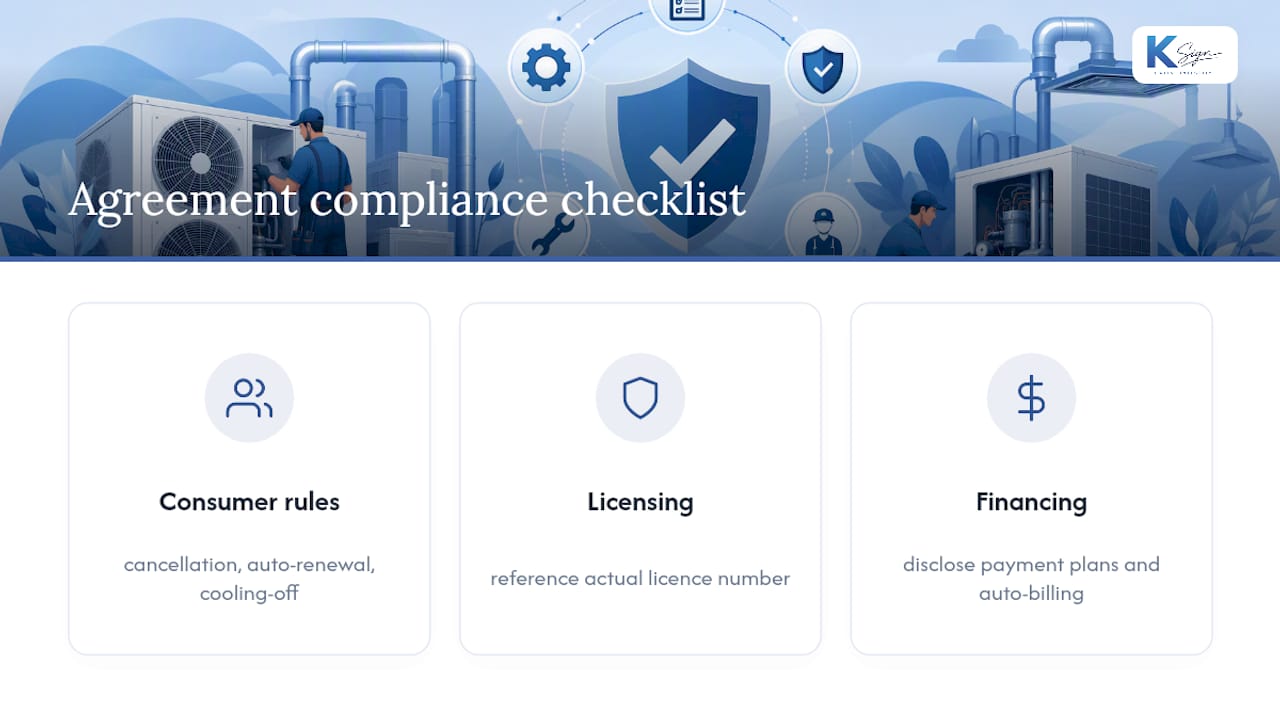
Service agreements are consumer contracts in most jurisdictions, which means state-level rules on cancellation rights, auto-renewal disclosure, and cooling-off periods can apply depending on where the customer lives and how the contract is sold. A door-to-door or in-home sale often triggers stricter disclosure requirements than a contract signed at your office or online, so check your state’s consumer protection statute before finalising standard wording.
Licensing and insurance requirements vary by state and sometimes by municipality, and your agreement should reference your actual licence number rather than a generic statement that you’re “fully licensed and insured.” That specificity protects you if a customer later disputes your authority to perform the work.
If your agreement includes financing, payment plans, or automatic recurring billing, review whether your state requires specific disclosure language for those terms. Auto-renewal rules in particular are inconsistent across states, some require an opt-in reminder before renewal, others require conspicuous font sizing on the clause itself. None of this replaces legal advice tailored to your state and business structure, but building these considerations into your template from the start avoids a costly rewrite later. A generic template pulled from a search result won’t reflect your state’s specific rules, so treat any downloaded sample as a starting draft, not a final document.
Common clauses to avoid or include for protection
Some clauses protect you. Others invite disputes or, worse, get thrown out by a court for being unreasonable.
Include these: a liability cap tied to a specific dollar figure, a clear exclusions list (misuse, acts of nature, pre-existing conditions), a defined dispute resolution process (mediation before litigation, for instance), and a severability clause so one unenforceable line doesn’t void the whole contract.
Avoid these: open-ended liability with no cap, vague scope language like “general maintenance,” automatic renewal with no cancellation window or reminder, and one-sided termination rights that let you cancel anytime but lock the customer in. A contract that reads as entirely one-sided is more likely to be challenged and less likely to build the kind of trust that gets renewed year after year.
One clause worth adding that many contractors skip: a clear statement of what happens to unused visits if a customer cancels mid-term. Silence on this point is a common source of chargeback disputes and negative reviews.
Tips for negotiating terms with service providers
If you’re a facilities manager or property owner reviewing a contractor’s agreement rather than writing one, a few negotiation points consistently matter more than others.
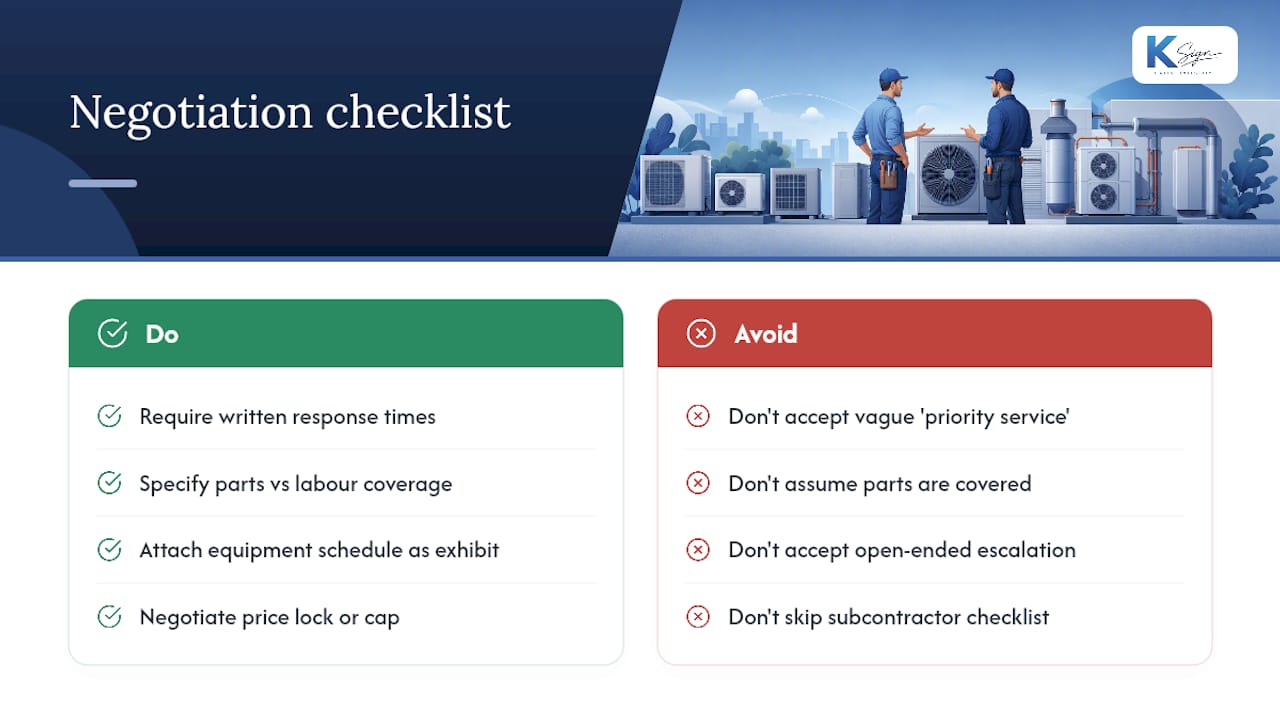
Push for specificity on response times before signing, “priority service” means nothing without a stated hour or day commitment attached to it. Ask whether the pricing reflects a parts/labour discount or genuine parts coverage, since the difference can be worth hundreds of dollars per repair. Request that the equipment schedule be attached as a signed exhibit, not just referenced in the body text, so there’s no ambiguity about what’s covered.
On multi-year terms, negotiate a price lock or a capped annual increase rather than accepting an open-ended escalation clause. And always ask what happens at cancellation, whether that means a prorated refund, a required notice period, or nothing at all. A contractor confident in their service quality should have no issue putting fair cancellation terms in writing. Before finalising, run through a subcontractor reliability checklist if you’re vetting a new provider rather than renewing an existing one, it catches gaps a standard contract review often misses.
Why form-native templates speed up sign-ups
Contracts built from a static Word template invite copy-paste errors, missing fields, and version confusion across a team. A guided form that asks for equipment details, visit frequency, and pricing tier, then auto-generates the contract from those answers, removes most of that risk before it starts.
The workflow is straightforward: collect job details through a form, generate the agreement automatically, then send it for signature with a deposit collected at the same step. Fewer manual entry points means fewer disputes later over what was actually agreed.
— Josh
How Ksign turns a template into a signed, paid agreement
A template solves half the problem. Getting it in front of a customer, signed, and paid without three days of email back-and-forth solves the other half. Ksign builds that second half directly into the first: a guided form collects the customer’s equipment details and plan choice, auto-generates the contract from those answers, and routes it straight to signature.
For an HVAC contractor, that looks like this: a technician fills in equipment details on a phone after a diagnostic call, the system generates the maintenance agreement on the spot, the customer signs electronically, and the deposit or first payment is collected at signing rather than invoiced separately days later. No printing, no scanning, no chasing a signature that sits in someone’s inbox for a week.
Every signed agreement is stored with its audit trail, so if a warranty dispute comes up eighteen months later, you’re not digging through email threads to find what was actually agreed. Start with the contract automation workflow and see how quickly a maintenance plan goes from quote to signed, paid agreement.
Sources
For further sample language or state-specific rules, these hubs are worth bookmarking:
- HVAC Service Agreement: Complete Guide (Free Templates)
- Free HVAC Service Agreement Template & Generator — FieldServiceCompare
- BuildOps — HVAC service agreements guidance