
Use this Australia-compliant service agreement template as the foundation for your client engagements. Download a ready-to-use version, customise the scope and pricing fields, and collect a legally binding electronic signature before work begins.
Legal note: templates are a starting point, not a substitute for legal advice. For high-value, long-term, or regulated work, have a qualified Australian solicitor review your contract before you send it.
This template suits:
- Tradies and field service operators (electricians, plumbers, cleaners, landscapers)
- Consultants and professional services providers
- Creatives (photographers, designers, videographers)
- Businesses providing recurring or retainer-based services
- Allied health and NDIS service providers
Electronic signatures are valid in Australia. Part 2A of the Electronic Transactions Act 1999 clarifies how electronic offer and acceptance operate, meaning a signed digital agreement carries the same legal weight as a wet-ink signature when the method identifies the signer and an audit trail is kept.
Key takeaways
A ready-to-use, Australia-compliant service agreement template is only as strong as the scope clause and variation process you build into it.
| Point | Details |
|---|---|
| Download and localise | Use an Australian-drafted template; confirm ABN, GST treatment, and governing state before sending. |
| Scope and acceptance criteria | Write specific deliverables and acceptance criteria to prevent the disputes that vague scope creates. |
| Variation process | Require written sign-off before any out-of-scope work begins; capture it in a signed variation order. |
| Form-to-contract workflow | Use a guided intake form to populate contract fields, collect e-signature, and take a deposit at the same step. |
| Ksign for production-ready agreements | Ksign automates the form-to-contract-to-signature-to-payment workflow for Australian small businesses. |
Electronic signatures are valid in Australia when the method identifies the signer, records their approval, and is supported by a verifiable audit trail.
Table of Contents
- What is a service agreement in Australia and when do you need one?
- What clauses does every Australian service agreement need?
- How do you customise the template safely for your industry?
- Where can you find reliable Australian service agreement templates?
- How do you turn client intake answers into a signed, paid agreement?
- When must you get legal advice before using a template?
- The mistake most small businesses make with service agreements
- Ksign makes your template production-ready from day one
- Sources
What is a service agreement in Australia and when do you need one?
A service agreement (also called a service contract) is a written contract that records the scope, fees, timing, intellectual property ownership, insurance obligations, and dispute process for a service relationship between a provider and a client. It is distinct from a quote, which is an offer of price only, and from an invoice, which records a completed transaction.
The two parties are the service provider (you) and the client (the person or business paying for the work). The agreement binds both parties from the moment it is signed, not from when the work starts or the invoice is paid.
You need a service agreement whenever the work involves meaningful money, a defined deliverable, or an ongoing relationship. Common use cases include:
- One-off fixed-scope projects (a website build, a kitchen renovation, a photoshoot)
- Retainer or recurring services (monthly bookkeeping, weekly cleaning, managed IT support)
- Ongoing maintenance contracts
- NDIS and in-home aged care services, where NDIS guidance defines a service agreement as a formal record of supports, responsibilities, and consent between participant and provider
- Any engagement where scope creep, payment disputes, or IP ownership could become contentious
A verbal agreement is technically enforceable in Australia, but proving its terms in a dispute is costly and unreliable. A signed written contract removes that ambiguity.
What clauses does every Australian service agreement need?
Sprintlaw’s guidance on Australian service agreements identifies the core clauses that every contract should include, and recommends tailoring scope, payment, variations, IP, warranties, and termination to your specific business model. The checklist below covers each clause with a short example phrase.
Parties and execution details
State the full legal names, ABNs, and addresses of both parties. Example: “This agreement is between [Provider Legal Name] ABN XX XXX XXX XXX of [Address] (‘Provider’) and [Client Legal Name] ABN XX XXX XXX XXX of [Address] (‘Client’).”
Scope of services and exclusions
Define exactly what you will deliver and, critically, what you will not. Vague scope is the single most common cause of service disputes. Example: “The Provider will supply [specific deliverables]. The following are expressly excluded: [list exclusions].”
Fees, deposits, and payment terms
State the fee (fixed price, hourly rate, or retainer amount), deposit percentage, due dates, and accepted payment methods. Include GST treatment: “All fees are stated exclusive of GST. GST will be added to each invoice at the current rate of 10%.” If you engage contractors, check the ATO’s employee vs contractor guidance to confirm your PAYG and superannuation obligations, and review superannuation obligations for small businesses before finalising payment clauses.
Timeframes and milestones
Specify start date, key milestones, and completion date. Tie payment to milestone sign-off where possible.
Variations and change orders
Require written approval (email or signed variation form) before any out-of-scope work begins. Example: “Any variation to the agreed scope must be documented in a written variation order, signed by both parties, before additional work commences.”
Termination and notice
State how either party can exit and what notice is required. Example: “Either party may terminate this agreement with [14] days’ written notice. Work completed to the date of termination is payable in full.”
Liability cap and indemnity
Cap your liability at the value of fees paid under the agreement. Broad, uncapped indemnities are a red flag. Example: “The Provider’s total liability under this agreement shall not exceed the total fees paid by the Client in the [3] months preceding the claim.”
Insurance
State the types and minimum coverage amounts you carry (public liability, professional indemnity, workers compensation where applicable). For construction sites, also address WHS obligations and site access conditions.
Intellectual property
Specify who owns IP created under the agreement. The default under Australian law is that the creator retains copyright unless the contract assigns it. Example: “All IP created by the Provider vests in the Client upon receipt of full payment.”
Confidentiality
Protect sensitive client information and your own proprietary methods. Keep this clause mutual.
Consumer law compliance
The Australian Consumer Law (ACL) implies non-excludable guarantees into consumer contracts. Since 9 November 2023, the unfair contract terms (UCT) regime also applies to many small-business standard-form contracts: terms that create a significant imbalance and are not reasonably necessary can be declared void. The ACCC’s small business guidance summarises these obligations. Avoid “take-it-or-leave-it” clauses without a clear business justification.
Dispute resolution and governing law
Name the Australian state or territory whose law governs the agreement and specify a dispute resolution process (negotiation, then mediation, then litigation). Example: “This agreement is governed by the laws of New South Wales. Disputes will first be referred to good-faith negotiation, then to mediation before either party commences proceedings.”
Pro Tip: Cap your liability clause at a specific dollar figure or a multiple of fees paid, not just “reasonable amounts.” An uncapped indemnity in a standard-form contract is both a UCT risk and a practical liability trap.
Choosing a clause structure for your business model
| Business model | Scope clause | Fee clause | Variation clause |
|---|---|---|---|
| Fixed-price project | Detailed deliverables list with acceptance criteria | Lump sum with milestone payments | Written variation order required; price agreed before work starts |
| Hourly / time-and-materials | Estimated hours with a not-to-exceed cap | Hourly rate plus disbursements | Client approval required when estimate is exceeded by 10% |
| Retainer | Monthly service description with included hours | Monthly fee, invoiced in advance | Additional hours billed at agreed rate; written approval required |
How do you customise the template safely for your industry?
Customise only the scope, pricing, milestones, and party details. Leave the legal risk-allocation language (liability caps, indemnities, UCT-compliant terms) to specialist review unless you are confident in what you are changing.
Safe edits you can make yourself:
- Insert your specific deliverables and exclusions
- Confirm your ABN and GST registration status
- Set project-specific milestones and payment triggers
- Specify your insurance types and coverage amounts
- Select the governing state or territory
Edits that need legal advice:
- Broadening indemnities beyond the standard mutual form
- Removing or weakening the liability cap
- Adding termination penalties that may be unfair contract terms
- Drafting IP assignment clauses for complex or high-value creative work
Industry-specific notes:
Tradies and field services: add clauses covering site access conditions, WHS responsibilities, and who bears the cost of delays caused by third parties. For construction bids and scope structuring, understanding how construction bids work helps you write acceptance criteria that hold up when a variation is disputed. Pair this with safety software for construction sites to capture site hazard records that support your contract documentation.
Creatives: IP assignment and licence language is where most creative disputes originate. Specify whether you are assigning all rights or granting a limited licence, and for what territory and duration.
Allied health and NDIS providers: use the sector-specific templates discussed below. Privacy Act obligations and NDIS consent requirements go beyond a standard commercial contract.
IT and MSPs: define data ownership, backup responsibilities, service levels, and what constitutes acceptable performance. The ATO’s contractor classification guidance is also relevant if you engage subcontractors.
Red flags that commonly cause disputes: vague deliverables (“a website” rather than “a five-page WordPress site with specified functionality”), no written acceptance criteria, no variation process, and payment terms that do not align with milestone completion.
Where can you find reliable Australian service agreement templates?
Prefer templates drafted for Australian law. Off-the-shelf templates from other jurisdictions often omit ACL consumer guarantees, GST treatment, and Privacy Act obligations, creating gaps that are not obvious until a dispute arises.
Vetted sources for Australian small businesses:
- NDIS service agreement guidance: mandatory reading for any provider delivering NDIS-funded supports. The NDIS publishes template language and explains the consent and review requirements specific to participant agreements.
- Australian Department of Health Support at Home template: a downloadable, government-authored template for in-home aged care providers. It illustrates the level of detail regulators expect for care services and is a useful structural reference even outside the aged care sector.
- Buying for Victoria goods and services contract templates: procurement-grade templates that show how larger clients structure service contracts. Useful if you supply to government or corporate buyers.
- Forms-Legal Australian service agreement: an Australia-specific commercial template that addresses ACL, Privacy Act, and GST requirements.
- Sprintlaw service contract guidance: practical drafting advice from an Australian legal platform, with clause-level guidance for common small-business scenarios.
Matching template type to your situation:
- Simple 2–4 page contract: fixed-scope, single-engagement work with a known deliverable and a straightforward payment structure.
- Master services agreement (MSA) plus statement of work (SOW): repeat clients where the core terms stay constant but the scope changes each engagement.
- Sector template (NDIS, health, aged care): any regulated care or support service where consent, privacy, and sector-specific obligations apply.
How do you turn client intake answers into a signed, paid agreement?
Use a guided intake form to capture scope, pricing, and acceptance criteria before the contract is generated. This approach, recommended by Sprintlaw’s contract workflow guidance, reduces scope disputes because the client’s own answers populate the deliverables clause. Collect the e-signature and deposit at the same moment the contract is presented, so cash flow is secured before work begins.
Step-by-step workflow:
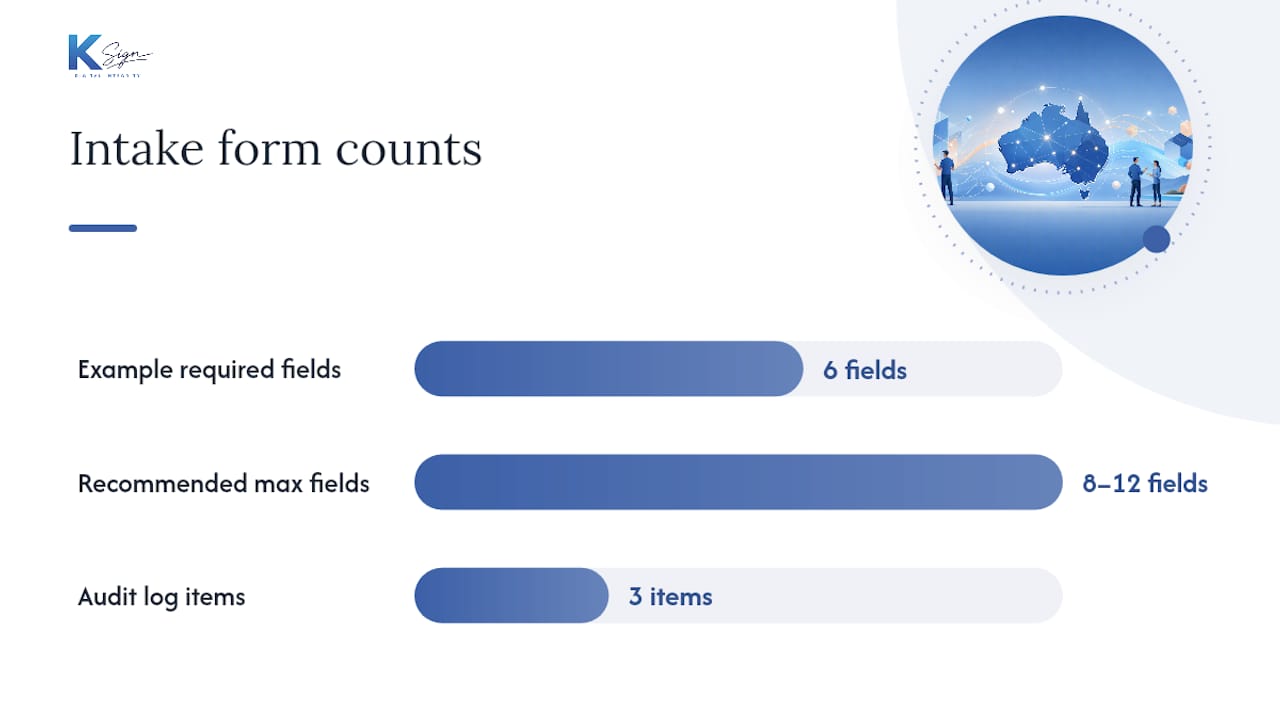
- Build the intake form. Capture client name, ABN, site address, scope details, preferred start date, and any site-specific conditions (access restrictions, hazards, special requirements).
- Map answers to template fields. Each form response populates a corresponding contract field: scope answers fill the deliverables clause, pricing answers fill the fee clause, and site conditions fill the access and WHS clause. Ksign’s contract automation feature handles this mapping automatically.
- Present the contract preview. The client reviews a complete, personalised agreement before signing. This step alone reduces “I didn’t know that was included” disputes.
- Take the deposit or payment. Collect the agreed deposit at the moment of signing, before the client closes the browser. Separating the payment step from signing is where most businesses lose deposits.
- Store the signed document and trigger follow-on workflows. Archive the signed agreement with its audit trail, then trigger invoice reminders, project kick-off notifications, or calendar entries automatically.
Pro Tip: Keep intake forms short: 8–12 fields maximum for most service types. Validate critical fields (site access, known hazards) so the contract clause is never blank. For field-based work, require client initials on any variation request captured on-site, and photograph scope changes as supporting evidence.
For mobile-first signing in the field, the mobile signing guide for field workers covers device-specific best practices and audit trail requirements.
When must you get legal advice before using a template?
Get legal advice before deploying a template when the contract is high value, long-term, involves complex IP, or will be used as a standard-form agreement sent to many customers without negotiation.
Red flags that require a solicitor’s review:
- Unusual or one-sided indemnities that expose you to losses beyond your control
- Open-ended or uncapped liability clauses
- Ambiguous IP ownership, particularly for software, creative works, or proprietary data
- Contracts spanning multiple Australian states or involving overseas parties
- Regulated services: NDIS, aged care, health, financial services, and building work above certain thresholds
- Inconsistent terms across your website, quotes, and contracts (each document can form part of the overall agreement)
Legal briefing checklist to bring to your solicitor:
- Background: what service you provide and to whom
- Contract value and typical duration
- Scope of a typical engagement (deliverables, exclusions, milestones)
- Your desired liability cap and the insurance coverage you carry
- Any sector-specific regulation that applies (NDIS, health, building)
- Any terms a client has previously disputed or queried
The ACCC’s unfair contract terms guidance is worth reading before your appointment: terms that create a significant imbalance without reasonable justification can be voided, which means a clause you rely on may not protect you.
This article provides general guidance only and is not legal advice. For the enforceability of specific clauses in your contracts, consult a qualified Australian solicitor.
The mistake most small businesses make with service agreements
Vague scope causes the majority of service disputes in Australia. Not missing signatures, not absent termination clauses — vague scope. A tradie who writes “install new bathroom” instead of “supply and install [specific fixtures] to the dimensions shown in the attached plan, excluding tiling” will spend more time arguing about what was agreed than doing the work.
Three habits that prevent most disputes: insist on written acceptance criteria before work starts, require a signed variation order before any out-of-scope work begins, and take a reasonable deposit at signature. Timestamped communications — emails, form submissions, signed variation orders — are your evidence if a dispute reaches mediation.
Pro Tip: Before rolling out your intake form to real clients, run one complete test cycle yourself: fill in the form, generate the contract, sign it, and process a test payment. You will catch field-mapping errors and confusing questions before they reach a paying client.
Ksign makes your template production-ready from day one
Ksign turns a client intake form into a tailored service agreement, collects a legally binding e-signature with a full audit trail, and accepts a deposit at the moment of signing — all in one workflow, on any device.
The platform’s guided form builder lets you map client answers directly to contract fields, so every agreement reflects the actual scope discussed rather than a generic placeholder. Document generation produces a complete, personalised contract from those answers in seconds. The e-signature step captures timestamp, IP address, and device data to support enforceability under the Electronic Transactions Act. Embedded payments mean the deposit is collected before the client closes the browser, not chased by email three days later. Signed documents and audit trails are stored automatically, ready to retrieve if a dispute arises.
For small businesses that currently patch together Google Forms, Word templates, email approvals, and separate payment links, Ksign replaces that entire chain. Ksign and see how quickly a form becomes a signed, paid agreement.
Sources
- Electronic Transactions Act 1999 (consolidated text) — Part 2A
- Difference between employees and contractors — ATO
- Business