
A subcontract agreement is a written contract between a contractor and a subcontractor that defines scope, price, timeline, safety obligations, and payment terms for a specific portion of work. Every contractor engaging a subbie in Australia needs one — an email or quote is rarely sufficient, and tailored subcontract clauses are what reduce dispute and payment failure risk.
Before you read further, here is the short version of what every subcontract must cover:
- Scope and exclusions: exactly what work is included and what is not
- Price and payment: fixed price, milestones or rates, GST treatment, invoice timing
- Timeline and completion: start date, milestones, practical completion definition
- Variations: how changes are instructed, priced, and approved in writing
- Insurances: public liability, workers compensation, professional indemnity (where applicable)
- WHS obligations: Safe Work Method Statement (SWMS), white card, site induction
- Security of Payment alignment: progress claim format and response windows that comply with your state’s SOP legislation
- Dispute resolution: staged process from internal notice through to adjudication or mediation
- Execution: signed before work starts, with a clear audit trail
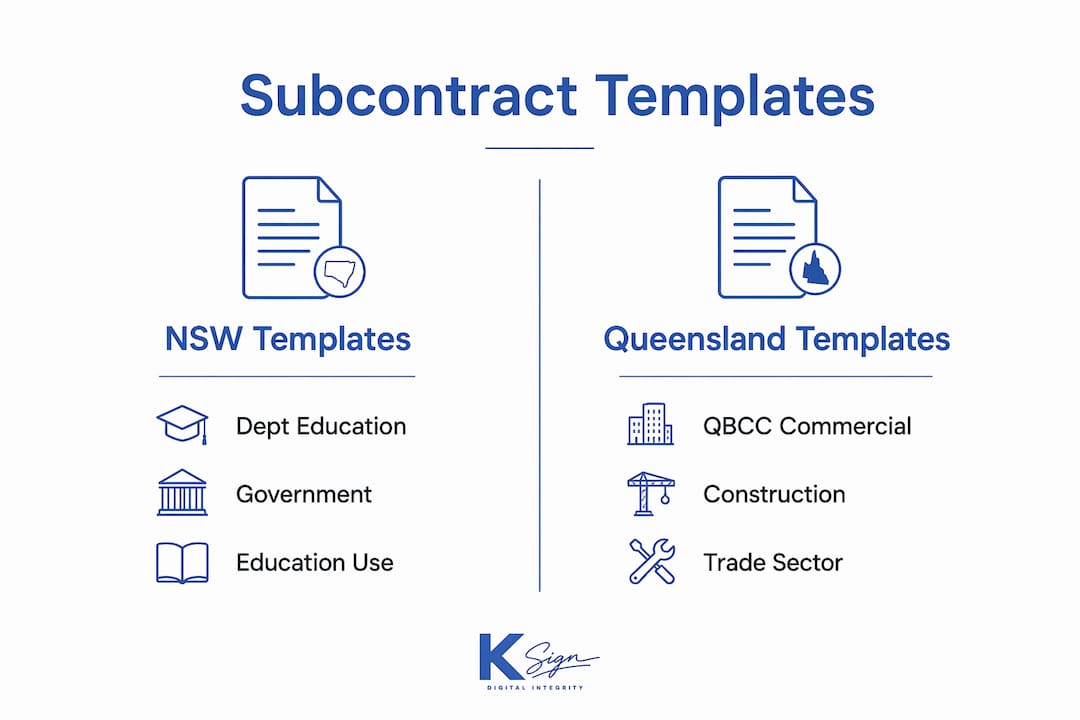
For an Australian template to start from, three sources stand out. The NSW Department of Education subcontract agreement is a government-issued legal template suited to education-procured works and general commercial use in NSW. The QBCC commercial subcontract template is the Queensland Building and Construction Commission’s own form, designed for commercial building work in Queensland. The SEME industry subcontract PDF is a trade-specific template used in commercial construction and is a useful reference for minimum insurance requirements and clause structure. Each needs to be tailored to your head contract and checked against your state’s Security of Payment laws before use.
Table of Contents
- What Australian subcontract templates are available and when should you use each?
- What clauses must every subcontract agreement include?
- How do flow-down (back-to-back) provisions work in practice?
- What pre-start checks, insurance, and licences do you need to collect in Australia?
- How do Security of Payment laws affect your subcontract?
- Which clauses should you negotiate, and what are the red flags?
- How do you safely customise and use a subcontract template?
- How a form→contract→sign→pay workflow makes subcontracting repeatable
- Key takeaways
- The part of subcontracting most small contractors get wrong
- Ksign turns your subcontract template into a repeatable, signed workflow
- Authoritative sources and templates to consult
What Australian subcontract templates are available and when should you use each?
Choosing the right starting template saves time and reduces the risk of missing jurisdiction-specific requirements. The three most widely referenced Australian templates each suit a different context.
The NSW Department of Education subcontract agreement is a government-issued legal template published for education infrastructure works. Its clause structure is thorough and its language is relatively plain, which makes it a practical starting point for general commercial subcontracts in NSW beyond the education sector. Because it is a government document, it reflects NSW procurement standards and WHS obligations.
The QBCC commercial subcontract is the Queensland Building and Construction Commission’s standard form for commercial building work. It is designed to comply with Queensland’s Building Industry Fairness (Security of Payment) Act 2017 and the QBCC licensing framework. If your project is in Queensland, this is the most compliance-ready starting point available.
The SEME industry subcontract PDF is a trade-sector template used in commercial construction. It is particularly useful as a reference for insurance minimums and clause structure on larger commercial jobs. One published example from an industry subcontract form specifies a substantial public liability minimum, illustrating the coverage levels that large head contractors typically require.
A critical point applies to all three: a generic template may not correctly reflect progress-claim mechanics or safety obligations for a specific state. Always treat any template as a checklist that requires tailoring to your head contract and jurisdiction.
| Template | Best for | Jurisdiction / caution |
|---|---|---|
| NSW Department of Education subcontract | Education-procured works; general commercial starting point | NSW; check against current NSW SOP Act |
| QBCC commercial subcontract | Commercial building and construction | Queensland; built around BIF Act 2017 |
| SEME / industry subcontract PDF | Trade and commercial construction; insurance clause reference | General; verify WHS and SOP for your state |
Pro Tip: Download the template that matches your state first, then compare it clause-by-clause against your head contract before filling in any project-specific details. Mismatches between the two documents are where gap risk lives.
What clauses must every subcontract agreement include?
A well-drafted subcontractor contract does more than record the price. Each clause below carries a specific protective function — understanding what it does helps you spot what is missing in a template.
Scope and statement of work
Describe the deliverables precisely: what work is included, what is excluded, and what documents (drawings, specifications, schedules) form part of the contract. Vague scope is the single most common source of variation disputes. Attach the relevant drawings and specifications as a schedule and reference them in the scope clause.
Commercial terms
State the contract price type clearly: fixed lump sum, milestone-based, or schedule of rates. Include GST treatment (prices exclusive or inclusive), invoicing frequency, and any retention arrangement. For retention, specify the percentage held, the maximum cap, and the release conditions tied to practical completion and the defect liability period.

Variations and change control
No verbal variations. Every change to scope, price, or time must be instructed in writing and priced before the work is done. The clause should specify who has authority to issue a variation instruction, the notice period for claiming additional cost or time, and what happens if the parties cannot agree on price (typically, work proceeds at a provisional rate while the dispute is resolved).
Time and completion
Define the start date, key milestones, and the practical completion standard. Include an extension of time clause that requires the subcontractor to give written notice within a defined period (often 5–10 business days) of a delay event, with supporting evidence. Without a notice obligation, extension of time claims become difficult to manage.
Defects, warranties, and rectification
Specify the defect liability period (commonly 12 months from practical completion), the process for notifying defects, and the subcontractor’s obligation to rectify at their own cost. If the head contract carries a longer defect period, flow that down into the subcontract.
Liability, indemnities, and caps
Mutual indemnities for property damage and personal injury caused by each party’s negligence are standard. Liability caps — typically set at the contract price or a multiple of it — protect both parties from disproportionate exposure. A clause without a cap leaves the subcontractor exposed to claims that could exceed the value of the work.
Intellectual property and confidentiality
Specify who owns the deliverables and any pre-existing IP each party brings to the project. A licence for the contractor to use the subcontractor’s pre-existing IP in the works is usually required. Confidentiality obligations should cover project pricing, head contract terms, and any client information shared during the works.
Termination and suspension
Include rights to terminate for breach (with a cure period), for insolvency, and for convenience. Termination for convenience clauses should specify what the subcontractor is entitled to be paid for work completed to the date of termination. Suspension rights should be tied to specific trigger events, not left open-ended.
Dispute resolution
A staged approach works best: written notice of dispute, followed by a senior-level internal meeting within a defined period, then mediation, and finally adjudication under the relevant state SOP Act or arbitration. Adjudication under state SOP legislation is often faster and cheaper than litigation for payment disputes.
Execution and evidence
Australian law can form a contract by conduct if work commences and is accepted — relying on post-start signatures or a quotation leaves parties exposed. Sign before mobilisation. Electronic signatures are legally binding in Australia under the Electronic Transactions Act 1999 (Cth) and its state equivalents, provided the signatory’s identity is verifiable and the method is reliable. A digital signing workflow that captures a timestamp, IP address, and document hash provides the audit trail you need if a dispute arises.
Pro Tip: Attach all pre-start evidence (SWMS, certificates of currency, trade licences) to the signed contract as schedules. Keeping them with the executed agreement means you have a single, complete record if a regulator or insurer asks for it.
How do flow-down (back-to-back) provisions work in practice?
Back-to-back provisions are best practice in Australian subcontracting. The principle is straightforward: the obligations your head contract places on you as contractor should be mirrored downstream into your subcontract, so the subcontractor carries the same standards, timeframes, and quality requirements that you are bound to deliver upstream.
Where contractors get into trouble is treating this as a copy-and-paste exercise. It is not. Upstream timeframes often need to be compressed in the subcontract to give you a practical buffer. If your head contract requires 48 hours’ notice for a variation instruction, your subcontract should require the subcontractor to notify you within 24 hours — otherwise you cannot meet your own upstream deadline. The same logic applies to defect liability periods, quality standards, and WHS obligations.
A practical tool is a cascade table in the subcontract: a short schedule that maps each head-contract obligation (clause number, upstream deadline, evidence required) to the corresponding subcontractor obligation. This prevents interpretation disputes and makes it immediately clear what the subcontractor must do and when.
The gap risk scenario worth understanding: if your head contract has a 12-month defect liability period but your subcontract only specifies six months, you carry the cost of any defect the subcontractor causes between months seven and twelve. That exposure is avoidable with a single clause.
- Mirror notice periods for variations, with a shorter subcontract window than the upstream deadline
- Flow down defect liability periods to match or exceed the head contract period
- Incorporate WHS and quality standards by reference to the head contract schedules
- Use a cascade table to map obligations clearly and avoid ambiguity
Pro Tip: When the head contract is long or complex, consider incorporating key provisions by reference (attaching the relevant head contract clauses as a schedule) rather than retyping them. This reduces transcription errors and keeps the subcontract aligned if the head contract is amended.
What pre-start checks, insurance, and licences do you need to collect in Australia?
Collecting the right evidence before work starts is not optional. Failure to collect pre-start documentation can expose the head contractor to regulatory penalties, insurance gaps, and WHS liability. The documents you need fall into three categories.
Core pre-start documents
- Safe Work Method Statement (SWMS): required for high-risk construction work under the Work Health and Safety Regulations 2011 (Cth and state equivalents). The SWMS must be specific to the work being performed and aligned to SafeWork guidelines.
- Certificate of currency — public liability: confirms the subcontractor holds current public liability insurance. On large commercial jobs, minimum limits of $20 million are not unusual.
- Certificate of currency — workers compensation: required for any subcontractor with employees. Sole traders without employees may be exempt in some states, but confirm this with your insurer.
- Certificate of currency — professional indemnity: required where the subcontractor provides design, engineering, or advisory services.
- Trade licence: verify the subcontractor holds the correct licence for the work in your state (e.g., electrical, plumbing, building).
- General construction induction (white card): required for anyone performing construction work in Australia.
Onboarding timeline
| Stage | Action | Timing |
|---|---|---|
| Engagement | Collect trade licence, white card, draft SWMS | Before contract execution |
| Pre-mobilisation | Collect certificates of currency, signed SWMS | Before first day on site |
| During project | Monitor insurance renewal dates; require updated COIs | At each policy renewal |
| Post-completion | Retain all documents with the signed contract | For the defect liability period |
A practical protection: make certificates of currency a condition precedent to the first payment. For longer projects, require renewal certificates at defined intervals and reserve the right to suspend work if insurance lapses. This is not punitive — it protects both parties from an uninsured incident mid-project.
How do Security of Payment laws affect your subcontract?
Security of Payment (SOP) legislation is state-based and generally cannot be contracted out of. SOP legislation takes precedence across Australian states, and payment clauses that make a subcontractor’s right to payment conditional on the contractor being paid — “pay-when-paid” arrangements — are typically unenforceable under these regimes. Queensland’s Building Industry Fairness (Security of Payment) Act 2017 is explicit on this point, and Victoria’s Building and Construction Industry Security of Payment Act 2002 operates on the same principle.
The practical implication: design your subcontract payment process to work inside the SOP framework, not around it. That means clear progress claim formats, defined response windows, and a straightforward internal dispute review step before escalation to adjudication.
Progress claim checklist
- Claim format: specify the required format (reference contract, claim period, itemised amounts, GST breakdown)
- Claim date: set a fixed date each month or milestone trigger for claims to be submitted
- Supporting evidence: list what must accompany each claim (SWMS compliance confirmation, variation approvals, photos where required)
- Payment schedule response window: align with your state SOP Act (typically 10–15 business days for the contractor to issue a payment schedule)
- Retention release: define the conditions and timing for releasing retention (practical completion, end of defect liability period)
- Disputed amounts: include a prompt internal review step (5 business days) before the subcontractor can refer to adjudication
State SOP Acts vary in their claim periods, adjudication timelines, and threshold amounts. NSW operates under the Building and Construction Industry Security of Payment Act 1999, Victoria under the 2002 Act, and Queensland under the 2017 BIF Act. Each has different reference dates and response periods — your subcontract payment clause must reflect the Act that applies to your project’s location.
Pro Tip: Structure payment protections with clear milestone approvals, simple progress-claim formats, and a prompt internal dispute review step. Relying on a single “pay-when-paid” mechanism can break cashflow for your subcontractor and expose you to adjudication regardless — the SOP Acts are designed to prevent exactly that outcome.
Which clauses should you negotiate, and what are the red flags?
Not every clause in a template is balanced. Some are drafted to favour the head contractor, and a subcontractor who signs without reading them can end up carrying disproportionate risk. The clauses worth scrutinising are consistent across most Australian subcontracts.
- Onerous indemnities: watch for indemnities that extend beyond your own negligence to cover the head contractor’s acts or omissions. Narrow these to “to the extent caused by the subcontractor’s negligence or breach.”
- Broad IP assignments: a clause that assigns all IP created during the works to the head contractor can strip you of rights to your own methods, designs, and pre-existing tools. Push for a licence rather than an assignment, or carve out pre-existing IP explicitly.
- Unlimited liability: any clause without a liability cap should be flagged. A reasonable cap is the contract price or a defined multiple of it. Unlimited liability is rarely justified for subcontract work.
- Unfair variation processes: clauses that allow the head contractor to instruct variations without agreeing on price first, or that deem silence as acceptance of a variation, create significant exposure. Require written price agreement before work proceeds.
- Broad termination for convenience: termination for convenience clauses are standard, but check what you are entitled to be paid. A clause that limits payment to “work completed to the contractor’s satisfaction” gives the contractor too much discretion. Payment should be for work properly performed to the date of termination.
- Ambiguous scope: a scope clause that uses phrases like “all work reasonably necessary” or “as directed by the superintendent” without limits is a blank cheque. Scope must be defined by reference to specific drawings, specifications, and schedules.
For small businesses, the practical trade-off is often this: a large head contractor will not renegotiate every clause, but most will accept a liability cap, a narrowed indemnity, and a clear IP carve-out if you ask in writing. Pick the three clauses that carry the most financial exposure and focus your negotiation there.
How do you safely customise and use a subcontract template?
A template is a starting point, not a finished contract. The steps below take you from template download to a signed, compliant subcontract without leaving gaps.
- Map your head contract obligations. Before opening the template, list the key obligations from your head contract: notice periods, defect liability period, insurance requirements, WHS standards, and payment terms. These are the items you must flow down.
- Select the right template. Use the NSW Department of Education template for NSW general commercial work, the QBCC template for Queensland building projects, or the SEME industry template for trade-specific commercial jobs.
- Customise scope and price. Fill in the project-specific details: scope of work, contract price, milestones, and any schedule of rates. Attach drawings and specifications as schedules.
- Add flow-down provisions. Insert or update clauses for notice periods, defect liability, quality standards, and WHS obligations to match your head contract. Use the cascade table approach to map each obligation clearly.
- Collect pre-start evidence. Obtain the SWMS, certificates of currency, trade licences, and white card before execution. Attach them as schedules to the signed contract.
- Get a brief legal review. For non-standard clauses, high-value works, or any project where the head contract is complex, a short legal review is worth the cost. Ask the lawyer to check flow-down alignment, SOP compliance, insurance adequacy, and liability caps specifically.
- Sign before work starts. Execute the contract electronically before mobilisation. A digital signing workflow that captures a timestamp and document hash gives you a verifiable audit trail.
- Store the signed contract with all attachments. Keep the executed agreement, schedules, and pre-start evidence in one place, accessible for the duration of the defect liability period.
For a small job, the draft-to-sign process typically takes a few business days if the template is well-matched to the project. A medium commercial job with a complex head contract may take a few weeks to allow for legal review and negotiation. Budget for a brief legal review on any job where the contract value or risk profile justifies it — the cost of a one-hour legal check is small relative to the exposure a missing clause can create.
Pro Tip: Never start work before the contract is signed. Australian law can form a contract by conduct if work commences and is accepted — which means you may end up bound by terms you never agreed to, or with no agreed terms at all.
How a form→contract→sign→pay workflow makes subcontracting repeatable
The practical challenge for small contractors is not understanding what a subcontract needs — it is executing the process consistently across multiple subbies, projects, and states. A form-based workflow solves this by turning a one-off document exercise into a repeatable, auditable process.
The workflow looks like this: a guided online form collects the subcontractor’s details, licence numbers, insurance information, and scope confirmation. Those answers auto-populate a contract template, generating a project-specific subcontract without manual data entry. The document is sent for electronic signature before mobilisation. Payment of a deposit or first milestone can be collected as part of the same workflow. The signed contract, supporting evidence, and payment record are stored together with a complete audit trail.
For a trade business onboarding a new subbie, this replaces a process that typically involves a Word document sent by email, a separate request for insurance certificates, a manual invoice, and a payment link — four separate steps, each with its own friction and risk of something being missed.
Features to look for in a workflow tool:
- Form templating with conditional fields: so the right questions are asked based on trade type or project category
- Contract automation: answers from the form populate the subcontract template automatically
- Electronic signatures with audit trail: timestamp, IP address, and document hash captured at signing
- Certificate of currency capture: ability to attach or upload pre-start documents within the workflow
- Integrated payment collection: deposit or first milestone payment collected at the point of signing
- Centralised document storage: all signed contracts and supporting evidence accessible in one place
Ksign’s contract automation platform is built around exactly this workflow. You create a guided form, the answers generate the subcontract, the document goes out for legally binding e-signature, and payment is collected in the same flow. The signed agreement and audit trail are stored in Ksign’s contract management system, so you have a complete, searchable record for every subcontractor across every project.
Pro Tip: Build one workflow per trade type (electrical, plumbing, carpentry) with the relevant licence fields and insurance requirements pre-configured. The first setup takes an hour; every subsequent subcontractor onboarding takes minutes.
Key takeaways
A properly drafted and executed subcontract agreement, aligned to your head contract and state SOP legislation, is the single most effective protection against payment disputes, liability gaps, and WHS exposure in Australian subcontracting.
| Point | Details |
|---|---|
| Use an authoritative Australian template | Start with the NSW Dept of Education, QBCC, or SEME template matched to your state and project type. |
| Flow down head contract obligations | Mirror notice periods, defect liability, WHS, and quality standards from the head contract into the subcontract. |
| Collect pre-start evidence before mobilisation | SWMS, certificates of currency, trade licences, and white card must be in hand before work begins. |
| SOP laws override “pay-when-paid” clauses | Design payment terms to comply with your state’s Security of Payment Act; conditional payment clauses are typically unenforceable. |
| Sign before work starts with a clear audit trail | Electronic execution with a timestamp and document hash protects both parties; Ksign’s workflow delivers this in one step. |
The part of subcontracting most small contractors get wrong
The most common mistake is not the contract itself — it is the timing. Contractors who have been working with a subbie for years often skip the paperwork, or send the contract after the job has started. That habit is fine until it is not: an injury on site, a payment dispute, or a defect claim arrives, and the absence of a signed agreement before mobilisation becomes the central issue.
The second pattern worth naming is the template-and-forget approach. A contractor downloads a template, fills in the price and scope, and sends it out without checking whether the defect liability period matches the head contract, whether the insurance minimums are adequate for the project, or whether the payment clause is SOP-compliant for the state the work is in. The template creates a false sense of security — it looks like a contract, but the gaps are where the exposure lives.
What actually works is treating the subcontract as a process, not a document. That means a checklist for every engagement: head contract reviewed, obligations mapped, template selected and tailored, pre-start evidence collected, contract signed before day one. When that process is embedded in a repeatable workflow, it stops being something that gets skipped under time pressure.
Ksign turns your subcontract template into a repeatable, signed workflow
For small contractors managing multiple subbies across projects, the gap between having a good template and consistently executing it is where risk accumulates. Ksign closes that gap with a form-to-contract workflow built specifically for trade and construction businesses.
You build a guided onboarding form once, per trade type. The subcontractor’s answers auto-generate the subcontract, pre-populated with their licence details, insurance information, and scope confirmation. The document goes out for legally binding e-signature before mobilisation. A deposit or first milestone payment can be collected in the same step. Every signed contract, certificate of currency, and audit trail is stored in one place, searchable across all your projects.
No more Word documents sent by email. No chasing insurance certificates separately. No manual data entry between a form and a contract. Ksign’s document generation and e-signature platform gives you a complete, auditable subcontract workflow on any device. Start your first subcontract workflow at ksign.co.
Authoritative sources and templates to consult
These are the primary references for Australian subcontract agreements, state SOP legislation, and legal guidance. Each serves a different purpose.
- NSW Department of Education subcontract agreement: government-issued legal template; best starting point for NSW commercial subcontracts and education-procured works. Download directly from the NSW Department of Education.
- QBCC commercial subcontract template: Queensland Building and Construction Commission’s standard form; built around the BIF Act 2017 and QBCC licensing requirements. Use this for any Queensland commercial building project.
- Sprintlaw: creating a subcontract agreement: practical legal guidance on key inclusions, risk management clauses, and when to seek legal review. Best for understanding what a tailored subcontract needs beyond a standard template.
- Sprintlaw: back-to-back contracts: detailed guidance on flow-down provisions, cascade tables, and practical translation of upstream obligations. Essential reading before drafting flow-down clauses.
- Sprintlaw: contractor vs subcontractor: explains the legal relationship between contractors and subcontractors, payment flow obligations, and SOP compliance requirements.
- Queensland BIF Act 2017, Section 6: primary legislation defining subcontracts and subcontracted work in Queensland; use this to confirm how the Act applies to your project structure.
- Victoria Building and Construction Industry Security of Payment Act 2002: primary SOP legislation for Victorian projects; check this for reference dates, claim periods, and adjudication timelines.
For high-value or complex projects, a short legal review by a construction lawyer familiar with your state’s SOP regime is the most cost-effective risk management step available. Templates and guides provide the framework; a lawyer confirms the details are right for your specific project and jurisdiction.
This article provides general information about subcontract agreements in Australia. It is not legal advice. Confirm the current requirements for your project and jurisdiction with a qualified legal professional or the relevant primary source before executing any contract.