
Staged payment approvals in construction are a contract-driven, evidence-matched workflow that releases funds only when agreed work is verifiably complete. The process follows four core steps: the contract establishes a Schedule of Values (SOV) and draw schedule; the contractor submits a payment application; the administrator performs a three-way match against the SOV, physical evidence, and inspection records; then payment is released and lien waivers collected. The key documents and actors are the SOV, the pay application, the contract administrator or superintendent, the certifier or engineer, the lender (where finance is involved) and the owner.
- SOV / draw schedule: the contractual baseline every payment is measured against
- Pay application: the contractor’s formal claim, supported by evidence
- Three-way match: reconciliation of the pay app, the SOV, and site evidence
- Payment release: funds disbursed after approval, lien waivers collected
Key takeaways
Staged payment approvals work reliably when the SOV is locked early, every pay application is three-way matched against it, and the approval chain runs on a documented, timestamped workflow rather than informal email exchanges.
| Point | Details |
|---|---|
| Lock the SOV before work starts | Every pay application is verification, not negotiation, when the SOV is signed at contract execution. |
| Enforce three-way matching | Reconcile each pay app against the SOV and physical site evidence to prevent overpayment and disputes. |
| Collect lien waivers in sequence | Conditional waivers come with the pay application; unconditional waivers follow confirmed payment receipt. |
| Know your state’s payment legislation | Security of payment statutes give contractors adjudication rights; owners must issue payment schedules to preserve withholding rights. |
| Ksign connects the full workflow | Form capture, document generation, e-signature, and embedded payments replace the email-and-PDF chain for small builders. |
Table of Contents
- How staged payment approvals work in construction
- Step-by-step approval flow on an Australian building project
- Common stages and typical payment splits in Australian contracts
- Who certifies and authorises stage payments?
- What belongs in a pay application?
- Digital and multi-party approval workflows
- Legal protections, retention, withholding and dispute pathways in Australia
- Practical checklist: what to check before releasing a staged payment
- Sample contract clauses and suggested wording for staged payments
- A practical note on staged payment workflows
- Ksign for staged payment approvals in construction
- Sources
How staged payment approvals work in construction
The industry uses three related but distinct terms, and conflating them creates real contract risk.
Stage payments (also called progress payments in many Australian contracts) are instalments tied to inspectable, physically completed work. The trigger is verifiable completion of a defined scope item, not a calendar date. Progress payments is the broader statutory term used in Australian security of payment legislation: any payment for construction work carried out or related goods and services supplied. In practice, many contracts use “progress payment” and “stage payment” interchangeably, particularly in residential builds. Milestone payments, by contrast, release funds when a specific project event occurs — a design approval, a council permit, or a commissioning test — regardless of the proportion of physical work completed.
Hybrid approaches are common on larger commercial projects: a monthly draw cycle with milestone verification gates. A subcontractor might submit monthly progress claims, but the contract administrator only certifies the claim once a defined milestone (say, structural frame completion) has been independently inspected. Residential trades typically use pure stage payments tied to physical sign-off. Specialist installers — lifts, mechanical plant, façade systems — often use milestone payments because their work cannot be meaningfully measured by percentage complete.
Step-by-step approval flow on an Australian building project
The end-to-end process has six ordered steps, each with its own timing expectations and failure points.
- Agree and sign the SOV and draw schedule. Lock the Schedule of Values before the first dollar of work begins. Every subsequent pay application is verification against this baseline, not a fresh negotiation. Misalignment on the SOV is a primary cause of payment friction.
- Contractor submits the pay application. The application includes a cover summary, a continuation sheet keyed to the SOV, progress photos, supplier invoices, and any approved change orders. More on the specific contents in the documentation section below.
- Administrator, architect, or lender inspects and three-way matches. Three-way matching reconciles the pay application against the SOV line items and against physical evidence from site inspection. Skipping this step under schedule pressure is a documented cause of overpayment disputes.
- Certificate of payment or notice of intended payment issued. The certifier or contract administrator issues a formal certificate stating the amount they intend to pay and the basis for any reductions. Under Australian security of payment statutes, this notice carries legal weight.
- Owner or lender processes payment. The owner pays from their own funds or instructs the lender to release a drawdown. Lender-managed projects add an independent inspection step before drawdown approval.
- Contractor provides lien waivers and releases subpayments. Once the principal contractor receives payment, conditional waivers convert to unconditional, and the contractor is obligated to pass funds to subcontractors within the timeframes set by contract or statute.
| Actor | Typical review / processing time |
|---|---|
| Architect / contract administrator review | several days to two weeks |
| Owner processing after certificate | up to a month, depending on contract |
| Lender independent inspection | about one to one and a half weeks |
| Subcontractor payment after principal receives funds | as specified in contract or relevant state law |
Delays most commonly occur at steps 3 and 5: incomplete pay applications that fail the three-way match, and lender inspection queues on financed projects.
Common stages and typical payment splits in Australian contracts
The percentage splits below reflect common practice in Australian residential and commercial builds. They are starting points, not statutory requirements. MoneySmart’s guidance on building a house recommends owners understand their payment schedule before signing and consider financial protections at each stage.
| Stage | Typical trigger | Typical payment portion |
|---|---|---|
| Deposit / mobilisation | Contract execution, site establishment | small initial percentage commonly seen |
| Base / foundations | Slab or footings poured and inspected | moderate percentage typical |
| Frame | Structural frame erected and certified | moderate to significant percentage typical |
| Lock-up / shell | External walls, roof, windows, doors complete | significant portion typical |
| First fix (fitout) | Internal rough-in: plumbing, electrical, insulation | moderate percentage typical |
| Second fix / practical completion | Finishes, fixtures, commissioning | moderate percentage typical |
| Final completion / retention release | Defects liability period ends, final inspection passed | small retention portion typically held |
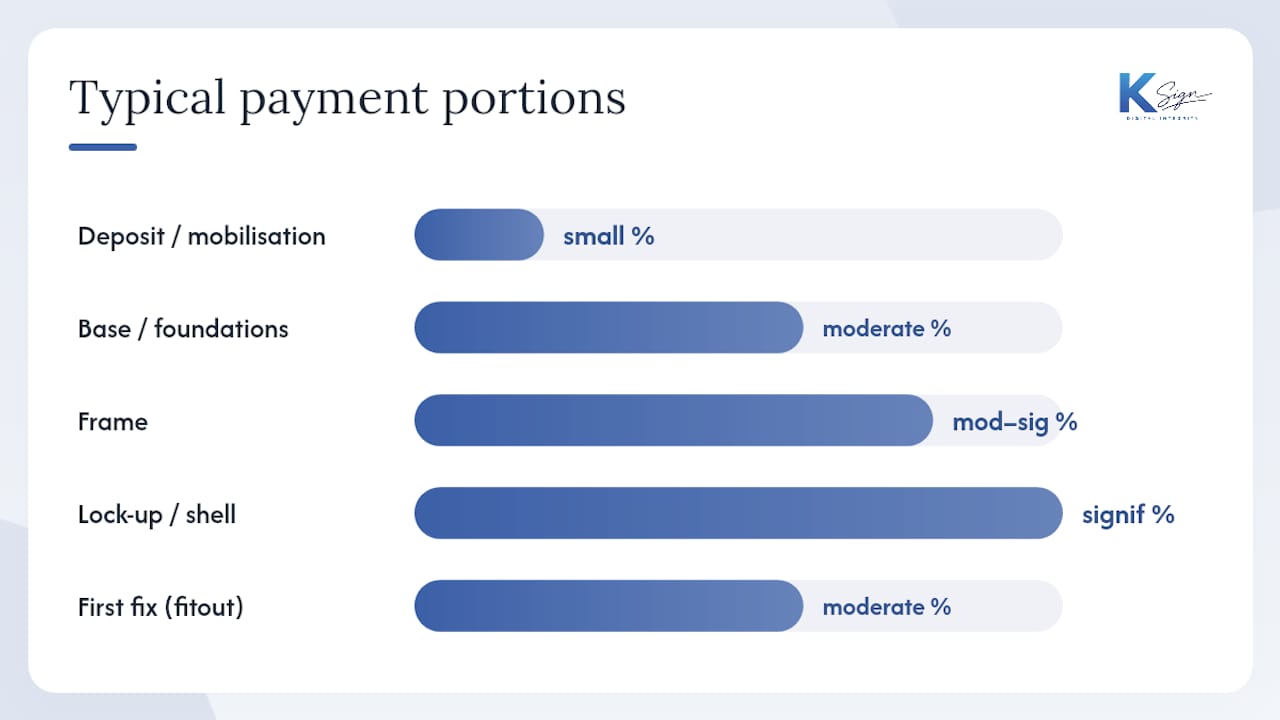
It is common for deposits above a moderate percentage on residential contracts in many Australian states to trigger additional consumer protections. Retention amounts are usually a small portion of the contract value and generally held until defects liability periods end. The cost curve matters: stages that represent the highest material and labour spend (frame, lock-up) carry higher percentages to match the contractor’s actual cash-flow exposure.
Who certifies and authorises stage payments?
Clarity about who holds approval authority at each step prevents the most common source of payment delay: a document that has been reviewed but not formally certified, or certified by someone without the contractual authority to do so.
Owner or client holds ultimate payment authority but typically delegates certification to a specialist. On residential projects, the owner often acts on advice from their lender and a private building surveyor. On commercial projects, the owner’s representative may be a project manager or development manager.
Principal contractor or general contractor prepares and submits the pay application. They are also responsible for ensuring subcontractor claims are captured accurately in the application and that subpayments flow once the principal is paid.
Contract administrator, superintendent, or architect is the central certification authority on most Australian contracts. They compare the pay application to the SOV, assess the physical evidence, and issue the payment certificate. Their certificate is the trigger for the owner’s payment obligation.
Certifier or engineer provides independent technical verification: structural inspections, waterproofing sign-offs, commissioning records. Their reports feed into the administrator’s three-way match but they do not typically issue payment certificates themselves.
Lender on financed builds requires its own independent inspection before releasing a drawdown. This is separate from the contract administrator’s certificate and adds 7–10 days to the cycle. Lenders may also impose their own draw schedule that differs from the contract’s SOV splits, which requires careful coordination.
Separating inspection authority from payment sign-off authority reduces conflicts of interest. Where the same person both inspects work and certifies payment, disputes about the independence of the certification are harder to defend.
What belongs in a pay application?
A pay application is more detailed than a standard invoice. Siteline’s guide to construction payment applications lists the standard components that administrators and lenders expect to see. Missing any of these is the fastest way to trigger a rejection and restart the clock.
- Cover summary form (equivalent to a G702-style summary): total contract value, approved change orders, amount previously certified, amount claimed this period, balance to complete
- Continuation sheet / SOV detail (equivalent to G703): line-by-line breakdown of each SOV item, percentage complete, and dollar amount claimed
- Progress photographs dated and geotagged where possible, showing the specific work claimed
- Supplier invoices and receipts for materials incorporated into the work
- Inspection reports from the certifier or engineer covering work completed in the period
- Approved change orders with signed variation approvals included in the SOV update
- Conditional lien waivers from the principal contractor and key subcontractors, covering the current claim period
- Evidence of stored materials (where the contract permits payment for materials on-site or off-site but not yet installed)
Pay each invoice through the ATO’s GST invoicing rules: a valid tax invoice is required for any business payment above $82.50 (GST-inclusive), and the pay application package should include compliant tax invoices for all claimed amounts.
Lien waivers in the Australian context operate differently from the US mechanic’s lien system, but the principle is the same: a conditional waiver is provided with the pay application, confirming the contractor will release any payment security claim upon receipt of the certified amount. An unconditional waiver is provided after payment is confirmed received. Collecting both types in sequence protects the owner and confirms the payment chain is clear.
Change orders must be formally approved and incorporated into the SOV before they appear in a pay application. Claiming unapproved variations is the single most common cause of disputed payment applications.
Digital and multi-party approval workflows
The approval workflow is where most construction payment delays actually live, not in the physical work itself. Automating document collection and approval routing reduces the resource drain of manual billing and cuts late payments.
The highest-value automation wins are:
- Standardised pay application templates that enforce completeness before submission
- Automated three-way match checks that flag SOV line-item discrepancies before human review
- Digital sign-off routing: site manager certifies field evidence, contract administrator certifies the SOV match, finance confirms payment authority, owner or lender approves release
- Timestamped audit trail for every approval action, giving all parties a verifiable record
- Embedded payment collection and conditional-to-unconditional waiver progression built into the workflow
For Australian projects, practical implementation means configuring approver sequences that reflect your contract structure, keeping mobile access open for field evidence capture (photos, inspection notes submitted from site), and integrating SOV templates that match your contract’s draw schedule. Getting building contracts signed digitally is now straightforward for small builders, and the same infrastructure supports ongoing payment approvals throughout the project.
Pro Tip: Automation accelerates whatever process you put into it. Weak SOV templates or poorly defined approval rules will produce faster bad approvals, not fewer disputes. Lock the template quality before you automate the routing.
Ksign maps directly to this workflow: structured web forms capture pay application data, document generation produces the SOV and pay app documents, e-signature handles certificates and lien waivers, and embedded payments manage draw releases. For small builders and trades, this replaces a chain of emails, PDFs, and separate payment links with a single auditable workflow.
Legal protections, retention, withholding and dispute pathways in Australia
Australian construction payment law is state-based, and the protections available depend on where the project sits.
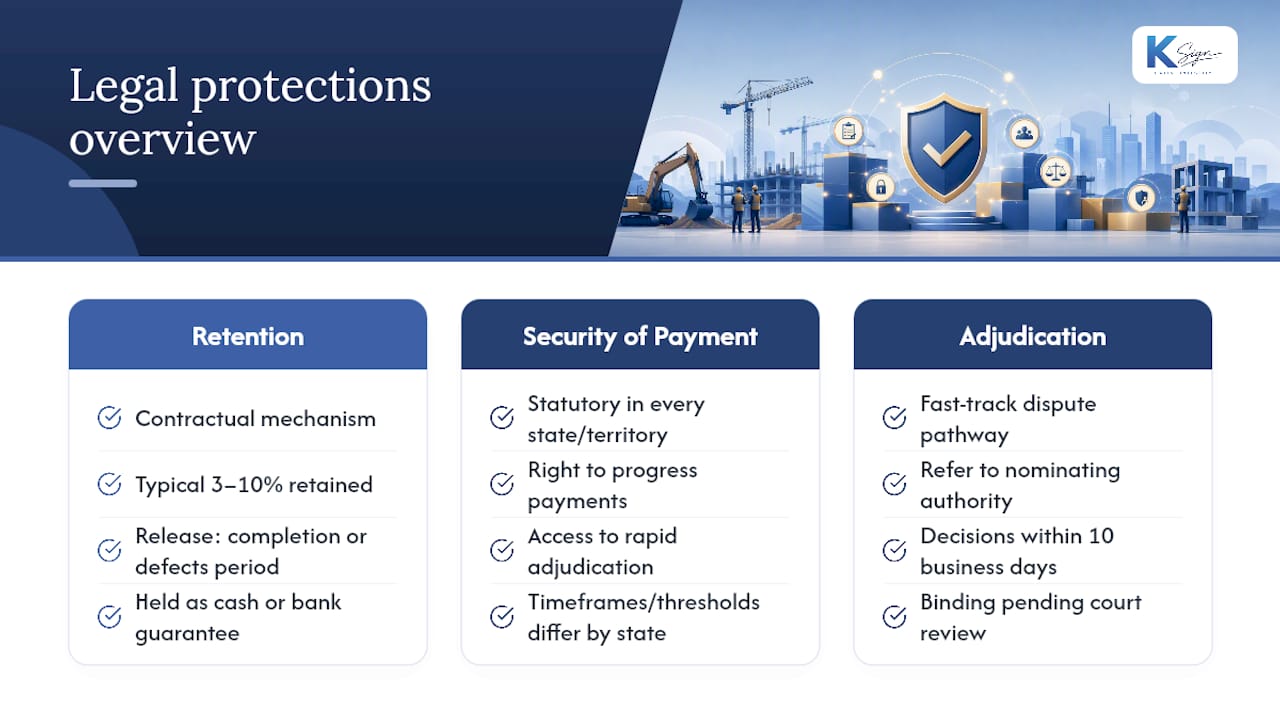
Retention is a contractual mechanism, not a statutory one. The contract sets the retention percentage (typically 3–10%), the conditions for release (practical completion, end of defects liability period), and whether retention is held as cash or a bank guarantee. Some states have introduced retention trust account requirements for larger projects to protect subcontractors if the head contractor becomes insolvent.
Security of payment legislation exists in every Australian state and territory. In NSW, the Building and Construction Industry Security of Payment Act 1999 gives contractors and subcontractors a statutory right to progress payments and access to rapid adjudication. Similar legislation operates in Victoria, Queensland, Western Australia, and other states, though the specific timeframes and thresholds differ. NSW Fair Trading’s security of payment guidance explains the claim and response process for that jurisdiction.
Adjudication is the fast-track dispute pathway under security of payment statutes. A contractor who has not been paid a certified amount, or who disputes a payment schedule, can refer the matter to an authorised nominating authority. Adjudication decisions are typically issued within 10 business days of the adjudicator’s acceptance and are binding pending any court review. This is materially faster than litigation and is the primary enforcement tool for unpaid progress claims in Australia.
Withholding rights allow an owner or administrator to reduce a certified amount for defective work, unapproved variations, or liquidated damages. The contract must specify the grounds and process for withholding. Issuing a payment schedule that sets out the reduced amount and the reasons is the correct procedural step; failing to issue a payment schedule in response to a valid progress claim can result in the full claimed amount becoming a debt under security of payment legislation.
The ACCC’s guidance and Consumer Affairs Victoria’s checklists are useful references for consumer-facing residential projects where additional protections apply.
Practical checklist: what to check before releasing a staged payment
Use this checklist before certifying or releasing any stage payment. It works equally well as a meeting agenda item or a sign-off form.
- SOV reconciliation confirmed: the claimed amount matches the SOV line items for the period; no unapproved variations are included.
- Supporting evidence verified: progress photographs are dated, geotagged, and cover all claimed work; supplier invoices match materials claimed.
- Site inspection completed or third-party report received: certifier or engineer has inspected the relevant work and their report is in the pay application package.
- Insurance and warranties current: contractor’s public liability and workers’ compensation insurance certificates are valid; any required product warranties are lodged.
- Conditional lien waivers collected: principal contractor and key subcontractors have provided conditional waivers covering this claim period.
- Change orders approved and incorporated: all variations in this claim have signed approvals and are reflected in the updated SOV.
- Payment due date logged: the contract’s payment timeframe is noted and the release date is scheduled to avoid a statutory breach.
- Retention conditions checked: confirm whether this payment triggers a partial or full retention release, and update the retention register accordingly.
Pro Tip: Walk the work before you certify it. Photographs can be taken of completed work from a previous period. A brief site visit, even 30 minutes, gives the contract administrator independent verification that the claimed scope is genuinely complete.
If any item on this checklist cannot be confirmed, issue a notice of intended payment stating the amount you intend to pay and the specific reasons for any reduction. This preserves your legal position under security of payment legislation and gives the contractor a clear basis to respond or rectify.
Sample contract clauses and suggested wording for staged payments
The clauses below are starting points. They should be reviewed by a solicitor or contract administrator before use on high-value projects, and adapted to the specific project type and governing state legislation.
Schedule of values and draw schedule
Payment application requirements
Three-way matching and inspection
Retainage
Conditional and unconditional lien waivers
Adapt the bracketed figures to your project’s risk profile and cash-flow requirements. Residential contracts under the relevant state’s domestic building legislation may have statutory limits on deposit amounts and payment timing that override these clauses. Contract automation tools can generate these clause sets from a template, reducing the risk of inconsistency between the contract body and the annexures.
A practical note on staged payment workflows
The gap between a well-drafted payment clause and a payment that actually arrives on time is almost always an execution problem, not a legal one. The SOV gets agreed but never formally signed. The pay application goes out by email with attachments in the wrong order. The contract administrator’s certificate sits in someone’s inbox for a week before the owner sees it. These are workflow failures, and they compound across every stage of a project.
What we see consistently with small builders using Ksign is that the friction disappears when the form, the document, the signature, and the payment are connected in a single workflow. Mobile sign-offs from site, template SOVs that pre-populate from the contract, and embedded payment capture mean the approval cycle runs in days rather than weeks. For retention releases specifically, having a timestamped audit trail of every prior approval makes the final sign-off straightforward rather than a reconstruction exercise.
Ksign for staged payment approvals in construction
Staged payment approvals involve more moving parts than most small builders expect: structured pay applications, SOV reconciliation, multi-party sign-off, lien waivers, and embedded payment release. Managing that chain through email and PDFs creates the exact delays and disputes this guide describes.
Ksign connects every step. Web forms capture structured pay application data from the field. Document generation produces SOV-aligned pay app documents and lien waiver templates automatically. E-signatures handle payment certificates and waiver sign-off across all parties, with a full audit trail. Embedded payments release draw funds directly within the approved workflow, so payment follows certification without a separate banking step. For small builders and trades managing multiple active stages at once, this is the difference between chasing approvals and receiving them. Visit Ksign’s construction solutions page to see how the workflow maps to your project type, or start a trial at Ksign.
Sources
The following sources are the most reliable starting points for jurisdiction-specific detail on construction payment rules in Australia.
- The Ultimate Guide to Construction Payments | NetSuite
- Construction payment management (Corpay)
- Consumer
- Fairtrading
- Accc
- Legislation