
Start with a template built on the same clause structure used in filings like Harland Clarke’s SEC exhibit, then customise nine essentials: scope, term, fees, payroll status, replacement guarantee, confidentiality, liability, IP and signatures. Pick the right variant first (temporary, temp-to-hire, or recruitment), because each carries different obligations. The rest is editing, not drafting from a blank page.
TL;DR:
- Staffing agreement templates must include clear clauses on employment status, renewal notice periods, and rates to prevent billing disputes.
- Specific clauses for timesheet verification and prevailing wage obligations are essential, especially for public or government-related work.
- Choosing the correct template depends on the staffing model; for example, temporary placements require payroll clauses, while direct placements focus on fees and guarantees.
- Using guided forms during drafting ensures all required information, like worker details and rates, is collected and attached, reducing operational errors.
- Legal review is key for high-liability roles or multi-state arrangements, but low-risk, standard templates often do not need immediate legal approval.
Table of Contents
- What must a staffing agreement template include?
- Practical sample clauses you can copy and adapt
- How do you choose the right staffing agreement template?
- Legal and compliance considerations you must check
- How do you fill, sign and operationalise a staffing agreement?
- Why guided templates and a form first workflow cut real risk
- Ksign turns your staffing agreement template into a signed, paid contract
- Authoritative downloadable templates and guidance
- Sources
- FAQ
What must a staffing agreement template include?
A usable staffing agreement template is not a one-page handshake document. It’s a structured contract with clause headings that map to the real obligations both sides carry once a worker turns up on site or on a client’s payroll. Miss one of these and you’re exposed to a dispute you could have avoided with a paragraph.
The clause list below reflects what shows up consistently across public model agreements, including the Harland Clarke staffing services agreement filed with the SEC, the USLegalForms model temporary agency-client agreement, and the sample terms published by MPW Industrial Services.
Essential clause headings:
- Parties and definitions — legal names, ABNs or business numbers, and defined terms for “assigned employee,” “client,” and “agency.”
- Scope of services — what staffing model applies: temporary assignment, temp-to-hire, direct placement, or a mix.
- Term, renewal and termination — start date, renewal mechanism, and the notice period either side needs to exit.
- Fees and billing — hourly bill rates, mark-up percentage, invoicing frequency and payment terms.
- Rate and order confirmations — a separate attachment or schedule listing the worker, agreed rate, and assignment length for each placement.
- Timekeeping and invoice verification — how hours get logged, approved and reconciled before billing.
- Employment status — a clear statement of who is the legal employer for tax, workers’ compensation and payroll purposes.
- Payroll and tax obligations — who withholds tax, pays superannuation, and issues payslips.
- Replacement guarantee — the warranty period during which the agency will replace a worker at no extra charge if the placement doesn’t work out.
- Confidentiality — protection for client business information the worker or agency encounters during the assignment.
- Intellectual property — ownership of anything a placed worker creates while on assignment.
- Liability, indemnity and insurance — minimum coverage limits and who indemnifies whom for what.
- Background checks and screening — what vetting happens before placement, and who pays for it.
- Data protection and privacy — handling of personal information collected during recruitment or onboarding.
- Signature blocks — space for both parties (and sometimes the placed worker) to sign and date.
The wording under several of these headings shifts depending on which staffing model you’re running. A pure temporary-labour agreement leans heavily on the employment-status and payroll clauses, because the agency stays the legal employer throughout. A temp-to-hire agreement needs an additional conversion clause: a fee the client pays if they hire the worker permanently after a trial period, often scaled down the longer the temp has already worked there. A recruitment or direct-placement agreement drops most of the payroll language entirely and instead centres on a placement fee tied to the candidate’s first-year salary, plus a guarantee period if the hire doesn’t last.
Pro Tip: If you’re editing a generic template for temp-to-hire work, search it for the word “conversion” — if that clause is missing entirely, you’ve probably got a straight temporary-staffing template that will cause a billing dispute the moment a client wants to hire someone permanently.
Three operational details separate a template that works from one that looks fine on paper but fails in practice.
Timesheet verification needs its own short clause, not a buried reference inside billing. Specify who approves hours (usually a named site supervisor), by when, and what happens if a timesheet goes unapproved past a set deadline. The MPW Industrial Services sample agreement ties weekly invoicing directly to signed timesheets, which closes off a common source of billing arguments.

Prevailing wage obligations matter mostly on government or public-infrastructure work, where a placement might legally require a minimum hourly rate regardless of what the agency and client agreed privately. If any of your placements touch public contracts, this clause isn’t optional.
Notice periods and renewal wording follow a fairly consistent pattern across the model agreements reviewed here. A written notice period of about one month for either party to terminate, paired with automatic renewal unless notice is given, is close to the industry default in the sample staffing contracts published by MPW Industrial Services and echoed in common automatic renewal clause language used across service contracts generally. Shorten that notice period if you’re testing a new client relationship; lengthen it once the relationship is established and you want billing continuity.
Practical sample clauses you can copy and adapt
Below are short, editable clause drafts for the headings that cause the most confusion. None of these replace a lawyer’s review for a high-value or multi-state arrangement, but they’ll get a working draft in front of the right person fast.
Scope of services
This wording, echoed closely in the Harland Clarke SEC exhibit, keeps day-to-day control with the agency while letting the client set outcomes, which supports the employment-status clause below.
Term and renewal
Termination for convenience
Add a second, shorter notice period (often 24 to 48 hours) for terminating an individual worker’s assignment without ending the whole agreement. Clients almost always want that flexibility separate from the master contract term.
Fees and payment
Hourly rates and overtime
The MPW Industrial Services template uses near-identical overtime language, tied directly to verified weekly timesheets rather than self-reported hours.
Payroll and employment status
Replacement guarantee
Confidentiality
Liability and insurance
Intellectual property
Pro Tip: Don’t leave insurance limits blank when you copy a template. A $1 million liability figure works for a general office placement but is thin for a construction or industrial site — check what your client’s own contracts require before you sign, not after an incident.
Every one of these clauses gets shorter and vaguer the more generic the template. Tighten liability, insurance and payroll wording whenever the placement involves higher-risk work (construction, healthcare, driving) or a client with strict compliance requirements, and loosen the confidentiality and IP clauses for low-risk, short-term office placements where heavy legal language just slows down signing.
How do you choose the right staffing agreement template?
Not every staffing arrangement needs the same contract shape. Work through this sequence before you touch a single clause.
- Identify the staffing model first. A temporary assignment keeps the agency as employer for the whole placement. A temp-to-hire arrangement adds a conversion fee if the client hires the worker permanently. A pure recruitment or direct-placement agreement skips payroll clauses entirely and centres on a one-off placement fee. Contractor placements need an independent-contractor classification clause instead of an employment-status one.
- Set your rates and mark-up structure before drafting anything else. Decide the hourly bill rate, your mark-up percentage over the worker’s pay rate, and whether overtime gets billed at 1.5x or a negotiated flat rate. Document every individual placement in a separate order confirmation or rate schedule attached to the master agreement, not buried in the body text.
- Work through the customisation checklist. Confirm party details and ABNs, attach any required background-check authorisation forms, set insurance limits appropriate to the work’s risk level, and add a prevailing-wage notice if the assignment touches a public or government-funded project.
- Scan for the red flags that void a template’s usefulness. Ambiguous employer-status wording, missing insurance certificates, no defined invoice or timesheet-approval process, and no replacement guarantee window are the four most common gaps in downloaded templates. A contractor scope of work attachment closes the gap between a generic contract and one that actually reflects the job.
If you’re staffing tradies or field-based workers rather than office placements, a contractor service agreement template built for site-based work often needs less editing than a generic corporate staffing contract, because it already assumes variable job locations and equipment responsibilities.
Legal and compliance considerations you must check
Every staffing agreement template starts from a federal baseline, and that’s exactly where the risk begins. Practical Law’s model temporary employee staffing agreement is explicit that state and local law can impose obligations well beyond what a generic federal-level template covers, and that gap catches out more businesses than any clause-drafting error.
Four areas need jurisdiction-specific checking before you sign anything at scale:
- Worker classification — misclassifying a temp worker as an independent contractor is one of the most heavily enforced areas of labour law, with penalties that can include back pay, taxes and fines.
- Wage and hour rules — overtime thresholds, meal-break requirements and minimum-wage rates vary by state and sometimes by city.
- Background-check regulations — some jurisdictions restrict what can be asked or disclosed in a pre-employment check, and when.
- Prevailing wage requirements — public infrastructure and government-funded projects often mandate minimum rates that override whatever the agency and client privately negotiated.
Some jurisdictions also require labour-hire licensing before an agency can legally supply workers at all, a step that has nothing to do with contract wording and everything to do with whether the business is allowed to operate.
Government-published sample contracts are a useful sanity check against your own draft. The NYC Department of Consumer and Worker Protection’s employment agency sample contract and Oregon’s state staffing services procurement guidance both show how public bodies structure staffing contracts, which is a good benchmark even for private-sector agreements.
Get a lawyer to review the agreement before signing when the contract covers a government contract, spans multiple states, or places workers in high-liability roles like healthcare, transport or construction.
How do you fill, sign and operationalise a staffing agreement?
Editing a template is only half the job. The other half is turning it into a live, working contract that survives contact with an actual assignment.
- Pick the right template variant for the staffing model, based on the decision sequence above.
- Fill in party details — legal names, business numbers, notice addresses, and signatory names and titles.
- Attach a job-specific order confirmation for each assignment, listing the worker, agreed rate, expected duration and any special site requirements.
- Confirm rates and invoicing terms match what you quoted the client, including overtime and mark-up percentages.
- Sign and store the agreement somewhere both parties can retrieve it, along with every order confirmation attached to it.
Once signed, the operational side kicks in: weekly timesheet verification against a named approver, invoicing on the agreed cadence, and a clear escalation path if a client disputes hours or a worker raises a grievance. Most disputes trace back to one of two failures: an order confirmation that was never properly attached, or an invoice sent before hours were actually approved.
This is where a form-first workflow earns its keep over a folder of PDFs and email threads. Instead of drafting a fresh contract for every placement, a guided form captures the worker, rate, and job details once, and generates the order confirmation and staffing agreement automatically from those answers. Platforms like Ksign’s contract automation tools are built around exactly that sequence: form, contract, signature, payment, all logged in one place.
Pro Tip: Keep every signed agreement, order confirmation and timesheet attachment in the same digital record. When a dispute happens six months into a placement, the business that can produce a full audit trail in thirty seconds wins the argument before it starts.
Why guided templates and a form first workflow cut real risk
Most staffing disputes I’ve seen written up don’t come from bad legal drafting. They come from good clauses sitting in a document nobody actually filled out properly, an order confirmation that got emailed once and never attached, or a rate that was verbally agreed and never matched what the invoice said.
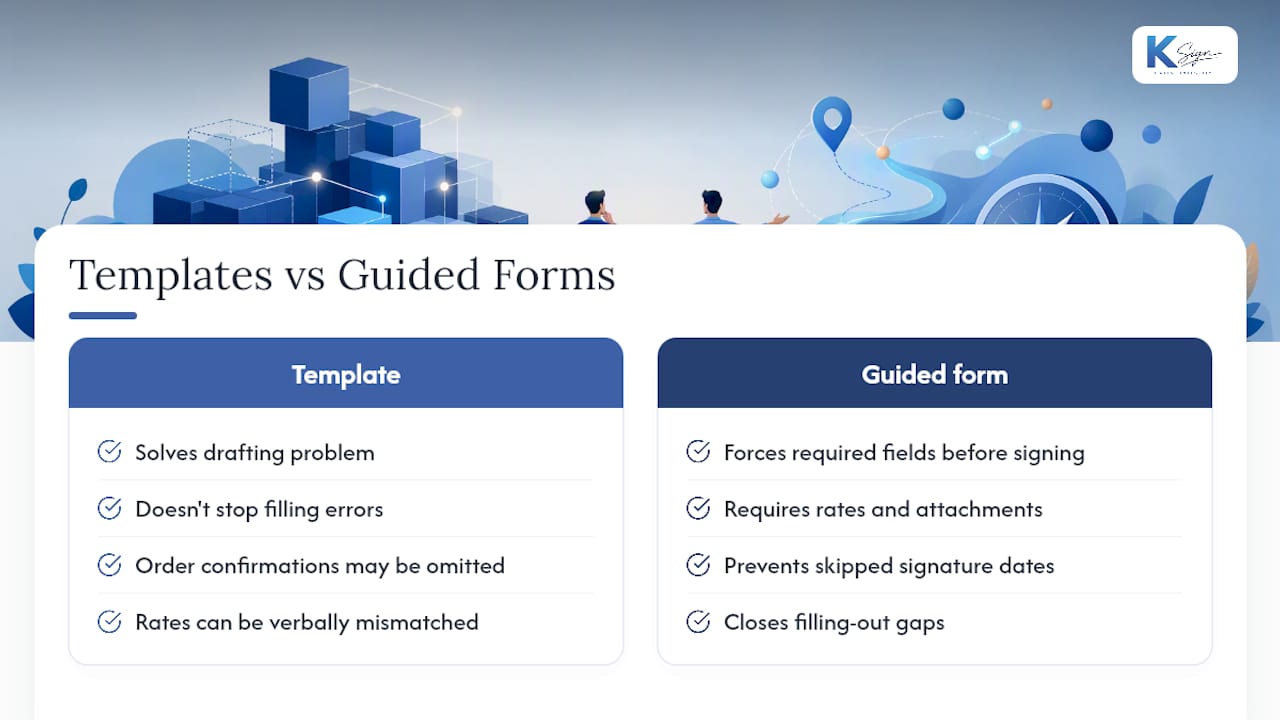
A downloadable template solves the drafting problem. It does nothing for the filling-out problem, which is where most small staffing operations actually bleed time and money. Guided forms fix that second half by forcing every required field, rate, and attachment before a document ever reaches signature. That’s not a nice-to-have for a business running a handful of placements a month; it’s the difference between a contract that protects you and one that just looks like it does.
I’ve watched a single missing signature date turn a straightforward replacement-guarantee dispute into a three-week argument. A form that won’t let you skip a field would have closed that gap before it opened.
— Josh
Ksign turns your staffing agreement template into a signed, paid contract
Editing a downloaded template gets your clauses right. It doesn’t stop a rate from getting typed wrong on invoice fifteen, or an order confirmation from sitting unsigned in someone’s inbox for a week. Ksign is built for exactly that gap: a guided form collects the worker, rate and assignment details once, auto-generates the staffing agreement from those answers, and sends it straight to e-signature.

The payoff is fewer missing clauses, faster onboarding for new placements, and the ability to collect a deposit or first invoice payment the moment the contract is signed, rather than chasing it separately afterwards. Every signed agreement, attachment and payment record stays together with a full audit trail, so a dispute six months later takes minutes to resolve, not weeks.
If you’re staffing tradies or field crews rather than office placements, Ksign’s web forms and payment collection tools slot into the same workflow described throughout this guide. Start by building your staffing agreement as a guided form on Ksign’s contract automation page and send your next placement out for signature the same day.
Authoritative downloadable templates and guidance
- SEC EX-10.6 — a real, fully executed corporate staffing services agreement.
- Practical Law model agreement — professionally drafted clause language with compliance notes.
- USLegalForms model agreement — a plain-language starting template.
- MPW Industrial Services sample PDF — real operational clauses on billing and timesheets.
- Nyc — a public-sector benchmark.
- Oregon — procurement-focused compliance notes.
Sources
- EX-10.6 staffing services agreement (Harland Clarke) — SEC
- Temporary Employee Staffing Agreement — Practical Law (Westlaw)
- Model Temporary Agency - Client Agreement — USLegalForms
- Temporary Employment Agreement — MPW Industrial Services (sample PDF)
FAQ
What Is a Staffing Agreement?
A staffing agreement is a contract between a staffing agency and a client that sets out how temporary, temp-to-hire, or contract workers are supplied, billed, and managed, including who acts as the legal employer for payroll and tax purposes.
How Do You Make a Simple Staffing Contract Agreement?
Start from an existing model like the MPW Industrial Services template, fill in party details and rates, attach a job-specific order confirmation, and cover the nine essential clauses: scope, term, fees, employment status, replacement guarantee, confidentiality, liability, IP, and signatures.
What Format Should an Employee Agreement Follow?
A staffing or employee agreement should follow a clause-by-clause structure covering parties, scope of work, term and termination, compensation, employment status, confidentiality, and signature blocks, similar to the format used in the Harland Clarke SEC exhibit.
Can You Legally Write Your Own Staffing Contract?
Yes, businesses can draft their own staffing agreements using a model template, though Practical Law notes that state and local laws can add obligations a federal-baseline template won’t cover, so high-risk or multi-state arrangements should get a legal review before signing.
Do You Need a Lawyer to Review a Staffing Agreement Template?
Not for a standard, low-risk placement built on a solid model template, but you should get legal review for government contracts, multi-state arrangements, or placements in high-liability roles like construction or healthcare.