
A signed labour-hire or contractor agreement materially reduces your legal and commercial risk. Require the host to sign a master labour-hire agreement before you place a single worker. That one step creates verifiable evidence of your obligations, limits accessorial liability, and satisfies the documentation expectations of the Fair Work Ombudsman, Safe Work Australia, and state licensing bodies such as the Victorian Labour Hire Licensing Authority and Queensland’s licensing regulator.
- A signed agreement is the primary documentary evidence that clarifies WHS responsibilities, insurance obligations, and payment terms between your agency and the host.
- The Fair Work Commission can make regulated labour-hire arrangement orders requiring your workers to receive no less than the host’s protected pay rate — a signed agreement is your evidence of intent and scope.
- Safe Work Australia’s model WHS laws treat both the labour-hire provider and the host as persons conducting a business or undertaking (PCBUs), each carrying primary duties that cannot be contracted away.
Table of Contents
- Why signed contractor agreements matter for labour hire companies in Australia
- What core clauses should every labour-hire agreement include?
- How do employment contracts differ from labour-hire agreements?
- How do you implement a signed agreement workflow in practice?
- What contract gaps create the most legal and commercial risk?
- How does a digital form-to-sign workflow reduce your compliance risk?
- When should you get legal advice, and where do you check current rules?
- Key takeaways
- The documentation habit that actually protects you
- Ksign makes labour-hire agreement workflows faster and audit-ready
- Authoritative Australian sources and further reading
Why signed contractor agreements matter for labour hire companies in Australia
Accessorial liability is the sharpest legal risk in labour hire. Under the Fair Work Act, third parties — including labour-hire providers — can be held liable for contraventions they were involved in, even when the host employer is the primary wrongdoer. A signed agreement documents your agency’s intent, the scope of supply, and the pay rates agreed, which is precisely the evidence the Fair Work Commission examines when assessing whether a regulated labour-hire arrangement order should apply.
WHS exposure compounds this. Under Safe Work Australia’s model laws, both the agency and the host are PCBUs with overlapping primary duties. A written agreement cannot transfer those statutory duties, but it can allocate practical on-site management responsibilities — who conducts inductions, who controls the work environment, who maintains plant and equipment. Without that written allocation, both parties are exposed equally when an incident occurs.
The commercial consequences of unsigned arrangements are equally concrete: insurers may reject claims where no written agreement exists, auditors treat absent documentation as a governance failure, and payment disputes become word-against-word contests with no agreed invoicing terms to fall back on. Written contractor contracts materially reduce dispute escalation costs by setting expectations before work begins, not after a disagreement surfaces.
Statistic callout: The Fair Work Commission’s regulated labour-hire arrangement order powers mean a host’s enterprise agreement pay rates can be applied directly to your placed workers. A signed agreement that records the agreed rate and scope is your first line of documentary defence.
Pro Tip: Bundle your site induction records and WHS induction checklists as attachments to the signed agreement. This creates a single, timestamped evidence package that covers both commercial and safety obligations.
What core clauses should every labour-hire agreement include?
A master Recruitment Labour Hire Agreement governs the commercial relationship between your agency and the host. It is a separate document from the employment contract you hold with the worker. Practitioners consistently identify the following clause areas as non-negotiable:
- Scope and supervision: Define which roles are supplied, who directs day-to-day work on site, and the host’s obligations to provide a safe workplace.
- Fee models and invoicing: Specify the charge rate, markup structure, invoicing frequency, and payment terms to prevent disputes.
- WHS allocation: State which party manages site inductions, hazard reporting, and incident notification — not to exclude statutory duties, but to clarify practical responsibility.
- Insurance and certificates: Require the host to provide evidence of public liability and workers’ compensation, and require your agency to do the same. Make certificate provision a condition of placement.
- Indemnities and limitations of liability: Allocate risk for third-party claims arising from the host’s direction of workers.
- Audit and compliance rights: Give your agency the right to inspect records and verify that workers are being used within the agreed scope and classification.
- Subcontracting rules: Prohibit the host from on-supplying your workers without written consent.
- IP assignment: Where contractors create deliverables, include a present assignment clause. Without it, your business may not own the intellectual property in work product the contractor produces.
The template should use plain language and modular clause inserts so the same document can serve multiple hosts across different industries with controlled variation fields rather than full redrafts.
Pro Tip: Draft your WHS clause as a checklist attachment rather than buried prose. A host who signs a checklist confirming site induction completion is harder to dispute than a host who signed a paragraph they may not have read carefully.

How do employment contracts differ from labour-hire agreements?
These are two distinct documents, and confusing them is one of the most common sources of legal exposure in labour hire.
Employment contract (agency to worker):
- Sets pay rates, classification, notice periods, leave entitlements, and superannuation obligations.
- Governs the employment relationship between your agency and the individual worker.
- Must reflect the real substance of the relationship — since 26 August 2024, the Fair Work Act applies a “whole of relationship” test, meaning courts examine practical reality, not just the label on the document.
Labour-hire agreement (agency to host):
- Sets commercial terms: fees, invoicing, WHS allocation, insurance, indemnities, and audit rights.
- Governs the supply arrangement between your agency and the host business.
- Does not create an employment relationship between the host and the worker.
Mixing the two — or using a single document that tries to do both — creates sham contracting risk and reclassification exposure. Courts examine substance over labels and will disregard a contract that does not reflect day-to-day reality.
A practical example: if your labour-hire agreement says the host “does not supervise or direct” workers, but on-site the host’s manager assigns tasks, sets hours, and controls the work method, that supervision clause fails the substance test. The written term must match operational reality, or it provides no protection at all.
What belongs where:
- Employment contract: pay rate, award classification, notice period, leave accrual, payroll obligations, superannuation.
- Labour-hire agreement: charge rate and markup, invoicing schedule, WHS site responsibilities, insurance certificate requirements, indemnity allocation, audit rights, IP assignment.
How do you implement a signed agreement workflow in practice?
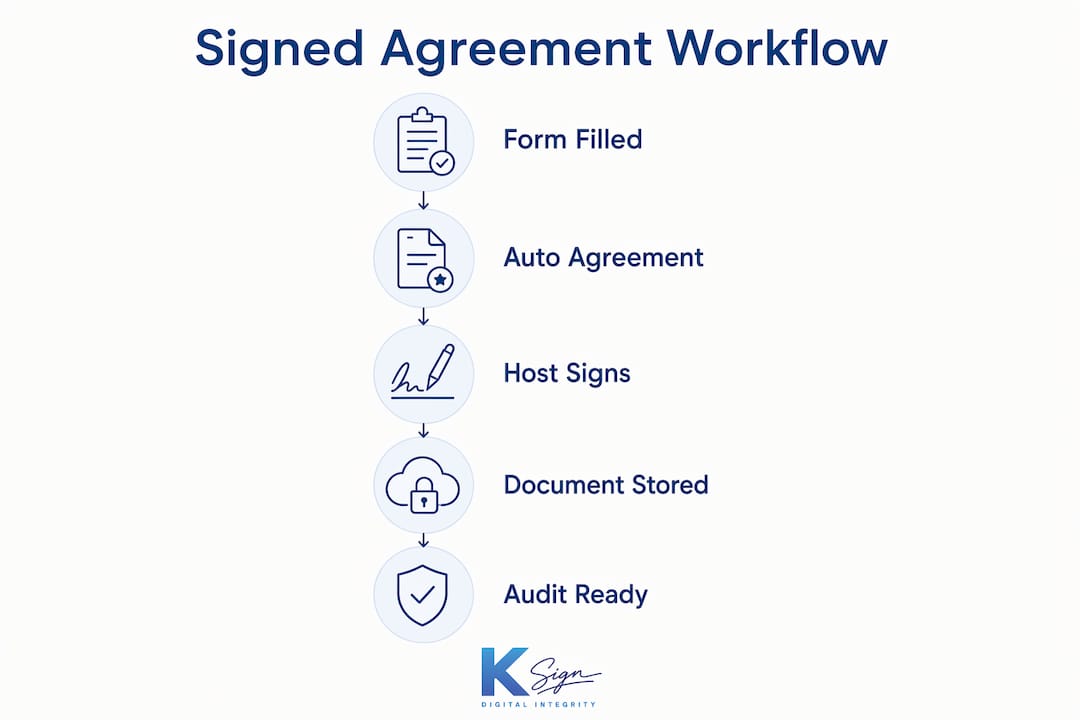
The end-to-end process for a small operator looks like this:
- Client intake: Collect host details, site address, role descriptions, and required start dates via an online form.
- Scope and pricing: Confirm charge rates, classification, and WHS site requirements.
- Auto-generate agreement: Use form data to populate the master template with host-specific fields.
- Legal review: For complex sites, high-risk WHS environments, or unusual fee structures, allow two to three business days for legal sign-off before sending.
- Electronic signing: Send the agreement for legally binding e-signature. Most hosts sign within one business day when the document is clear and pre-populated.
- Collect attachments: Require insurance certificates and site induction evidence as mandatory uploads before placement proceeds.
- Store audit trail: Archive the signed document, attachments, and execution history in a single immutable record.
| Step | Manual process | Digital workflow |
|---|---|---|
| Draft agreement | — | Under 5 min (auto-populated from form) |
| Chase signatures | 2–5 days by email | Same day with automated reminders |
| Collect insurance certs | Ad hoc, often missed | Mandatory upload field before signing completes |
| Store and retrieve | Shared drive, inconsistent | Centralised, searchable audit trail |
Note: timing estimates above are illustrative based on typical small-operator admin patterns, not sourced benchmarks.
Pro Tip: Build one master template with clearly labelled variation fields (site address, role type, charge rate, WHS contact). Roll it out to every new host without redrafting. Version-control the template so all active agreements reference the same base document.
What contract gaps create the most legal and commercial risk?
Most compliance problems in labour hire trace back to a small set of recurring gaps:
- Missing WHS allocation clause: Leaves both parties equally exposed when a workplace incident occurs.
- No audit or compliance rights: Removes your ability to verify that workers are being used within the agreed classification and scope.
- Vague supervision language: Creates reclassification risk when on-site reality differs from the written term.
- Absent insurance verification: Insurers treat unsigned or unverified arrangements as evidence of poor governance, increasing the chance of a disputed claim.
- No IP assignment: Where contractors produce materials, the absence of a present assignment clause means ownership is legally ambiguous.
- Inconsistent invoicing terms: Disputes over payment timing and rate calculations are almost always traceable to a contract that did not specify them clearly.
- Handshake deals and oral amendments: In licensed states — Victoria, Queensland, South Australia, and the ACT — unsigned arrangements are red flags for both regulators and insurers. Licence audits in these jurisdictions expect written agreements that match the licence conditions on record.
Statistic callout: Some Australian states and territories operate mandatory labour-hire licensing schemes. Operators who cannot produce a signed agreement matching their licence conditions risk licence suspension or refusal at renewal.
How does a digital form-to-sign workflow reduce your compliance risk?
The functional mapping between risk and product features is direct. Each gap identified above has a corresponding control in a well-designed digital workflow:
| Risk | Feature that mitigates it |
|---|---|
| Accessorial liability / pay rate disputes | Auto-generated contract with agreed rates locked at signing; legally binding e-signatures and timestamped audit trail |
| WHS evidence gaps | Mandatory insurance certificate upload and site induction attachment before signing completes |
| IP ownership ambiguity | Present assignment clause in the auto-populated template, signed and dated |
| Invoice disputes | Payment terms and charge rates captured in the form and reproduced verbatim in the agreement |
| Unsigned placements | Automated reminders and placement-blocked workflow until signature is confirmed |
The workflow in practice: the host fills an online intake form, the agreement auto-builds from their responses, the host e-signs, a deposit or placement fee is collected, insurance certificates are uploaded as mandatory attachments, and the entire package is archived with a full audit trail. No chasing emails. No version confusion. No missing attachments discovered during an audit.
Pro Tip: Make insurance certificate upload a mandatory field in the signing workflow, not a follow-up task. If the certificate is not uploaded, the agreement does not complete. This single control eliminates the most common audit gap.
Field service businesses in adjacent industries — including those managing tree maintenance contracts — use the same principle: mandatory evidence collection at the point of agreement, not after the work begins.
When should you get legal advice, and where do you check current rules?
A signed agreement limits risk but does not stop lawsuits. Legal review is warranted in specific circumstances:
- Complex IP assignments where contractors produce commercially valuable deliverables.
- High-risk WHS sites (construction, mining, electrical, confined spaces).
- Unusual fee models or profit-share arrangements that could imply a joint venture.
- Cross-border placements where multiple state licensing obligations apply simultaneously.
- Any situation where sham contracting or worker reclassification is a genuine possibility.
- Licence doubt — if you are unsure whether your operations require a licence in a given state, get advice before placing workers.
Primary Australian sources to verify current rules:
- Fair Work Ombudsman — labour hire and supply chains: guidance on accessorial liability, regulated labour-hire arrangement orders, and pay rate obligations.
- Safe Work Australia: model WHS laws, PCBU duty guidance, and industry-specific codes of practice.
- Victorian Labour Hire Licensing Authority: licence application, renewal, and compliance guidance for Victorian operators.
- Queensland Office of Industrial Relations — labour hire licensing: Queensland licensing requirements and host obligations.
- business.gov.au — prepare a contract: practical guidance on contractor agreement elements and sham contracting risk.
A signed contract is evidence, not immunity. If a dispute or reclassification risk arises, consult a qualified employment or commercial lawyer before responding to a regulator or opposing party.
This article is general information, not legal advice. Verify current rules with the relevant regulator or a qualified legal professional for your specific situation.
Key takeaways
A signed labour-hire agreement is the single most effective commercial control a small operator can implement before placing workers — it creates verifiable evidence, allocates WHS responsibilities, and satisfies the documentation expectations of every Australian state licensing authority.
| Point | Details |
|---|---|
| Sign before placement | Require the host to sign the master agreement before any worker is placed on site. |
| Include WHS and insurance clauses | Allocate practical on-site responsibilities and make insurance certificate upload mandatory at signing. |
| Separate your two documents | Keep the employment contract (agency to worker) entirely separate from the labour-hire agreement (agency to host). |
| Add an IP assignment clause | Where contractors create deliverables, a present assignment clause is the only way to confirm your business owns the work. |
| Ksign automates the workflow | Ksign’s form-to-contract-to-e-sign workflow removes manual drafting, chases signatures automatically, and stores a complete audit trail. |
The documentation habit that actually protects you
The most underrated shift a small labour-hire operator can make is treating documentation as an operational control, not a legal formality. Most operators who get caught in a Fair Work audit or a WHS incident investigation do not lack knowledge of the rules — they lack the paperwork to prove they followed them. A signed agreement that was never retrieved, a certificate that was never uploaded, an induction that was never recorded: these are the gaps that turn a manageable dispute into an expensive one.
Run a quarterly contract audit. Pull every active host agreement, check that insurance certificates are current, and confirm that the supervision clauses still match on-site reality. Keep a single versioned template so every new host agreement is consistent and every amendment is tracked. The discipline of that quarterly review is worth more than any individual clause, because it catches drift before a regulator does.
Ksign makes labour-hire agreement workflows faster and audit-ready
Getting agreements signed before placement is the right policy. The gap for most small operators is execution: drafting takes too long, chasing signatures by email loses days, and insurance certificates end up in someone’s inbox rather than attached to the agreement.
Ksign’s contract automation turns your master labour-hire template into a form-driven workflow. The host fills in their details, the agreement auto-populates, they e-sign with a legally binding signature, and the completed document with its full audit trail goes straight into your contract management system. Insurance certificate uploads and payment collection are built into the same flow — no separate steps, no missing attachments. For labour-hire companies placing workers across multiple hosts and sites, that consistency is what makes audits manageable rather than stressful. See how Ksign works for your placement workflow at ksign.co.
Authoritative Australian sources and further reading
- Fair Work Ombudsman — labour hire and supply chains: regulator guidance on accessorial liability, pay rate obligations, and regulated labour-hire arrangement orders. Primary source.
- Safe Work Australia: model WHS laws and PCBU duty guidance. Primary source.
- Victorian Labour Hire Licensing Authority: Victorian licence conditions, compliance guidance, and contractor classification guidance (updated to reflect the 26 August 2024 Fair Work Act changes). Primary source.
- Queensland Office of Industrial Relations — labour hire licensing: Queensland licensing requirements for providers and hosts. Primary source.
- business.gov.au — prepare a contract: practical guidance on contractor agreement elements, sham contracting risk, and signature requirements. Government guidance.
- Sprintlaw — Labour Hire Act compliance essentials: practitioner commentary on clause checklists and compliance obligations. Legal commentary.
- LegalVision — employees or contractors in a labour hire company: analysis of misclassification risk and the substance-over-labels test. Legal commentary.
- Wise Recruitments — labour hire agreement template: practical template guidance covering clause areas, insurance requirements, and licence compliance. Template and commentary.