
Your property management agreement template is ready to download in DOCX and PDF, with a fillable web-form version for anyone who wants to sign digitally without wrestling with margins. Grab the format that suits your workflow, fill in the property details, and check the licensing rules for your state before anyone signs. That last step matters more than most owners expect: real-estate licensing and trust-account rules vary enough between states that a clause perfectly valid in one jurisdiction can be unenforceable in another.
This template covers what most owner-manager relationships need: scope of services, fees, leasing authority, spending limits, insurance, termination, and the exhibits that keep everyone’s expectations on paper instead of in someone’s memory. It follows the same structural logic used in publicly filed management agreements and the clause sets recommended by industry landlord associations. Use it as a working draft, not a finished legal document. If you’re managing anything beyond a single rental unit, a limited legal review before signature is cheap insurance against a costly dispute later.
Key Takeaways
A safe, enforceable property management agreement combines a customised template with a state-specific licensing check and a documented signing and storage process.
| Point | Details |
|---|---|
| Download the right file | Use the DOCX to draft, the PDF to circulate, and the fillable form to sign with an audit trail. |
| Set spending thresholds explicitly | Fix a dollar cap (commonly $500) for repairs a manager can approve without owner sign-off. |
| Confirm local licensing rules | Check your state’s broker-licence and trust-account requirements before granting leasing authority. |
| Get limited legal review when it counts | Bring specific clauses, not the whole document, to a lawyer once value or complexity rises. |
| Sign digitally and store with an audit trail | Ksign’s form-to-contract workflow generates, e-signs, and stores the agreement with payment capture in one pass. |
Table of Contents
- Property management agreement template: what’s in the download package
- What does a property management agreement include?
- What state and licensing rules should you check first?
- How do you customise the template safely?
- Sample clause language you can copy and adapt
- How do you sign and execute the agreement?
- What red flags should you watch for before signing?
- When should you get a lawyer to review the agreement?
- Why templates aren’t the risk people think they are
- Generate, sign, and store your agreement without the back-and-forth
- Frequently asked questions
- Sources
Property management agreement template: what’s in the download package
You get three files, and each one does a different job in the signing process.
- Editable DOCX — the drafting copy. Open it in Word or Google Docs, fill in the property address, owner details, and fee schedule, and mark up clauses with a colleague or lawyer before anyone signs.
- Printer-friendly PDF — the version you hand over or attach to an email once the draft is finalised. It locks formatting so nothing shifts when the recipient opens it on a different device.
- Fillable web form — a hybrid version that lets the owner and manager complete fields directly online, which is useful if you want a built-in audit trail rather than tracking edits across email threads.
Which file to use depends on where you are in the process. Draft and negotiate in the DOCX. Finalise and circulate in the PDF. Use the fillable form when you want the signing history captured automatically. Fillable web forms also make it far easier to spot a stray blank field before it becomes a signed omission.
Pro Tip: Keep a simple version history, even if it’s just “v1, v2, final” in the file name. Attach the fee schedule and any property inventory as a separate exhibit rather than burying them in the body text. When the fee changes next year, you only need to update and re-sign one page, not the whole contract.
What does a property management agreement include?
A property management agreement is a services contract between an owner and a manager, and every functioning one hits the same load-bearing clauses regardless of property type. Below is the core structure, drawn from the pattern used in SEC-filed management agreements and standard landlord templates.
Appointment and term sets who’s managing what, and for how long. Most run for a fixed term with automatic renewal unless either party gives timely notice to terminate. Owners often push for shorter initial terms until trust is established; managers prefer longer terms to justify upfront setup costs.
Scope of services defines exactly what the manager does, which typically mirrors the duties official labour statistics attribute to property managers: rent collection, tenant relations, maintenance oversight, and vendor management. Vague scope language is the single biggest source of later disputes.
Leasing authority grants (or withholds) the manager’s power to sign leases, set rent, and approve tenants on the owner’s behalf. This is also where state licensing rules bite hardest, since some jurisdictions require a real-estate licence to conduct any leasing activity for compensation.
Fees and commissions, spending authority, and money handling govern the financial mechanics: how much the manager earns, how much they can spend without asking, and whether funds sit in a dedicated trust account or the owner’s operating account.
| Clause | Why it matters | Typical owner concern |
|---|---|---|
| Scope of services | Defines what tasks the manager will and won’t perform | Vague wording leads to disputes over “who was supposed to do that” |
| Leasing authority | Determines whether the manager can sign leases and set rent unilaterally | Owners want approval rights on new tenants or rent changes |
| Fees and commissions | Sets the manager’s compensation structure and triggers | Unclear triggers can lead to surprise charges on renewals |
| Spending authority | Caps how much a manager can spend without owner sign-off | Owners want a firm dollar ceiling, not an open-ended allowance |
| Money handling | Governs trust vs operating accounts and disbursement rules | Owners want visibility into where rent actually sits |
| Insurance and indemnity | Allocates liability if something goes wrong on the property | Owners want the manager’s negligence covered by the manager’s policy |
| Termination | Sets notice periods and exit obligations | Owners want the ability to terminate if performance is unsatisfactory without being tied to a long lock-in period. |
Standard templates commonly separate day-to-day management from asset-management work and price them differently, an approach worth copying even for a single rental property, since it stops “extra” work quietly becoming unpaid scope creep.
What state and licensing rules should you check first?
Landlord-tenant law and real-estate licensing requirements sit at the state level in the United States, and this is where a generic template can quietly fail you. A clause granting a manager full leasing authority is meaningless if that state requires a licensed broker to negotiate leases for a fee, and using a template drafted for one jurisdiction in another can leave provisions unenforceable or expose both parties to regulatory risk, as legal advisers covering California’s rules point out.
Before anyone signs, verify these locally:
- Whether the manager or their company needs a real-estate broker’s licence to lease units for a fee.
- What activities a licensed agent can legally delegate to an unlicensed employee (showings are often fine, lease negotiation usually isn’t).
- Whether trust-account rules require rent to be held separately from the manager’s operating funds, and for how long.
- What disclosure obligations apply, particularly around security-deposit handling and lead-paint or habitability notices.
- What data-handling duties attach to tenant personal information collected during applications or maintenance requests.
Pro Tip: A ten-minute search for “[your state] property management licensing requirements” plus a check of your state real-estate commission’s website will catch most obvious traps. If you find anything ambiguous, that’s the specific question to bring to a lawyer, not a general “can you check this contract” request that costs more and answers less.
How do you customise the template safely?
Work through these steps in order, and resist the urge to jump straight to the signature line.
- Fill in property and exhibit details. Address, unit count, owner entity name, and manager’s business details go first. Attach a property inventory as a separate exhibit if furnishings or fixtures matter.
- Set the term and renewal rules. A 12-month initial term with 30 days’ notice to terminate at renewal is common; adjust based on how much setup work the manager is doing upfront.
- Define the scope precisely. Decide whether this is pure property management (rent collection, maintenance, tenant relations) or extends into asset management (capital planning, refinancing advice).
- Set the fee schedule. Residential management fees are commonly charged as a percentage of collected rent, with separate leasing or renewal fees.
- Set spending authority and emergency thresholds. A common structure allows the manager to approve repairs up to a reasonable fixed amount without owner sign-off, with higher amounts requiring written approval except in genuine emergencies.
- Choose operating vs trust-account instructions. Specify where rent lands, how disbursements work, and what reserve balance the manager must maintain.
- Attach exhibits. Fee schedule, inventory list, and any insurance certificates should sit as attachments, not buried in the main clauses.
- Get final approvals and signatures. Circulate the completed draft one more time before signing to catch any field left blank.
Pro Tip: Every time you amend the agreement (a new fee percentage, an extended term), attach a signed one-page amendment rather than editing the original. Keep a simple schedule listing each amendment date and what changed. It saves enormous confusion when a dispute forces you to reconstruct what was actually agreed.
Sample clause language you can copy and adapt
The wording below covers the clauses owners and managers negotiate most often. Adapt the bracketed terms to your situation, and treat this as a starting draft rather than finished legal text.
Appointment and Authority “Owner hereby appoints Manager as the exclusive property manager for the property located at [address], and grants Manager the authority to perform the services described in this Agreement, subject to the limitations set out in Section [X].”
Spending Approval “Manager may authorise repairs or expenditures up to [$500] per occurrence without prior Owner approval. Expenditures exceeding this amount require written Owner consent, except where Manager reasonably determines an emergency threatens life, safety, or property, in which case Manager shall notify Owner within [24] hours.”
Fees and Commission “Owner shall pay Manager a management fee of [8]% of gross monthly rent collected, payable on the [5th] day of each month, plus a leasing fee of [50]% of one month’s rent for each new tenancy Manager procures.”
Termination “Either party may terminate this Agreement upon prior written notice as specified in the Agreement. Upon termination, Manager shall provide a full accounting of funds held and transfer all tenant files, keys, and security deposits within [10] business days.”
Dispute Resolution “The parties agree to attempt resolution of any dispute through good-faith negotiation for [15] days before pursuing mediation. If mediation fails, disputes shall be resolved through binding arbitration in accordance with the rules of [arbitration body], or, at either party’s election, through litigation in the courts of [state].”
The red-flag language to avoid: open-ended spending authority with no dollar cap, fee triggers described as “reasonable” without a number attached, and termination clauses that only let one party walk away. When you paste these into your DOCX, save a new version number each time rather than overwriting the original, so you can always point back to what was agreed at signing.
How do you sign and execute the agreement?
Electronic signatures are legally binding for most property management agreements in the United States under the federal ESIGN Act and equivalent state laws, provided both parties consent to signing electronically and the signature can be tied to the signer’s identity. A wet signature or notarisation is rarely required for the management agreement itself, though notarisation may still apply to related documents like a power of attorney granting leasing authority, or in certain states, to specific real-estate filings.
A practical digital execution flow looks like this: build the agreement from a guided form, generate the finished contract automatically, route it for e-signature, then store the executed copy with a timestamped audit trail. If a deposit or setup fee is part of the arrangement, capturing that payment at the same moment the contract is signed removes an entire follow-up step. This is also where digitising the signing process tends to eliminate the “did they actually sign this” uncertainty that paper-based workflows create.

Pro Tip: Keep every executed exhibit, not just the main agreement, in the same storage location as the signed contract. A fee schedule or property inventory signed separately from the main document is easy to lose track of, and disputes almost always hinge on exactly which version of an exhibit was in effect on a given date.
What red flags should you watch for before signing?
Templates pulled from generic sources sometimes carry clauses that quietly favour one party. Check for these before you sign anything:
- Overly broad delegation — language granting the manager authority to “act in all matters” without specific limits.
- Unlimited spending authority — no dollar cap on repairs or purchases the manager can approve unilaterally.
- Vague fee triggers — commission language that doesn’t specify exactly what event triggers payment (a signed lease, a renewal, a sale).
- Unilateral termination — a clause letting the manager terminate without notice while the owner is locked into a longer term.
- Unclear money handling — no specification of whether rent sits in a trust account or the manager’s general operating account.
- Missing insurance limits — indemnity language with no cap, or no requirement that the manager carry their own liability coverage.
Owners negotiating these points usually want tighter spending caps, an approval requirement above a set threshold, and clear pass-through accounting for any expenses charged back. Managers, in turn, usually want clearly defined fee triggers and a reasonable cure period before an owner can terminate for alleged non-performance, rather than immediate termination on the first missed deadline. Building a strong working relationship on both sides often comes down to operational clarity as much as contract language, something covered well in guidance on running an effective property management team.
Pro Tip: Whenever a negotiation results in a concession (say, the owner agrees to a higher spending cap in exchange for lower monthly fees), write it down as a signed side-note or amendment at the time. Verbal concessions are the single most common source of “that’s not what we agreed” disputes eighteen months later.
When should you get a lawyer to review the agreement?
Most straightforward, single-property arrangements between a reasonable owner and an established local manager can run safely on a well-customised template. Legal review becomes strongly advisable once any of the following applies:
- The portfolio involves multiple high-value properties or commercial real estate rather than a single residential unit.
- The manager is being granted atypical authority, such as the power to sign leases, approve capital improvements, or refinance on the owner’s behalf.
- Trust accounting is complex, involving multiple owners, joint-venture investors, or pooled reserve funds.
- Local statutes appear to conflict with standard template language, particularly around licensing or security-deposit handling.
- The insurance or indemnity structure is bespoke rather than the standard mutual-limits arrangement.
Before the meeting, bring the current draft, your proposed fee schedule and exhibits, a written list of state-specific questions, and a short chronology of what’s been customised and why. As commercial template guidance from LegalZoom notes, a limited-scope review focused on the clauses you’ve actually changed is far cheaper than a full document review, and most lawyers will quote a fixed fee for that narrower job if you ask upfront.
Why templates aren’t the risk people think they are
The common objection to using a template is that it’s somehow less rigorous than paying a lawyer to draft from scratch. That gets the risk backwards. The real danger in property management agreements isn’t the source of the clause language, it’s the gap between what’s written and what actually happens on the ground: verbal fee changes, spending approvals given over text message, amendments that exist only in someone’s inbox.
A well-built template forces structure onto a relationship that would otherwise run on goodwill and memory. The clauses in a publicly filed SEC management agreement aren’t more “correct” than a small landlord’s template, they’re simply more disciplined about spelling out spending authority and termination mechanics because a public company can’t afford ambiguity. There’s no reason a landlord with two rental properties should accept less discipline than a REIT.
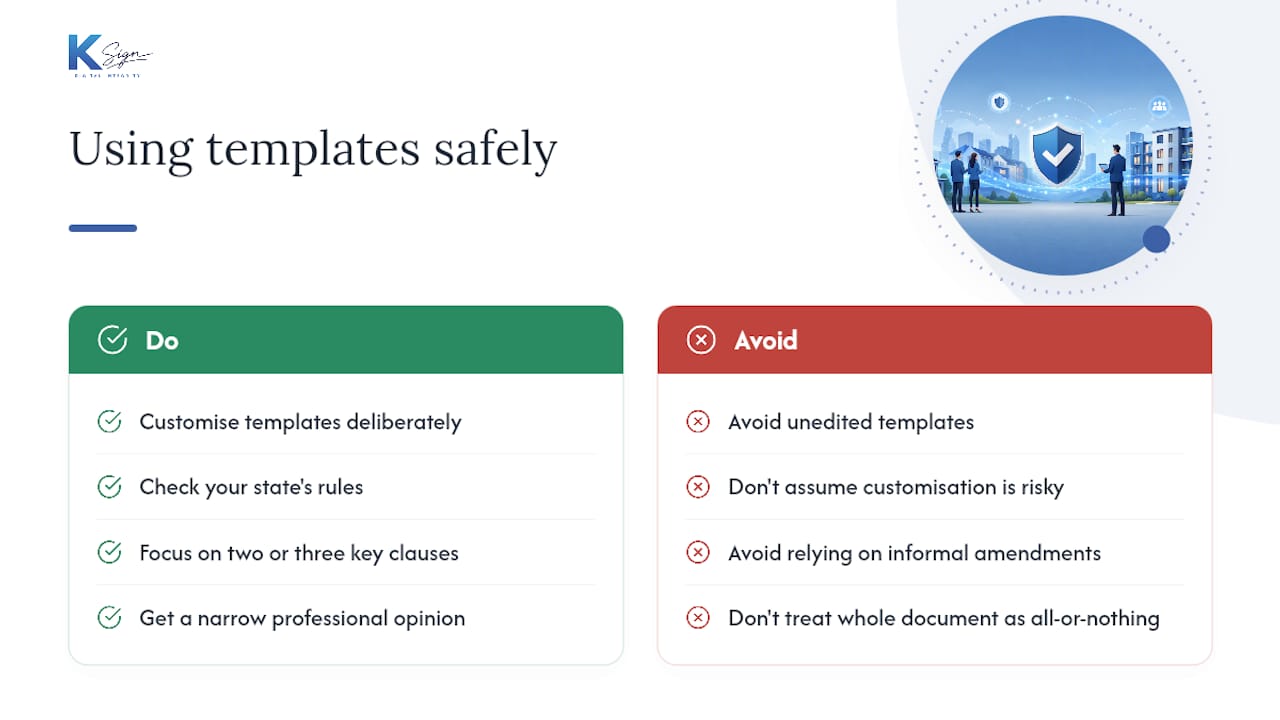
What I’d push back on is the idea that customisation is the risky part and using a stock template is the safe part. It’s the opposite. An unedited template with the wrong state’s leasing-authority language is far more dangerous than a carefully customised one, because it looks complete while quietly being unenforceable. The safest path isn’t avoiding customisation, it’s customising deliberately, checking your state’s rules on the two or three clauses that actually carry legal weight, and getting a narrow professional opinion on those specific points rather than treating the whole document as either fully DIY or fully lawyer-drafted.
Generate, sign, and store your agreement without the back-and-forth
Filling in a DOCX template is the easy part. The friction usually shows up afterwards: chasing signatures by email, manually copying fee details from a form into the contract, then hunting for a payment link once it’s finally signed. Ksign closes that gap by starting with a guided form instead of a blank document. You answer a short set of questions about the property, fee structure, and spending thresholds, and the platform auto-generates the finished contract from your answers, ready to send.
From there, the agreement goes out for legally binding e-signature, and if a setup fee or deposit is part of the deal, you can capture that payment in the same step instead of sending a separate invoice afterwards. Every executed copy is stored with a timestamped audit trail, so there’s no digging through email threads to confirm which version an owner actually signed. If you manage more than a handful of properties, build the property management agreement as a reusable form once, then generate a fresh, correctly filled contract for every new owner relationship in minutes. Set up your first form and see how quickly a signed agreement moves from draft to done.
Frequently asked questions
What does a property management agreement typically include? It typically includes the appointment and term, scope of services, leasing authority, fee structure, spending authority, money-handling rules, insurance and indemnity terms, termination conditions, and exhibits like a fee schedule or property inventory.
Is there a property management agreement template available in Excel? Most providers offer DOCX and PDF formats rather than Excel, since the document is a legal contract rather than a data table. A separate Excel or spreadsheet exhibit is commonly used for the fee schedule or expense tracking, attached alongside the main agreement.
Do property management agreements need to be notarised? Generally no, though electronic or wet-ink signatures are sufficient in most states under the ESIGN Act and equivalent state e-signature laws. Notarisation may still be required for related documents, such as a power of attorney granting leasing authority, so check your state’s specific rules.
Can a property management agreement be terminated early? Yes, if the termination clause allows it. Most templates include a notice period (commonly 30 days) for termination without cause, and a shorter cure period for termination due to breach or non-performance. Read this clause carefully, since a one-sided version can lock an owner in far longer than expected.
How do property management agreements handle tenant data? A well-drafted agreement should specify that tenant personal information collected during applications or maintenance requests is handled confidentially and only used for purposes related to the tenancy. This ties into broader consumer-data obligations that vary by state, so confirm your local disclosure and data-retention rules rather than relying solely on the template’s confidentiality clause.
Should a property management agreement reference the lease agreement separately? Yes. The property management agreement governs the owner-manager relationship, while the lease agreement governs the manager (or owner) and the tenant. Keeping them as separate documents, cross-referenced where necessary, avoids confusion about which obligations belong to which relationship.
This article is general information, not a substitute for advice from a qualified lawyer. Consult a qualified legal professional about your own circumstances before acting on anything here.
Sources
The resources below are worth bookmarking if you want to compare clause language or verify a specific state requirement before finalising your agreement.
- FORM OF PROPERTY MANAGEMENT AGREEMENT (SEC filing)
- Property management agreement template | fynk
- California property management agreement (FS Residential)
- Property, real estate and community association managers (BLS)
- Property management agreement form (American Apartment Owners Association)
- Property Management Agreement Template | LegalZoom