
A supply agreement is a legally binding contract that sets the terms for supplying specified goods or services — use one for any ongoing or one-off purchase where price, delivery, quality, and remedies need to be locked in before the first order ships. Whether you are a buyer onboarding a new vendor or a supplier protecting your payment terms, a well-drafted procurement agreement is the operating manual for the relationship, not just a legal formality.
Before you draft or sign anything, check these five items first:
- Scope and specifications: Are the goods or services described precisely enough that a court could determine whether they were delivered?
- Price and GST treatment: Does the agreement state whether prices are GST-inclusive or exclusive, and does it require a valid tax invoice with an ABN?
- Delivery, risk, and title: Does the contract define the exact moment ownership and risk pass from supplier to buyer?
- Acceptance and inspection: Is there a defined window to inspect, test, and reject non-conforming goods?
- Remedies: Are repair, replacement, refund, and termination rights spelled out, and are they ACL-compliant?
If any of those five items is missing or vague, ambiguity in essential terms — price, delivery, quality — commonly causes commercial disputes in Australian supply relationships. Fix the gap before you sign.
Next steps: Download an Australia-specific template (see the templates section below), run through the clause checklist in this guide, then consider digitising execution with an e-signature and payment workflow to create a verifiable audit trail from day one.
Table of Contents
- Where can you find the right Australian supply agreement template?
- What makes a supply agreement legally enforceable in Australia?
- Which clauses does every supply agreement need?
- How do you draft price, GST, delivery, and title transfer clauses?
- How do you manage performance and resolve disputes under a supply agreement?
- Are electronic signatures valid for supply agreements in Australia?
- Annotated sample supply agreement: clause-by-clause guide
- How to negotiate a supply agreement: tactics and red flags
- Key takeaways
- A practical perspective on when to accept contractual risk
- Ksign makes supply agreement workflows faster and more verifiable
- Useful sources and model templates
Where can you find the right Australian supply agreement template?
Not all templates are equal, and jurisdiction matters. A US or UK template may omit GST treatment, miss Australian Consumer Law (ACL) protections, or use Incoterms in ways that do not align with Australian delivery practice. The sources below are vetted for Australian use.
| Template source | Best for | Format | Key inclusions |
|---|---|---|---|
| Buying for Victoria — one-off supply | One-off purchases with defined outputs and end dates | Word/PDF | Scope, price, delivery, acceptance, warranties, termination |
| Procurement SA — standard goods and services | Detailed public-procurement-style clause bank; complex or high-value supply | DOCX | Full clause library: SLAs, audit rights, IP, confidentiality, dispute resolution |
| Lawpath — Supply Agreement template (Australia) | Small-to-medium commercial supply; editable for private buyers and suppliers | DOCX | GST, ACL warranties, payment terms, termination |
| LegalVision — supply agreement guidance | Buyers and suppliers wanting plain-language guidance alongside a template | Online/PDF | Payment, delivery, warranties, ACL, termination checklist |
Practical download checklist — before you use any template:
- Confirm the template is governed by Australian law (check the governing law clause).
- Verify it references the ACL and does not attempt to exclude statutory guarantees for consumer transactions.
- Check that GST is addressed: prices stated as inclusive or exclusive, and a valid tax invoice requirement included.
- Confirm the execution block suits your entity type (individual, company under section 127 of the Corporations Act 2001 (Cth), or trust).
- Replace all placeholder text — especially party names, ABNs, and product descriptions — before sending for signature.
Mapping templates to common scenarios:
A small supplier selling finished goods to a retailer on repeat orders needs an ongoing or framework agreement, not a one-off template. The Buying for Victoria model suits a defined project with a clear end date. For a manufacturing buyer managing multiple vendors with SLAs and audit rights, the Procurement SA template provides the clause depth you need. Private businesses without a public-procurement obligation can adapt either template or use a commercial provider such as Lawpath or LegalVision.
When to involve a lawyer: Use a template without legal review for low-value, standard-form supply where both parties are businesses and the ACL does not apply (i.e., the buyer is not a consumer). For supply agreements above $100,000, involving IP or confidential information, or where one party is a consumer, get a lawyer to review before you sign. The cost of a one-hour review is a fraction of a disputed delivery claim.
What makes a supply agreement legally enforceable in Australia?
Australian contract law requires eight essential elements for a valid, enforceable agreement. Miss one, and the contract may be void or voidable — meaning either party could walk away without consequence.
- Intention to create legal relations: — Commercial agreements between businesses carry a strong presumption of this intention. Social or domestic arrangements do not.
How the ACL and Corporations Act overlay these elements
The Australian Consumer Law (Schedule 2 to the Competition and Consumer Act 2010 (Cth)) imposes non-excludable consumer guarantees on goods and services supplied to consumers. You cannot contract out of them. For business-to-business supply, the ACL’s unfair contract terms regime applies to standard-form contracts where one party is a small business — meaning a clause that creates a significant imbalance in rights and is not reasonably necessary to protect a legitimate interest may be declared void.
For company execution, section 110A of the Corporations Act 2001 (Cth) sets the statutory framework for electronic signing by companies, requiring that the method identify the signatory and indicate their intention to be bound. Two directors, or a director and a company secretary, can execute electronically under the Act’s technology-neutral provisions.
What courts look for when testing validity: Evidence of offer and acceptance (email chains, signed order forms, purchase orders), proof of authority (board resolutions, delegations of authority), and a clear record of what was agreed at the time of signing. Keep every version of the draft and every exchange that records a change to terms — these become your evidence if the agreement is disputed.
To protect consent and authority during negotiation, record:
- The date and version of each draft exchanged.
- Who approved the final terms on each side (name, title, authority).
- Any oral agreements confirmed in writing immediately after the call.
- The method and date of execution (wet ink, e-signature platform, date stamp).
Which clauses does every supply agreement need?
A vendor agreement that covers formation but skips operational detail is a liability, not a protection. Effective Australian supply agreements include specific operational clauses that define how the relationship actually runs. Here is a clause-by-clause checklist with the drafting detail that matters.
Scope and specifications
Describe goods by SKU, technical specification, or a schedule attached to the agreement. Include tolerances, testing standards (e.g., AS/NZS standards where applicable), and what constitutes a non-conforming delivery. Attach product data sheets as schedules rather than embedding lengthy specs in the body — it makes amendments cleaner.
Ordering, forecasts, and lead times
State whether orders are binding on placement or subject to supplier acceptance. Define minimum order quantities, forecast obligations (binding or indicative), lead times, and the process for urgent or variation orders. A change control clause prevents scope creep from becoming an unpriced obligation.
Payment and invoicing
Specify payment terms (e.g., 30 days from a valid tax invoice), accepted payment methods, and late payment consequences — typically interest at a defined rate. For high-value supply, consider requiring a bank guarantee or retention amount. Always require a valid tax invoice with the supplier’s ABN as a condition of payment.
Warranties, defects, and acceptance
Define the inspection window (e.g., 10 business days from delivery), the acceptance test criteria, and the deemed-acceptance rule if no rejection notice is given. Specify whether the remedy for a defect is repair, replacement, or refund, and align this with ACL guarantees for consumer transactions. A warranty period (e.g., 12 months from acceptance) should be stated separately from the ACL guarantee period.
ACL alignment note: For supply to consumers, the ACL guarantees that goods are of acceptable quality, fit for purpose, and match their description. These guarantees cannot be excluded or limited by contract. For B2B supply, you have more flexibility, but courts will still scrutinise clauses that attempt to exclude liability for negligence or fundamental breach.
Termination and transition
Include termination for convenience (with notice), termination for cause (with a cure period), and termination for insolvency. Define what happens to outstanding orders, stock held for the buyer, and tooling or moulds on termination. A transition assistance clause — requiring the outgoing supplier to cooperate with a replacement — is worth including for any supply arrangement lasting more than 12 months.
Confidentiality, IP, and insurance
State which party owns IP in custom-manufactured goods or bespoke specifications. Require the supplier to hold public liability insurance (minimum coverage appropriate to the risk) and provide certificates of currency on request. Confidentiality obligations should survive termination by at least two years.
Pro Tip: Attach a schedule listing the minimum insurance types and coverage amounts required. Requiring a certificate of currency annually — rather than just at signing — gives you ongoing assurance that coverage has not lapsed.
How do you draft price, GST, delivery, and title transfer clauses?
Vague delivery and acceptance terms are a common cause of disputes in Australian supply relationships. The fix is precision: define the “how, when, and where” of each obligation so that non-compliance is objectively measurable.
GST treatment
Every supply agreement should state explicitly whether prices are GST-inclusive or exclusive. The standard commercial approach is to state prices exclusive of GST, with GST payable in addition on receipt of a valid tax invoice. A valid tax invoice under the A New Tax System (Goods and Services Tax) Act 1999 (Cth) must include the supplier’s ABN, a description of the supply, the GST amount or a statement that GST is included, and the date.
Drafting example — price and GST clause: “The Price is AUD [X] per unit, exclusive of GST. The Buyer must pay the Price plus any applicable GST within 30 days of receiving a valid tax invoice from the Supplier. A valid tax invoice must include the Supplier’s ABN, the date of issue, a description of the goods supplied, and the GST amount payable.”
Price mechanics
For ongoing supply, include an indexation clause (e.g., CPI adjustment annually) or a price review mechanism with a defined notice period. Pass-through cost clauses — allowing the supplier to recover increases in raw material costs — should include a cap (e.g., no more than 5% per annum without buyer consent) and a minimum notice period (e.g., 60 days). This protects the buyer from unilateral price spikes while giving the supplier a legitimate adjustment pathway.
Delivery terms
| Delivery scenario | Recommended clause language | Risk transfer point |
|---|---|---|
| Supplier delivers to buyer’s premises | “Delivered Duty Paid (DDP) to [address]” | On delivery and acceptance at buyer’s premises |
| Buyer collects from supplier’s warehouse | “Ex Works [supplier address]” | When goods are made available for collection |
| Third-party carrier | “FOB [named port/depot]” | When goods pass the ship’s rail or are handed to carrier |
| Staged delivery | Define each milestone and acceptance test separately | At acceptance of each stage |
For domestic Australian supply, Incoterms are a useful shorthand but must be defined in the agreement — do not assume both parties interpret them identically. Always specify the delivery address, the carrier’s responsibility, and who bears the cost of insurance in transit.
Risk and title transfer
Retention of title (ROT) clauses protect the supplier if the buyer becomes insolvent before paying. A standard ROT clause provides that title does not pass until the purchase price is paid in full. Critically, an ROT clause must be registered on the Personal Property Securities Register (PPSR) as a purchase money security interest (PMSI) to be enforceable against a liquidator. Registration without the clause, or the clause without registration, leaves the supplier exposed.
How do you manage performance and resolve disputes under a supply agreement?
Well-structured procurement contracts treat SLAs and KPIs as management tools, not just legal obligations. The goal is to align supplier incentives with buyer outcomes — and to create an evidence trail that makes enforcement straightforward if performance falls short.
Writing measurable SLAs and KPIs
For goods supply, measurable KPIs typically include on-time delivery rate, defect rate, and fill rate, with targets set by agreement. State the measurement period (monthly, quarterly), the data source (supplier’s despatch records, buyer’s goods-received notes), and the reporting format.

Audit rights and record-keeping
Require the supplier to maintain records of production, quality testing, and despatch for a minimum period (typically three years). The buyer’s audit right should include the right to inspect premises, review records, and commission independent testing — with reasonable notice (e.g., five business days) except where a material breach is suspected.
Practical enforcement note: Certificates of acceptance, signed by an authorised buyer representative at each delivery, are your strongest evidence that goods met specification at the time of delivery. Without them, a supplier can argue that defects arose after delivery. Build acceptance certificates into the workflow from day one — digitising this step with a mobile-friendly sign-off form makes it frictionless.
Remedies ladder
Structure remedies in escalating order, including cure periods, rework obligations, liquidated damages based on genuine pre-estimates of loss, step-in rights, and termination for cause.
Liquidated damages (LDs) are enforceable in Australia where they represent a genuine pre-estimate of loss at the time of contracting. Courts will strike down a clause that is a penalty — so document your loss estimate in the negotiation record.
Dispute resolution pathway
A staged escalation clause reduces the cost and disruption of disputes. A typical Australian supply agreement structure:
- Business leads: — Senior representatives of each party meet within 10 business days of a dispute notice.
Governing law should match the state where the buyer’s principal place of business is located, unless there is a strong reason to choose otherwise.
Are electronic signatures valid for supply agreements in Australia?
Yes. Electronic signatures are legally valid for most commercial supply agreements in Australia, provided the method identifies the signer and indicates their intention to be bound. This is the technology-neutral standard established under section 110A of the Corporations Act 2001 (Cth) and mirrored in the Commonwealth and state Electronic Transactions Acts. The law does not prescribe a particular technology — a typed name in an email, a click-to-sign button, or a cryptographic signature all satisfy the test if the surrounding evidence supports identity and intention.
What evidence to retain for electronic execution:
- Signer’s name, email address, and IP address at the time of signing.
- Timestamp of each signature event (to the second, UTC).
- Document version hash or fingerprint confirming no post-signature alteration.
- Audit log showing the sequence of events: document sent, opened, signed, completed.
- Any identity verification steps taken (e.g., SMS OTP, email confirmation).
For company execution under section 127 of the Corporations Act, two authorised signatories must sign. An e-signature platform that supports sequential or parallel multi-party signing satisfies this requirement, provided the audit trail records each signatory’s identity and the order of execution.
Annotated sample supply agreement: clause-by-clause guide
The model below is a compact skeleton — not a complete agreement. Use it as a drafting reference alongside an authoritative Australian template, and attach product specifications, pricing schedules, and testing protocols as schedules rather than embedding them in the body.
| Clause | Purpose | Red flags and drafting notes |
|---|---|---|
| Recitals | Identify the parties and the commercial context. | Keep brief. Recitals are not operative — do not put obligations here. |
| Definitions | Define key terms used throughout (Goods, Order, Delivery Date, Acceptance, Price, GST, etc.). | Undefined terms are a dispute waiting to happen. Define every term used more than once. |
| Supply obligation | Supplier agrees to supply Goods in accordance with the Specifications set out in Schedule 1. | Attach the specification as a schedule. “As described in the purchase order” is too vague. |
| Term | Agreement commences on [date] and continues for [X] months, unless terminated earlier. | State whether the term auto-renews and on what notice it can be terminated. |
| Price and GST | Price is AUD [X] per unit, exclusive of GST. GST payable on receipt of a valid tax invoice. | Never leave GST treatment ambiguous. State the ABN requirement explicitly. |
| Delivery | Supplier delivers to [address] by [date/lead time]. Risk passes on delivery and acceptance. | Define “delivery” precisely. “Delivered to site” is not the same as “accepted by buyer.” |
| Inspection and acceptance | Buyer has [10] business days to inspect and reject non-conforming Goods. Silence = acceptance. | The deemed-acceptance rule protects the supplier. Buyers should negotiate a longer window for complex goods. |
| Warranties | Supplier warrants Goods are of acceptable quality, fit for purpose, and match Specifications. | Align with ACL guarantees for consumer supply. For B2B, state the warranty period and remedy. |
| Liability | Neither party is liable for indirect or consequential loss. Total liability capped at [X]. | Liability caps must be reasonable relative to the contract value. An unconscionably low cap may be unenforceable. |
| Termination | Either party may terminate for cause on [10] business days’ notice after a cure period. Buyer may terminate for convenience on [30] days’ notice. | Include transition assistance obligations on termination. State what happens to outstanding orders. |
| Confidentiality | Each party keeps the other’s confidential information secret for [2] years after termination. | Carve out information that is publicly available or independently developed. |
| Execution | Signed by authorised representatives of each party in accordance with the Corporations Act. | For company execution, two signatories or a director and company secretary. Record authority on file. |
Legal review callout: For supply agreements above $100,000, involving custom IP, or where one party is a consumer, have a lawyer review the executed form before it is sent for signature. A template is a starting point, not a substitute for legal advice on your specific transaction.
How to negotiate a supply agreement: tactics and red flags
Negotiation is where the commercial reality of a supply relationship gets tested against the legal framework. The sequence matters: agree commercial terms first (price, volume, delivery, payment), then work through legal housekeeping (liability, IP, governing law). Reversing the order wastes time and creates friction.
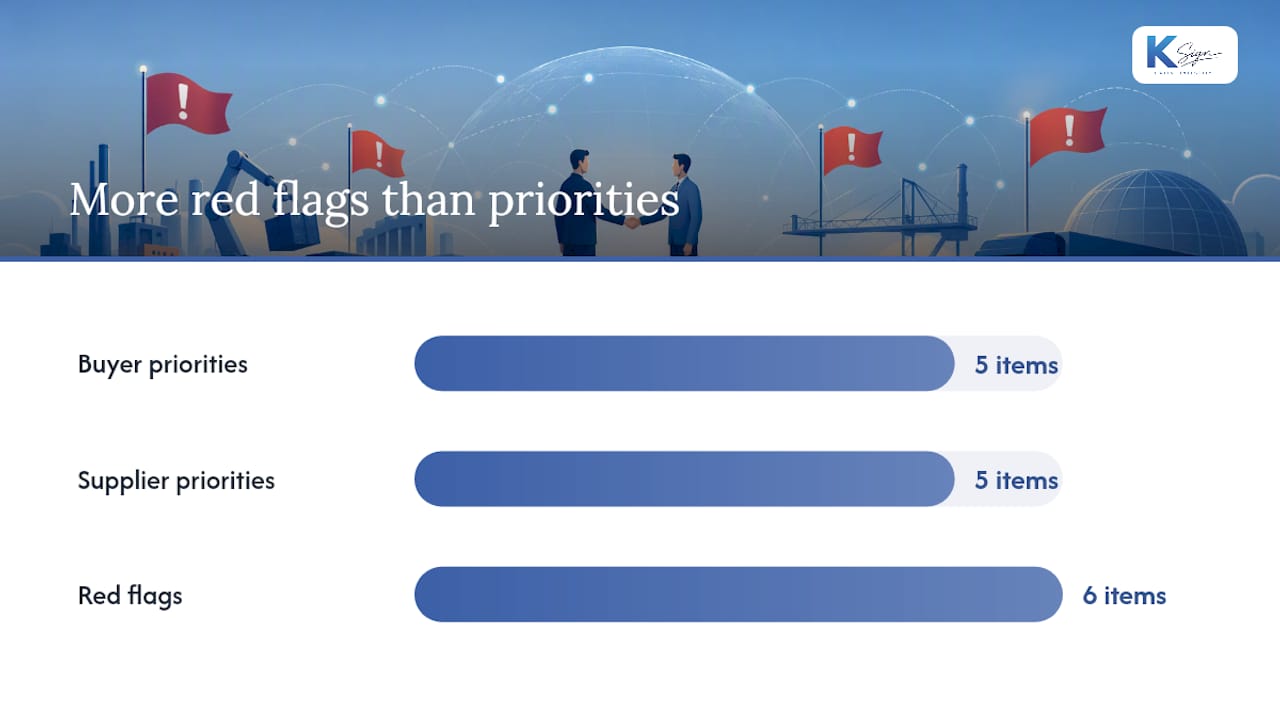
Buyer negotiation priorities:
- Insist on objective acceptance tests with defined pass/fail criteria — “satisfactory quality” is not a test.
- Secure audit rights with a reasonable notice period and the right to commission independent testing.
- Push for price protection: a cap on annual indexation and a minimum notice period for any price increase.
- Negotiate balanced termination rights — a buyer-only termination for convenience clause with no equivalent for the supplier creates dependency.
- Require PPSR-registered ROT clauses to be disclosed upfront so you can assess the supplier’s security position.
Supplier negotiation priorities:
- Lock in payment terms and late payment interest from the first draft — buyers routinely try to extend terms during negotiation.
- Limit open-ended liability: cap total liability at the contract value or the value of the relevant order, and exclude consequential loss.
- Include a retention of title clause and register it on the PPSR before the first delivery.
- Resist acceptance test criteria that give the buyer unlimited discretion to reject conforming goods.
- Secure a minimum order commitment or a take-or-pay obligation if you are investing in dedicated capacity.
Red flags for both sides:
- Vague specifications that reference “industry standard” without defining which standard or which edition.
- Unilateral variation rights — a clause allowing one party to change price, specs, or delivery terms without the other’s consent.
- Broad indemnities that cover loss caused by the indemnified party’s own negligence.
- Missing authority to sign: no evidence that the signatory is authorised to bind the entity.
- Payment terms that are unconscionable under the Competition and Consumer Act 2010 (Cth) or that breach the Payment Times Reporting Act 2020 (Cth) for large businesses.
- A governing law clause that selects a foreign jurisdiction without a clear commercial reason.
Pro Tip: Before the first negotiation meeting, prepare a one-page issues list ranking each clause as “must have,” “want,” or “tradeable.” This prevents you from conceding a must-have in the heat of negotiation and gives you a clear record of what was agreed and what was traded away.
For supply arrangements involving transport or logistics providers, the same negotiation discipline applies — you can see how signed service agreements protect both parties in a logistics context in this guide for transport companies.
Key takeaways
A supply agreement is only as strong as its weakest clause — the five items to check first are scope, price and GST, delivery and risk transfer, acceptance criteria, and remedies.
| Point | Details |
|---|---|
| Check five items first | Scope, price and GST, delivery and risk, acceptance criteria, and remedies must all be defined precisely before signing. |
| Use Australian templates | The Buying for Victoria one-off template and Procurement SA standard agreement are vetted, jurisdiction-correct starting points. |
| Eight elements for enforceability | Offer, acceptance, consideration, intention, certainty, capacity, genuine consent, and legality are all required under Australian law. |
| Electronic signatures are valid | Section 110A of the Corporations Act permits e-signing where the method identifies the signer and indicates intention; retain the full audit trail. |
| Ksign automates the workflow | Ksign’s form-to-contract, e-signature, and payment workflow replaces disconnected tools and creates a verifiable audit trail in one step. |
A practical perspective on when to accept contractual risk
There is a version of supply agreement advice that tells you to negotiate every clause to its theoretical maximum protection before you sign anything. In practice, that approach costs you relationships and delays supply. The real skill is knowing which risks are worth accepting and which require a hard line.
Termination rights are the most common trade-off. A supplier who is investing in dedicated stock or tooling for your business will resist a broad buyer termination for convenience clause — and that resistance is commercially reasonable. Accepting a longer notice period (say, 90 days rather than 30) in exchange for a committed supply arrangement is often the right call, provided you put operational controls in place to compensate: regular performance reviews, a clear escalation path, and a holdback or retention amount that gives you leverage if performance deteriorates.
The clauses where you should not trade are acceptance tests and audit rights. Vague acceptance criteria are the single most reliable predictor of a defect dispute. If a supplier will not agree to objective, measurable pass/fail criteria, that tells you something about their confidence in the product. Walk away from that negotiation, or at minimum, insist on a short initial trial order before committing to volume.
Clause libraries and guided authoring tools reduce the time your legal team spends on standard-form supply agreements, which frees them to focus on the genuinely novel risk in each transaction. The goal is not to eliminate legal review — it is to make legal review faster and more targeted. A well-maintained clause library means your lawyer is reviewing the 20% of clauses that are genuinely negotiated, not the 80% that are standard.
Ksign makes supply agreement workflows faster and more verifiable
Getting a supply agreement signed and a deposit collected should not require four separate tools and a chain of follow-up emails. Ksign brings the entire workflow into one place: guided form builder, contract automation from form responses, legally binding e-signatures, integrated payment collection, and a full audit trail stored against each executed agreement.
For a small business supplier onboarding a new buyer, the workflow is straightforward: the buyer completes a guided intake form, Ksign auto-generates the supply agreement with all variables populated, both parties sign electronically, and the deposit is collected before the document is archived. No PDFs emailed back and forth, no separate invoice link, no chasing signatures. For procurement teams managing standard-form supply arrangements at volume, Ksign’s contract management capabilities give you a central register of executed agreements, renewal alerts, and a searchable audit trail — without the complexity or cost of an enterprise system.
The same workflow applies to tradespeople taking job deposits, cleaning businesses confirming recurring service agreements, and construction suppliers managing variation approvals. If your business currently uses a mix of Word templates, email, and a separate payment link, Ksign replaces that stack with a single, mobile-friendly workflow. Start with a free trial at ksign.co and see how quickly a supply agreement can go from blank form to signed, paid, and stored.
Useful sources and model templates
The sources below are authoritative starting points for drafting, reviewing, or verifying supply agreements under Australian law.
Government templates:
- Key elements of a valid contract in Australian law | Sprintlaw
- Supplier agreement template: essential terms and tips | Sprintlaw
- Legal briefing — electronic signatures (AGS)
- Corporations Act 2001 (Cth) s110A — AustLII
- Agreement for the supply of goods, one‑off purchases — Buying for Victoria
- Standard goods and services agreement template — Procurement SA
- What to look for in a supply agreement | LegalVision
- Procurement contracts: types, clauses & management tips | Ivalua
- Supply contracts: key elements explained | LawTram
Commercial guidance and templates:
- LegalVision — What to look for in a supply agreement: Plain-language guidance covering payment, delivery, warranties, termination, and ACL implications. Useful for buyers and suppliers who want a practical checklist alongside a template.
- Sprintlaw — Key elements of a valid contract in Australian law: Authoritative explanation of the eight formation elements required for enforceability under Australian law.
- Sprintlaw — Supplier agreement template: essential terms and tips: Practical clause guidance covering specifications, delivery, inspection, remedies, and ACL alignment.
- LawTram — Supply contracts: key elements explained: Focused guidance on delivery and acceptance terms, risk transfer, and the PPSR implications of retention of title clauses.
Statutory references:
- Corporations Act 2001 (Cth), section 110A: The statutory basis for electronic execution by companies — identity, intention, and reliability tests.
- AGS Legal Briefing — Electronic signatures: The Australian Government Solicitor’s authoritative briefing on technology-neutral signing rules, evidence requirements, and practical guidance for electronic execution.
- Ivalua — Procurement contracts: types, clauses and management tips: Useful framing of procurement contracts as operational management tools, with guidance on SLAs, milestone payments, and contract governance.
A note on using these sources: Government templates are free and jurisdiction-correct, but they are designed for public procurement and may need adaptation for private commercial supply. Commercial provider templates are more flexible but vary in quality. For any agreement above low value or involving consumer supply, treat these sources as a starting point and have a lawyer confirm that the final document suits your specific transaction.
This article provides general information about supply agreements under Australian law. It is not legal advice. Confirm current statutory requirements and the suitability of any template for your specific transaction with a qualified Australian lawyer.