
Use a lease extension addendum when you only need to change the end date or a single minor term. Sign a new fixed-term lease when you want to reset multiple terms such as rent, bond, permitted use, or guarantor obligations. If neither party acts before the fixed term expires, the tenancy automatically continues as a periodic (month-to-month) agreement under the existing terms — which is lawful, but leaves both parties without the certainty of a fixed end date.
Three immediate next steps:
- Check the current lease for any option-to-renew clause, notice windows, and rent-review provisions before you draft anything.
- Decide whether terms are changing. A date-only change suits an addendum; multiple substantive changes suit a new agreement.
- Give written notice. Whatever you decide, confirm it in writing to create a verifiable record.
Table of Contents
- How do you extend a residential lease quickly and correctly?
- Addendum or new fixed-term lease — which one do you need?
- How to draft a simple lease extension addendum
- What are the official forms and rules in each state and territory?
- What timing and costs should you plan for when extending a lease?
- How do rent increases and bond adjustments work on extension?
- How do you sign, execute and store an extension safely?
- When should you get legal help or contact the tenancy tribunal?
- Key takeaways
- What experienced property managers know about lease renewals
- Ksign makes lease extension signing faster and more verifiable
- Official sources and templates — quick links for each state
How do you extend a residential lease quickly and correctly?
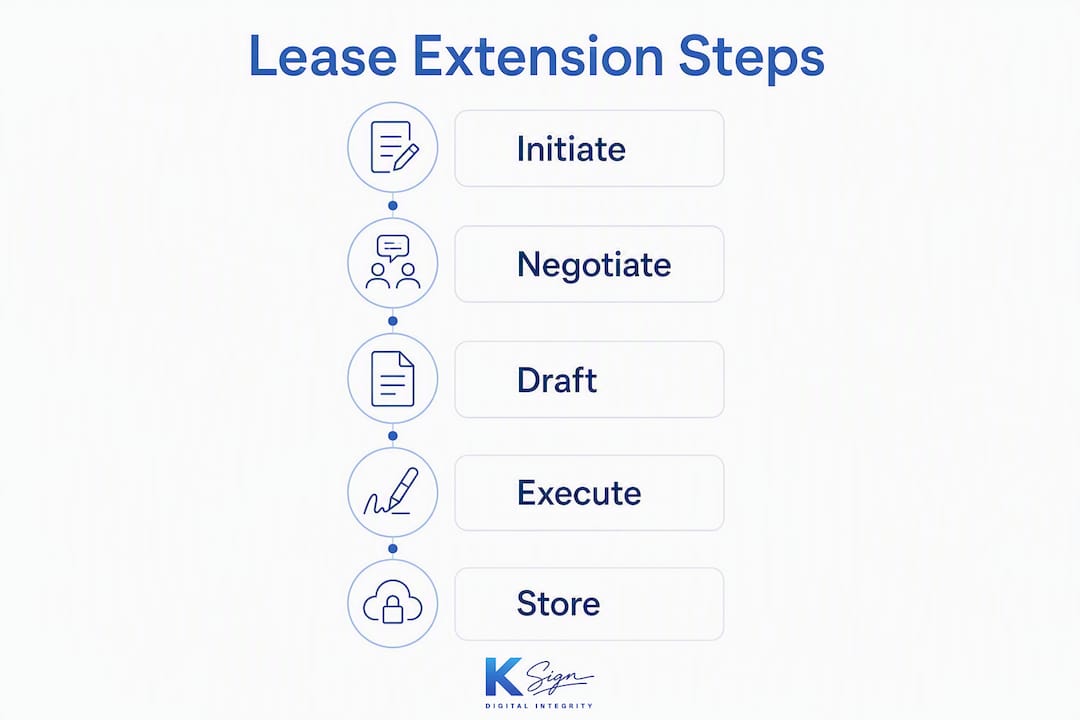
The fastest path to a valid extension follows four steps.
-
Review the existing lease. Locate the expiry date, any option clause, and any rent-review or notice-period provisions. Note whether a prescribed form is required in your state (South Australia, for example, has a Notice of Lease Extension form issued by Consumer and Business Services).
-
Choose your instrument. If only the end date changes, an addendum is faster and cheaper. If rent, bond, permitted use, or guarantor details are also changing, a fresh fixed-term agreement is cleaner and reduces ambiguity.
-
Prepare and send the document. Draft the addendum or new lease, attach any required prescribed forms, and send it to the other party with a clear deadline for signature. For a rent increase, the written notice must meet your state’s statutory notice period (commonly 60 days) before the new rent takes effect.
-
Execute and store. Both parties sign, each receives a copy, and the signed document is stored alongside the original lease with a clear audit trail.
Pro Tip: If the extension involves a guarantor, confirm whether the guarantor must re-execute the document. Under a simple addendum, existing guarantor obligations generally continue untouched. A new lease typically requires fresh guarantor signatures.
Addendum or new fixed-term lease — which one do you need?
A lease extension addendum keeps the original lease in force and amends only the specified terms, such as the end date. A renewal creates an entirely new contract, which may require fresh disclosures, new guarantor signatures, and in some cases registration. Choosing the wrong instrument does not necessarily void the arrangement, but it can create disputes about which terms apply.
| Dimension | Extension addendum | New fixed-term lease |
|---|---|---|
| When to use | Date-only or single-term change | Multiple term changes, new rent, new guarantor |
| Existing securities and guarantors | Continue unless expressly varied | Must re-execute; new obligations stated |
| Bond | Continues; top-up only if rent increases | Reset or recalculated at commencement |
| Disclosure obligations | Generally none triggered | May trigger disclosure requirements |
| Registration (long leases) | Usually not re-triggered | May be required depending on term length |
| Administrative effort | Low | Higher |
| Risk of ambiguity | Low if drafted carefully | Low if all terms are restated |
Sample addendum clause — new term:
Sample rent-review clause for a new lease:
Option-to-renew clauses must set clear, objective criteria for future rent increases; vague rights to set arbitrary rent can be unenforceable or found unfair under consumer law. A fixed percentage, CPI adjustment, or market review method each satisfy that objectivity test.
Pro Tip: When many clauses are changing, or when formalities like registration or lender consent are involved, a deed of variation or fresh lease is often the safer legal instrument. The addendum is not always the simpler choice once complexity rises.
How to draft a simple lease extension addendum
A well-drafted addendum needs six core elements. Each one carries legal weight, so precision matters.
- Parties and property. Full legal names of landlord and tenant, and the full address of the rental property.
- Reference to the original lease. State the original lease date and any prior amendments so the document chain is unambiguous.
- New start and end dates. Specify the exact commencement and expiry of the extended term.
- Rent and bond handling. State whether rent changes (and if so, the new amount and effective date), whether the bond continues unchanged, and whether a top-up is required.
- Savings clause. Confirm that all other terms of the original lease remain in full force.
- Execution block. Signature lines for each party, with printed name, date, and witness details where required by your state.
Filing and recordkeeping:
- Attach the signed addendum to the original lease and store both together.
- Provide the tenant with a copy of the signed addendum within the timeframe your state requires (check your state authority’s page for specifics).
- If the extension is documented on a prescribed form (as in South Australia), file it as directed by Consumer and Business Services.
A lease extension or renewal agreement template can document whether the extension is a fixed term or a periodic conversion, include rent review provisions, and address bond continuation or top-ups. Using a structured template reduces the risk of omitting a clause that later becomes a dispute point.
When to convert to a deed of variation: if you are changing more than two substantive clauses, altering guarantor obligations, or dealing with a registered lease, a deed of variation executed as a deed (with witnessing formalities) provides stronger legal standing than a simple addendum.

What are the official forms and rules in each state and territory?
State and territory rules differ on prescribed forms, notice periods, and bond handling. The table below summarises the key differences and links to the authoritative source for each jurisdiction.
| State/Territory | Automatic periodic rollover | Rent increase notice | Prescribed extension form | Official source |
|---|---|---|---|---|
| Queensland | Yes, if no new fixed term agreed | 2 months’ written notice | No prescribed form; written agreement required | RTA Queensland |
| Victoria | Yes, converts to periodic automatically | 60 days’ written notice | No prescribed form | Consumer Affairs Victoria |
| South Australia | Yes | 60 days’ written notice | Yes — CBS Notice of Lease Extension | Consumer and Business Services SA |
| New South Wales | Yes | 60 days’ written notice | No prescribed form; written agreement required | NSW Fair Trading / NCAT |
| Western Australia | Yes | 60 days’ written notice | No prescribed form | Consumer Protection WA |
| Tasmania | Yes | 60 days’ written notice | No prescribed form | Consumer, Building and Occupational Services |
| ACT | Yes | 60 days’ written notice | No prescribed form | ACT Civil and Administrative Tribunal |
| Northern Territory | Yes | 30 days’ written notice | No prescribed form | NT Consumer Affairs |
Practical pointer: Start renewal conversations 60–90 days before the lease expires. That window gives both parties time to negotiate, prepare documents, and meet statutory notice periods before the new rent date. Queensland’s Residential Tenancies Authority and Consumer Affairs Victoria both publish guidance on extending tenancies, and South Australia’s Consumer and Business Services provides a downloadable prescribed form. NSW Fair Trading is the first contact point for New South Wales tenants and landlords, with NCAT as the tribunal for disputes.
What timing and costs should you plan for when extending a lease?
Start lease renewal conversations 60–90 days before expiry and aim to finalise the signed document at least 30 days before the new rent date if a rent increase is involved. That buffer absorbs negotiation delays and ensures the statutory notice period is met.
Typical costs to budget for:
- Tribunal application fees: — if a dispute arises, VCAT, NCAT, and equivalent tribunals charge application fees that vary by jurisdiction and claim type.
The cost of getting the process wrong — a disputed rent increase, an unenforceable option clause, or a missed notice period — typically exceeds the cost of a brief legal review upfront.
How do rent increases and bond adjustments work on extension?
Under Australian residential tenancy legislation, rent increases must meet statutory notice periods (commonly 60 days) and generally cannot occur more than once every 12 months; failing to meet those requirements can invalidate the increase entirely at tribunal. The extension agreement itself can serve as the written rent-increase notice, provided it is delivered to the tenant the required number of days before the new rent takes effect.
Bond handling on extension follows a straightforward rule in most states: the bond continues and is not forfeited or reset simply because a new fixed term begins. A top-up is lawful only where the rent has increased, and only to bring the bond into line with the new rent level (typically calculated as a set number of weeks’ rent under each state’s legislation). Record the current bond amount in the addendum, state whether a top-up is required, specify the top-up amount, and confirm how it will be paid and lodged with the relevant bond authority.
Pro Tip: Avoid vague rent-increase language in option clauses such as “rent to be agreed by the parties.” If the parties cannot agree, that clause may be unenforceable. Use a fixed percentage, a CPI formula, or a market review method with a clear valuation process instead.
How do you sign, execute and store an extension safely?
Properly executed electronic signatures are generally valid in Australia where intention and consent are clear, supported by the Electronic Transactions Act 1999 (Cth) and equivalent state legislation. The key requirements are that the signatory intended to sign, consented to the electronic method, and that the signature is reliably linked to the document. For standard residential lease extensions, e-signatures satisfy these requirements in most circumstances.
A practical signing and storage workflow:
- Generate the addendum or new lease from a template, confirming all fields are complete.
- Send the document to each party via a platform that captures timestamps, IP addresses, and signer email addresses as part of the audit trail.
- Collect signatures in the correct order (landlord, then tenant, or as required by your state).
- Where a witness is required (for a deed or in certain states), confirm the witnessing formalities are met before finalising.
- Store the fully executed document alongside the original lease in a secure, searchable location, with the audit trail attached.
Digitising your property management agreement signing removes the friction of chasing paper copies and creates an indisputable record if a dispute arises later.
Execution edge cases: Guarantors, deeds, and registered leases carry additional formalities. A guarantor signing electronically may be valid, but some lenders and courts expect wet-ink signatures on guarantee documents. Seek legal advice before relying solely on an e-signature for these instruments.
Pro Tip: An e-signature platform with audit trails captures the timestamp, device, and IP address of each signing event. That metadata is your evidence of intent and consent — far more defensible than a scanned PDF with no signing record.
When should you get legal help or contact the tenancy tribunal?
Not every extension is straightforward. Certain situations carry enough legal risk that professional advice or tribunal intervention is the prudent path.
Seek legal advice when:
- A rent increase is contested and the parties cannot agree on a market review method.
- Guarantor obligations are unclear or the guarantor disputes their continuing liability.
- The lease requires registration (typically leases over three years) or lender consent before extension.
- A make-good or reinstatement dispute is unresolved at the time of renewal.
- The option-to-renew clause contains ambiguous rent-setting language.
Contact the relevant tenancy tribunal when a dispute cannot be resolved between the parties. VCAT (Victoria), NCAT (New South Wales), and equivalent bodies in each state handle disputes about agreement formation, unlawful rent increases, bond disagreements, and failure to extend on agreed terms. Applications are generally made online through each tribunal’s website; VCAT’s residential tenancies portal is a useful starting point for Victorian matters.
When attending a tribunal, bring the original lease, all correspondence about the proposed extension, the draft or signed addendum, and any rent-increase notices. A clear document trail is the single most persuasive thing you can present.
Pro Tip: Many tenancy disputes that reach tribunal could have been avoided with a single written record of what was agreed. Even an informal email exchange confirming the new end date and rent amount creates a verifiable record. Make it a habit to confirm every verbal agreement in writing within 24 hours.
Key takeaways
A lease extension addendum is the right instrument when only the end date or a single minor term changes; a new fixed-term lease is the right choice when multiple terms, guarantors, or registration requirements are involved.
| Point | Details |
|---|---|
| Addendum vs new lease | Use an addendum for date-only changes; use a new fixed-term lease when rent, bond, or guarantor terms are also changing. |
| Start early | Begin renewal conversations 60–90 days before expiry to meet statutory notice periods and avoid a lapse into periodic tenancy. |
| Rent increase notice | The extension agreement can serve as the rent-increase notice if delivered to the tenant at least 60 days before the new rent takes effect. |
| Bond on extension | Bond generally continues; a top-up is only lawful to reflect a higher rent, and must be lodged with the relevant state bond authority. |
| Ksign for signing and storage | Ksign’s contract automation and audit-trail features let property managers generate addenda from templates, collect e-signatures, and store signed records in one workflow. |
What experienced property managers know about lease renewals
The paperwork is the easy part. What actually determines whether a tenant renews is how they felt about the tenancy in the months before the conversation started. Landlord success in securing renewals is influenced more by tenant experience — particularly maintenance responsiveness — than by the renewal paperwork itself. A tenant who waited three weeks for a leaking tap to be fixed is already mentally preparing to move.
That insight changes how you approach the negotiation. Rather than opening with a rent increase and waiting for a response, consider offering two options in writing: a 12-month extension at market rent, and a 6-month extension at a smaller increase. Giving the tenant a genuine choice signals respect and often produces a faster decision. Document any agreed concession — a delayed rent increase, a landlord-funded repair — in the addendum itself, not just in an email.
Recordkeeping discipline separates smooth renewals from last-minute disputes. Keep a single folder (physical or digital) for each tenancy containing the original lease, all signed addenda, rent-increase notices, bond lodgement receipts, and correspondence. When renewal time arrives, you have everything you need in one place, and so does your tenant if they ask for copies. That transparency builds the kind of trust that makes a tenant sign the extension without hesitation.
Ksign makes lease extension signing faster and more verifiable
Property managers and landlords who handle more than a handful of renewals each year know the real cost is not the legal drafting — it is the back-and-forth of chasing signatures, confirming receipt, and filing documents in a way you can actually find later.
Ksign’s contract automation lets you build a lease extension template once, populate it from a guided form, and send it for legally binding e-signature in minutes. Every signing event is captured with a timestamp, IP address, and signer identity, creating an audit trail that holds up if a dispute reaches VCAT or NCAT. Bond top-up payments can be collected in the same workflow using Ksign’s integrated payments, removing the need for a separate bank transfer and a separate receipt.

For property managers renewing multiple leases, high-volume templates mean the same compliant document goes to every tenant without manual reformatting. Start a free trial at ksign.co and see how much admin you can remove from your next renewal cycle.
Official sources and templates — quick links for each state
Use these authoritative sources to download prescribed forms, check current notice periods, and access tribunal contacts for your jurisdiction.
- Extending a tenancy — Residential Tenancies Authority (Queensland)
- Renewing a rental agreement — Consumer Affairs Victoria
- Residential rental agreements — Consumer Affairs Victoria
- Notice of Lease Extension (prescribed form) — Consumer and Business Services SA
- Lease agreements — SA.gov.au
- What to do at the end of the lease — NSW Small Business Commission
- Apply for residential tenancies — VCAT (Victoria)
- Residential Tenancies Act 1997 — legislation.vic.gov.au
- Lease extension / renewal agreement template — Forms Legal (Australia)
- Lease extension agreements: essential guide — Sprintlaw
This article provides general information about lease extension processes in Australia. It is not legal advice. Confirm current rules with the relevant state authority or a qualified property lawyer before executing any tenancy document.