
The quickest route to a usable photography contract is an editable Word template or a guided contract generator, not a blank page. Download a base document built for your shoot type, then customise the clauses for your pricing, your state, and the way you actually work. The sections below cover which template to start from, the clauses that make it enforceable, and a workflow that gets it signed and deposited without chasing anyone.
TL;DR:
- Use targeted template types for each shoot, such as wedding, portrait, commercial, or event, to ensure relevant clauses are included.
- Highlight key clauses like scope, payment, licensing, and cancellation upfront to prevent misunderstandings and disputes.
- Customize templates by removing unmanageable promises, adjusting licensing language, and confirming legal details for your location and practice.
- Collect signatures and deposits simultaneously through electronic workflows to reduce cancellations and streamline the booking process.
- Implement an automated contract and payment system that fills in client details from a booking form, saving time and reducing errors.
Table of Contents
- Which photography contract template should you download?
- What should a photography contract include?
- How do you customise a template so it holds up?
- What’s the right sequence for signing, delivery, and payment?
- Copy-ready clause snippets and a quick checklist
- How a form-driven workflow speeds up customising and signing
- Keep the contract clear, not clever
- Build the contract once, then let it fill itself in
- Sources
- FAQ
Which photography contract template should you download?
Not every shoot needs the same document. A wedding contract carries backup-photographer and rescheduling language that a headshot session never touches, while a commercial shoot needs licensing terms a family portrait session doesn’t.
The main template types worth knowing:
- Wedding photography contract template — covers timelines, multiple locations, backup coverage, and often a payment schedule tied to milestones rather than one lump sum.
- Portrait or family session agreement — shorter, focused on personal usage rights and simple delivery terms.
- Commercial or branding shoot contract — built around licensing fees, usage duration, and territory, since the client is paying to use the images, not just to own them.
- Event photography agreement — hourly or block-time structure, with clauses on overtime and access restrictions.
- Model release — a standalone document, separate from the main agreement, authorising use of a person’s likeness.
On format: a Word document is best when you expect to rewrite whole clauses for each client. A fillable PDF works well once your terms are stable and you only need to swap names, dates, and fees. A contract generator suits photographers who want guided prompts that populate the right clauses automatically, which LegalTemplates and ProShoot both offer as free starting points. If you’re shooting a commercial campaign, skip the generic services agreement and go straight to a licensing-specific template. The usage terms are different enough that bolting them onto a standard contract usually leaves gaps.
What should a photography contract include?
Every photography contract needs to answer seven questions: who, what, when, how much, who owns it, what happens if it falls through, and who’s liable if something goes wrong. According to Pixieset’s clause breakdown, the essentials are the parties’ full legal names, a detailed scope of work, payment terms, deliverables, copyright and usage rights, model releases, and signatures from both sides.
Here’s how that breaks down in practice:
- Parties, scope, dates, and location — full legal names, the exact date, start and finish times, and every venue involved.
- Deliverables and turnaround — the number of edited images, file formats, whether prints or an album are included, and how many revision rounds the client gets.
- Payment terms — the total fee, deposit amount, payment schedule, refund conditions, and any late fee for outstanding balances.
- Copyright and licensing — who owns the images (usually the photographer, per the U.S. Copyright Office) and whether the client’s licence is personal use only or extends to commercial use, priced separately.
- Model release and privacy — consent for using images in a portfolio or on social media, with tighter language for sensitive shoots or images involving minors.
- Cancellation and rescheduling — notice periods, refund tiers, and a backup-photographer clause for weddings covering illness or emergencies.
- Liability, indemnity, and dispute resolution — a cap on damages, confirmation of insurance where relevant, and how disputes get resolved before anyone considers legal action.
Pro Tip: Don’t bury the cancellation and licensing clauses at the bottom in fine print. Clients skim contracts, and the two sections most likely to cause a dispute later are usage rights and refund terms. Put them where they’ll actually get read.
How do you customise a template so it holds up?
A downloaded template is a starting point, not a finished contract. SLR Lounge notes that generic templates often carry clauses that don’t match how a particular studio actually operates, and an unenforced or contradictory clause can undermine the rest of the document if a dispute goes to review.
Work through these before you send anything to a client:
- Strip out equipment lists or “guaranteed shot” promises you can’t reliably deliver. Naming specific gear or poses in writing creates a commitment you may not be able to keep on the day.
- Set your retainer percentage and cancellation window to match your actual season. A wedding photographer booked out 18 months ahead needs stricter refund terms than a portrait photographer with open weekly slots.
- Spell out licensing in plain terms. State whether the client gets personal use only, and put a separate dollar figure next to any commercial usage rights.
- Adjust model release wording for shoots involving minors, requiring a parent or guardian signature rather than the subject’s own.
- Check the governing law and severability clauses actually name your state, so the contract doesn’t default to boilerplate that doesn’t apply to you.
- For high-value commercial licensing deals, get a lawyer to review the usage and indemnity clauses before signing. A template gets you close, but licensing disputes get expensive fast.
What’s the right sequence for signing, delivery, and payment?
The order matters more than most photographers assume. Enquiry leads to a quote, the quote leads to a signed contract and deposit, then the shoot happens, followed by delivery and the final payment. Skip the deposit step and you’re exposed to no-shows; skip the delivery clause and you’re exposed to endless revision requests.
Retainers in the industry commonly sit at 25% to 50% of the total fee to reserve a date, and that deposit is usually made non-refundable inside a defined cancellation window, protecting the income you’ve already turned away other bookings to hold. A backup-photographer clause is standard for weddings, covering illness or emergencies without leaving the client stranded.
- Collect the signature and deposit at the same moment, using e-signature tools rather than emailing a PDF back and forth.
- State the delivery timeline in the contract itself: how many proofs, how many retouching rounds, and the final file handover date.
- Tie the final payment to delivery, not to a vague “when convenient” clause.
Pro Tip: Collecting payment at the point of signing, rather than as a separate step afterwards, is one of the simplest ways to cut down on last-minute cancellations.
Copy-ready clause snippets and a quick checklist
You don’t need to write these from scratch. Adapt short, direct phrasing and check it against a compact list before you send the final document.
Sample lines you can drop straight into a draft:
- Scope: “Photographer will provide up to [X] hours of photography coverage at [location] on [date].”
- Deposit: “A retainer of [X]% is due upon signing to secure the booking and is non-refundable within [X] days of the event.”
- Delivery: “Edited images will be delivered within [X] business days via online gallery, including up to [X] rounds of revisions.”
- Licence: “Client is granted a personal-use licence to reproduce and share delivered images; commercial use requires a separate licensing fee.”
- Model release: “Client authorises Photographer to use images for portfolio, marketing, and promotional purposes unless otherwise noted in writing.”
- Cancellation: “Either party may cancel with [X] days’ notice; deposits paid within the cancellation window are non-refundable.”
- Liability: “Photographer’s liability is limited to the total fee paid under this agreement.”
Before sending, run through this checklist: full names, confirmed date and location, deposit amount and due date, delivery timeline, licence type, and signature lines for both parties. Sample contract libraries such as PPA’s collection are worth comparing your draft against.
Keep signed copies organised with a clear naming convention. A file labelled “ClientName_Project_Contract_v1_signed.pdf” is far easier to locate during a dispute than one buried in an inbox thread from eight months ago.
How a form-driven workflow speeds up customising and signing
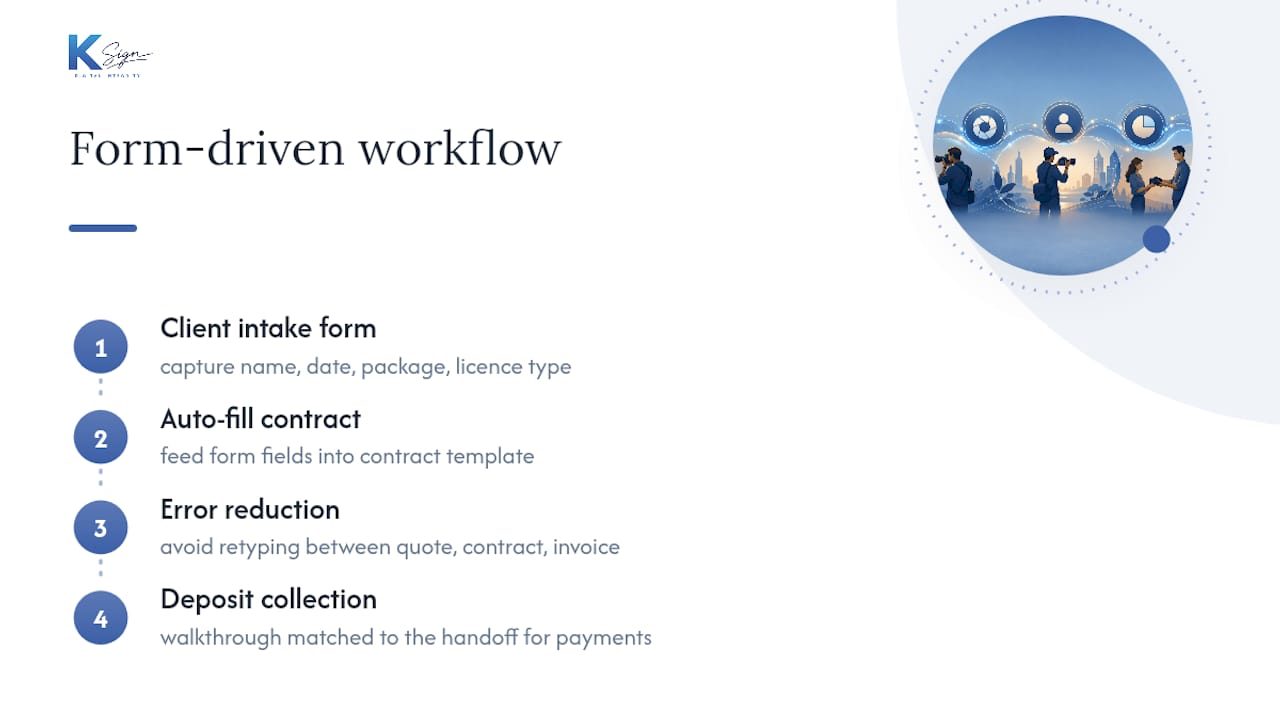
A booking form that captures the client’s name, event date, package, and licence type can feed straight into a contract template, filling in the fields automatically instead of retyping them each time. That cuts the errors that creep in when details get copied by hand between a quote, a contract, and an invoice. Fields worth including on the intake form: full names, shoot date and location, deliverables, and personal versus commercial licence type, matched against a deposit collection walkthrough built for exactly this handoff.
Keep the contract clear, not clever
Plain-language clauses get signed faster than dense legal phrasing, because clients actually read and understand what they’re agreeing to. The goal is protection without alienating the person paying you. Keep the clauses that matter (deposits, licensing, cancellation) and cut the boilerplate that only exists to sound official. For high-value commercial licensing, still get a lawyer’s eyes on it. A template gets most photographers most of the way there, but it’s not a substitute for legal advice when real money is on the line.
— Josh
Build the contract once, then let it fill itself in
Downloading a template solves the first problem. The second problem is doing it again for every client, retyping the same names, dates, and fees into a fresh document each time. Some platforms are built around that gap: a booking form can feed straight into an auto-generated contract, the client signs electronically, and the deposit gets collected in the same step, with a stored audit trail so you’re not digging through email threads later.

For photographers, that means one guided form replaces the quote, the contract draft, and the payment link you’d otherwise send separately. Contract automation turns your intake questions into a populated agreement automatically, and payment collection sits inside the same signing step rather than as a follow-up invoice. If you want to see how the form-to-signature flow works for your own booking process, start with the e-signature workflow and build your first contract template from there.
Sources
- 12 essential things to include in your photography contract - Pixieset Blog
- Copyright basics for photographers - U.S. Copyright Office
- Free Photography Contract Templates (3) - eForms
- Photography contract template (SLR Lounge)
FAQ
What should a photography contract include?
At minimum, both parties’ legal names, scope of work, payment and deposit terms, deliverables with a turnaround date, copyright and licensing terms, model release language, and signatures, per Pixieset’s breakdown.
What is the 20 60 20 rule in photography?
Definitions vary across the industry, and this isn’t a standard contract or business term covered by established photography sources, so it’s best not to rely on a single fixed meaning without checking the specific source using it.
How much should you charge for 3 hours of photography?
Pricing depends heavily on location, experience, and shoot type, so there’s no single industry figure. It’s better to build a quote from your own deliverables, editing time, and licensing terms than to anchor to a flat hourly rate.
Is $4,500 a lot for a wedding photographer?
It depends entirely on the market, the photographer’s experience, and what’s included (hours, prints, albums, second shooter). A contract that clearly itemises deliverables and licensing terms matters more to the client’s sense of value than the number alone.
What’s the best way to collect a deposit when sending a contract?
Collecting the signature and the deposit in the same step, using e-signature and payment tools together, reduces no-shows compared to sending a contract and a separate payment link.