
Require a booking deposit or retainer, backed by a signed contract, before you mark a date as confirmed. No signature and no payment means no date. This single rule protects your calendar from casual enquiries that turn into last-minute cancellations, and it filters out clients who are not genuinely committed.
As a rule of thumb:
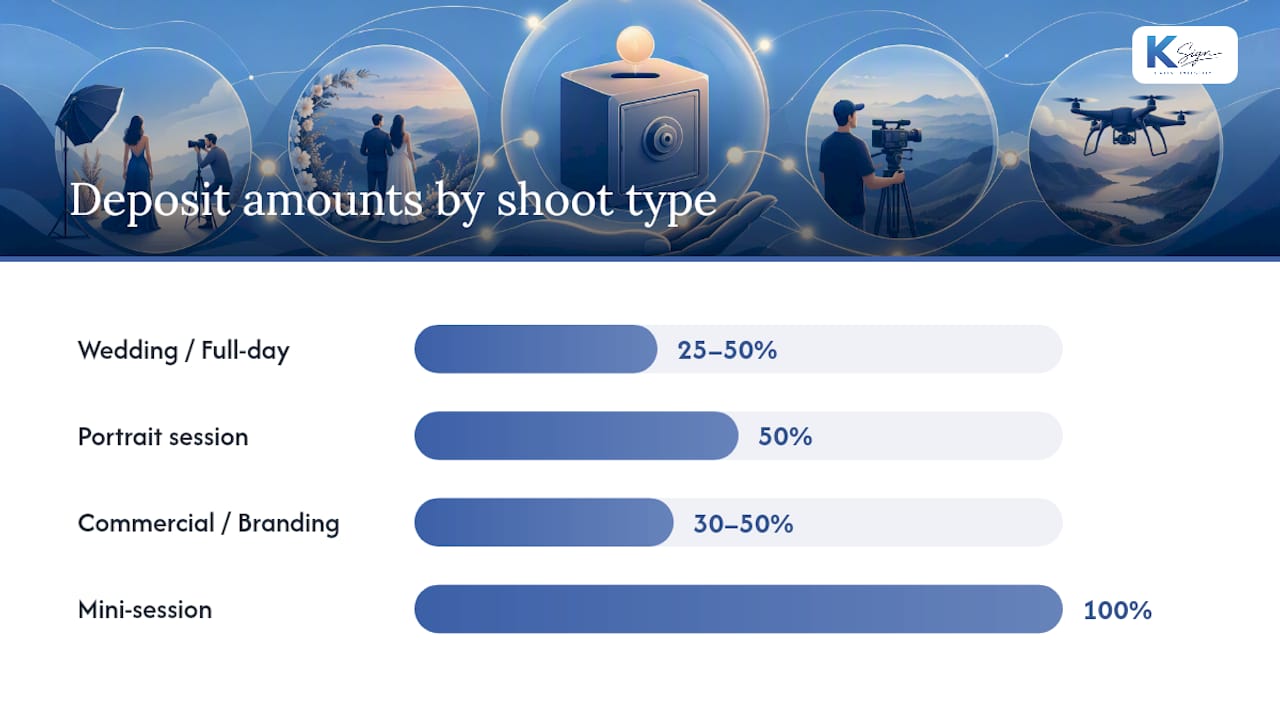
- Weddings and full-day events: 25–50% of the total fee at booking, per LegalClarity’s photography invoicing guidance
- Portrait sessions: often a booking fee around half the total, sometimes a flat retainer
- Mini-sessions and low-price bookings: full prepayment is commonly required
Whatever figure you land on, tie it to a signed contract. A verbal agreement or an unsigned quote is not a booking. It’s a placeholder someone else can still take.
Key Takeaways
Requiring a signed contract and a deposit at the same moment is what actually makes a booking enforceable, not the deposit amount alone.
| Point | Details |
|---|---|
| No deposit, no date | Confirm a booking only once both a signature and payment have been received. |
| Match deposit to shoot type | Charge 25–50% for weddings, 50% for portraits, and full prepayment for mini-sessions. |
| Define refundability precisely | Use one plain sentence stating whether the retainer is refundable, transferable, or forfeited. |
| Gate delivery until paid | Hold final galleries and high-resolution files until the balance clears. |
| Collapse the workflow into one step | Platforms like Ksign combine form, contract, signature, and deposit payment into a single flow. |
Table of Contents
- Why deposit collection matters for photographers protecting bookings
- Setting deposit amounts and refund rules by shoot type
- What payment methods work best for collecting photography deposits
- How should you record deposits on invoices and contracts
- How do you handle cancellations and refund requests fairly
- A step-by-step checklist for setting up deposit collection
- How a form-to-payment workflow removes the back-and-forth
- Editorial take: why the workflow matters more than the policy
- Get deposit collection working without juggling five tools
- Sources
Why deposit collection matters for photographers protecting bookings
A booked wedding date is perishable inventory. Once a Saturday in October is gone, you cannot resell it retroactively if the client cancels three weeks out. Understanding how deposit collection works for photographers starts with this reality: every unpaid hold on your calendar carries an opportunity cost, because you’re turning away other enquiries for a date that might evaporate.
Deposits filter for commitment. Photographers who keep a strict “no deposit, no date” policy report fewer no-shows and far fewer last-minute cancellations, according to Lydia Anne Photography’s wedding-payment guide, because clients who pay upfront have skin in the game.
Deposits also solve a cashflow problem most photographers underestimate:
- Covering second-shooter or assistant fees booked in advance
- Paying for gear hire, travel, or accommodation tied to that date
- Funding editing software subscriptions or album production costs before the final invoice lands
Setting deposit amounts and refund rules by shoot type
Deposit, retainer, and booking fee sound interchangeable in conversation, but they are not the same thing legally. A retainer typically reserves your availability and is often non-refundable, while a deposit can imply a partial refund depending on how your contract defines it, per The Law Tog’s breakdown of the terminology. Pick one term, define it precisely in your contract, and use it consistently across every invoice and email.
| Shoot type | Typical amount | Refundability |
|---|---|---|
| Wedding or full-day event | 25–50% of total fee | Usually non-refundable retainer |
| Portrait session | 50% booking fee | Non-refundable, transferable within a window |
| Commercial or branding shoot | 30–50%, scaled to project size | Negotiated per contract |
| Mini-session | 100% prepayment | Non-refundable |
Flat retainers work well for lower-priced sessions where the admin of calculating percentages isn’t worth it. Percentage-based deposits scale naturally as your pricing grows, which suits wedding and commercial photographers with variable package sizes.
Pro Tip: Write your refund clause in one plain sentence the client can understand in five seconds, such as “This retainer is non-refundable but transferable to a new date within 60 days of cancellation.” Complex legal phrasing reduces the chance a client actually reads it before signing.
What payment methods work best for collecting photography deposits
Card processors and digital wallets like Stripe and PayPal give you instant payment confirmation and let clients pay however suits them, though The Honcho’s guide to accepting online payments notes that bank transfers and cheques take longer to clear and demand tighter manual tracking.
Collecting the deposit inside your booking flow, rather than sending a separate invoice days later, closes the gap between enquiry and confirmed date. A platform that combines contract signing with payment in one step means the client can’t sign without paying, and can’t pay without agreeing to your terms.
If you do accept cash or cheque:
- Issue a numbered receipt immediately, not “later that week”
- Log the transaction in your accounting software the same day
- Deposit cash daily rather than letting it sit in a drawer
Watch processor rules closely. Some gateways restrict surcharging on debit cards, apply different fee tiers to international cards, and handle chargebacks in ways that can leave you exposed if your contract terms weren’t crystal clear at the point of payment. A payment processing guide for contractors is worth a read if you’re weighing processors for the first time, since the fee structures vary more than most photographers expect.
How should you record deposits on invoices and contracts
Send the deposit invoice at the same time as the contract, not after. This is where the collect booking deposit from photography clients process either builds trust or creates confusion.
- Label the invoice clearly, such as “Deposit — Invoice 1 of 2,” so both parties can track what’s been paid and what’s outstanding, a practice InvoiceBloom recommends for sequential billing.
- Spell out the deposit amount, refundability, and reschedule policy in the contract itself, not just the invoice.
- Set a clear balance due date, typically before the shoot or before final delivery.
- State that final, high-resolution files are held until the balance clears.
- Keep the whole thing on one page where possible. Practitioners who bundle booking details, the deposit line item, and a single-sentence cancellation clause into one template find clients read and sign faster, since complexity reduces acceptance rates.
Pro Tip: Gate your online gallery the same way you gate final files. If a client can preview low-res proofs but can’t download or print until the balance clears, you rarely need to chase a late payment twice.
How do you handle cancellations and refund requests fairly
Three models cover most situations: a non-refundable retainer, a transferable credit, or a prorated refund scaled to notice given. Each has trade-offs.
- Non-refundable retainer protects high-demand dates outright but can feel harsh to clients cancelling for genuine emergencies.
- Transferable credit within a 30 to 60 day window balances fairness with protection, letting a client reschedule without losing money outright.
- Prorated refund works for photographers with flexible calendars but adds admin and invites negotiation.
A common rule: reschedules inside 30 to 60 days of the shoot are free, cancellations inside 14 to 30 days forfeit the retainer entirely. Automated reminders about these deadlines, sent a week before each cutoff, cut down on disputes because nobody can claim they weren’t told.
A step-by-step checklist for setting up deposit collection
- Decide your deposit amount and refund policy, then write it down in one sentence.
- Update your contract and invoice templates to reflect that exact wording.
- Connect a payment method, card processor or embedded payment tool, directly into your booking flow.
- Require signature and payment together to confirm any date, then automate a reminder sequence for balances due.
- Gate final gallery delivery until the balance clears, and log every transaction the same day it happens.
Pro Tip: Test your own booking flow as if you were a client. If it takes more than two minutes to read the contract, sign it, and pay the deposit, clients will abandon it halfway through.
How a form-to-payment workflow removes the back-and-forth
Most of the friction in deposit collection comes from switching tools: a form here, a PDF contract there, a separate invoice link sent by email three days later. A single guided workflow removes that gap. The client fills in a form with their shoot details, that form generates the correct contract automatically, they sign it electronically, and the deposit is collected in the same flow.
When signature and payment happen in one uninterrupted step, you get a signed agreement, an instant payment confirmation, and a full audit trail without opening five different apps.
Ksign builds this exact sequence for small service businesses, including photographers, through contract automation that turns form answers straight into a bookable agreement. Look for these capabilities in any platform you consider:
- Industry-relevant contract templates you can adapt quickly
- Embedded payment collection at the signing step, not a separate link
- A stored audit trail for every signed agreement
- Mobile-first design, since most clients sign from their phone
Editorial take: why the workflow matters more than the policy
Most advice on this topic focuses entirely on the numbers: what percentage to charge, when it’s refundable, how many days before the wedding the balance is due. That’s the easy part. Photographers usually already know their preferred deposit amount. What trips them up is enforcement, because a policy that lives in a Word document nobody reads isn’t a policy at all.
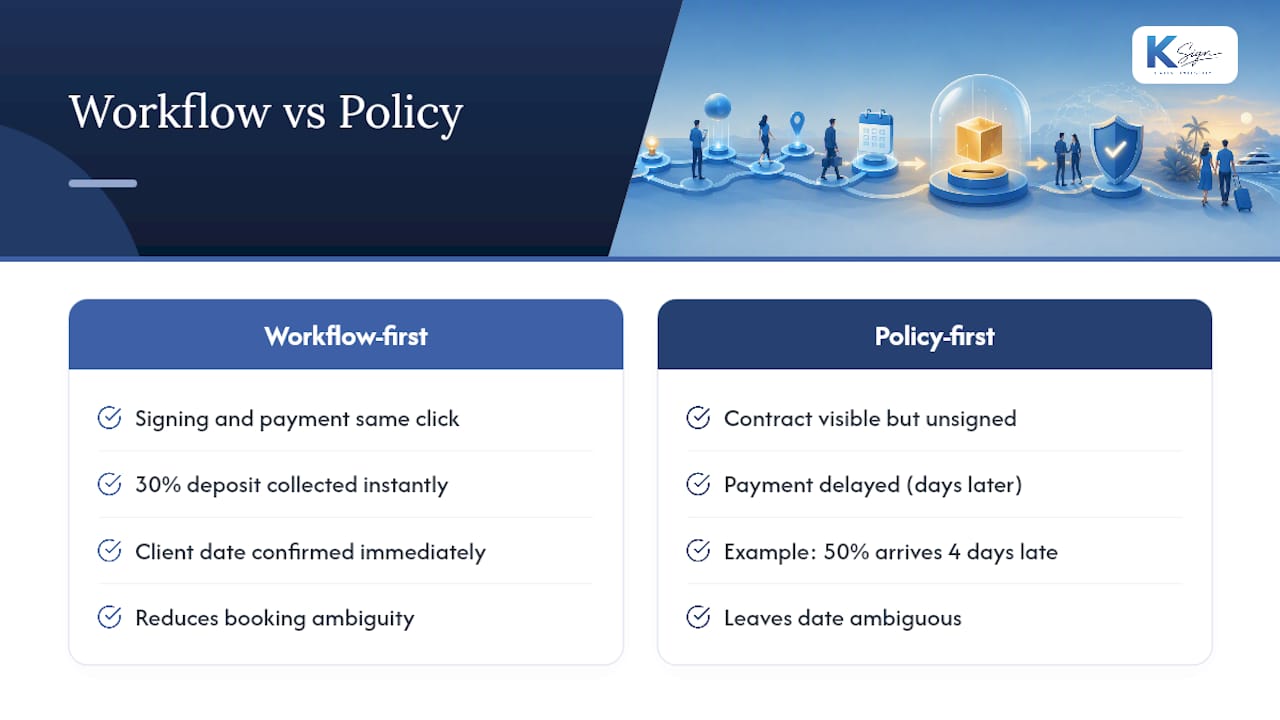
The overlooked issue is sequencing. If a client can view your contract, delay signing it, and still hold the date in their head as “booked,” you’ve created ambiguity that benefits nobody. The fix isn’t a stricter policy. It’s removing the gap between agreeing to terms and paying for them, so the two happen in the same click.
Prioritise your workflow before you tinker further with your percentages. A 30% deposit collected instantly, tied to a signature, beats a 50% deposit that arrives four days late because the client had to find their cheque book.
— Josh
Get deposit collection working without juggling five tools
Chasing signatures in one inbox and payment links in another is exactly the friction this article has been describing. Ksign puts the whole sequence, form, contract, signature, and deposit, into a single mobile-friendly flow, so a client can’t confirm a booking without paying for it.

Rather than exporting a PDF contract and sending a separate invoice through your accounting software, you build one guided form that generates the right agreement automatically and collects the deposit through embedded payments at the moment of signing. For photographers running weddings, portraits, or mini-sessions side by side, that means one template per shoot type instead of three disconnected systems to maintain. Explore the product overview to see how form-to-payment workflows are built, or start setting up your first contract template today.
Sources
- Why photographers should require a deposit or retainer — The Law Tog
- How photographers take deposits and send contracts online — ROXO Hub
- How to invoice for photography — InvoiceBloom
- How to accept online payments as a photographer — The Honcho