
A substantial completion certificate records the date a project became fit for its intended use, and that single date carries real legal weight. It shifts operational responsibility to the owner, starts the warranty clock, and usually triggers the release of retained funds. The owner, contractor, and architect or engineer typically sign it, and standard forms like AIA G704 or ConsensusDocs 280 give the document its enforceability.
TL;DR:
- The certificate of substantial completion usually triggers the start of warranties, release of retainage, and shift in operational responsibility, making its accuracy critical.
- The joint inspection process must involve all key parties, with clear acknowledgment of the completion date, scope, and outstanding items, to prevent future disputes.
- Essential fields in the certificate include project details, scope, date, occupancy statement, punch list reference, and signatures; incomplete forms are often challenged legally.
- The substantial completion date influences lien deadlines, claim periods, and project schedules, so it must be documented carefully and communicated promptly.
- Digital workflows with electronic signatures streamline closeout, reduce errors, and provide a tamper-proof record, helping avoid delays and legal challenges.
Table of Contents
- What is a certificate of substantial completion?
- Who initiates, inspects, and signs the certificate?
- What fields belong in the certificate?
- How does the certificate affect payments and warranties?
- How do you prepare and issue the certificate step by step?
- Where do you find recognised certificate templates?
- How do digital workflows reduce closeout errors?
- What legal disputes can arise from the certificate?
- How does the certificate affect deadlines and time extensions?
- Do substantial completion rules differ by contract or jurisdiction?
- Does the certificate trigger lien or claims deadlines?
- Practitioner perspective: the mistakes that cause the most damage
- How KSign helps you close out a project without chasing paperwork
- Sources
- FAQ
What is a certificate of substantial completion?
Substantial completion means the work is finished enough for the owner to occupy or use the project for its intended purpose, even if minor items remain outstanding. Industry guidance and state-issued forms frame it exactly this way: the building or facility functions, even while a punch list of small corrections sits unresolved.
This is not the same as final completion. Final completion happens once every outstanding item, including punch list work, is finished and the project is closed out entirely. Substantial completion is the milestone that lets the owner move in, start operating, or begin the next phase, while final completion is the administrative full stop.
Owners rely on the certificate to justify occupancy and insurance transitions. Contractors rely on it to trigger payment and warranty timing. Architects and engineers rely on it as the professional record that the design intent has been met. Skipping this step, or handling it loosely, tends to be where closeout disputes start.
Who initiates, inspects, and signs the certificate?
The contractor usually starts the process by requesting a substantial completion inspection once the work looks ready. In design-bid-build arrangements, the architect or engineer typically issues the notice and coordinates the walkthrough; on design-build or owner-managed jobs, the owner’s representative may lead it instead.
A joint inspection follows, and it should involve:
- The contractor or site superintendent
- The owner or the owner’s designated representative
- The architect or engineer of record
- Any relevant subcontractors for specialised systems
All three primary parties, owner, contractor, and architect or engineer, need to acknowledge the date and the outstanding items for the certificate to hold up. When there’s disagreement about whether the work has actually reached that threshold, the contract’s dispute resolution clause governs, and many agreements specify a period for the architect to make a binding determination. Document every point of disagreement in writing at the time it arises. Verbal assurances about “it’s basically done” rarely survive a payment dispute later.
What fields belong in the certificate?
A certificate that skips a required field is a certificate that gets challenged. The essential fields are:
- Project title and location
- The designated portion of work covered (whole project or a defined area)
- Date of substantial completion
- A statement permitting the owner’s use or occupancy from that date
- Reference to the attached punch list
- Signature blocks and dates for owner, contractor, and architect/engineer
Beyond the core form, a complete closeout package usually attaches:
- The punch list itself, itemised and dated
- Operation and maintenance (O&M) manuals for installed systems
- Warranty documents and start dates
- Record (as-built) drawings
- Lien waivers or releases tied to the payment stage
State forms illustrate how these fields work in practice. The New Jersey DPMC template ties the date directly to warranty commencement and requires the punch list to be appended, not just referenced. If you’re drafting your own checklist, start from a recognised form and adapt it. Building one from scratch is where fields get missed.
How does the certificate affect payments and warranties?
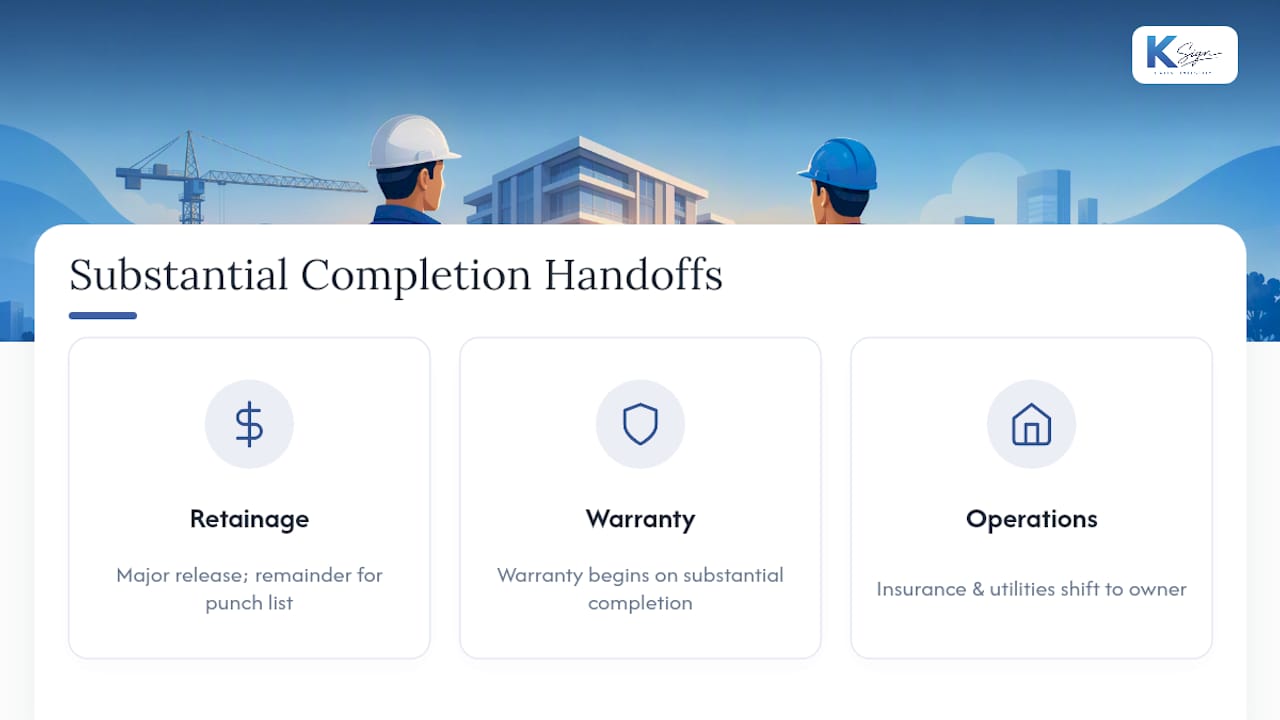
Retainage release is usually tied to this document. Many contracts reduce retained funds substantially once the certificate is signed, with the remainder held back until punch list items and final completion are done. ConsensusDocs 280 is built specifically to confirm that date and support that release.
Warranties almost always start counting from the date of substantial completion, not from final completion or contract signing. That’s a critical detail contractors sometimes overlook: a one-year warranty period that began on the substantial completion date may be closer to expiry than the team assumes.
Insurance and operational responsibility shift too. Once the owner takes beneficial use, property insurance, utilities, and day-to-day risk typically move from the contractor’s builder’s risk policy to the owner’s standard coverage. Confirm this handoff explicitly in the certificate or a companion letter, because a gap in coverage during transition is an expensive place to discover ambiguity.
How do you prepare and issue the certificate step by step?
Getting from “looks finished” to a signed certificate follows a fairly consistent sequence on most projects.
- Run a pre-inspection walkthrough. The contractor and site superintendent check systems, finishes, and life-safety items before inviting the formal inspection.
- Hold the joint inspection. Owner, contractor, and architect/engineer attend together, note every deficiency, and agree on what belongs on the punch list.
- Draft and circulate the punch list with a completion timetable. Attach dates for each outstanding item, not just a vague deadline.
- Sign off jointly and distribute copies. All three parties sign the certificate, and every signatory keeps a copy along with attachments.
- Retain the full record. Store the signed certificate, punch list, and photos together for warranty claims and any later dispute.
Timelines from substantial to final completion vary by project size, but punch list resolution periods often span a few weeks to a couple of months on mid-sized commercial builds.
Pro Tip: Name specific attendees for the inspection in the contract, not just “owner’s representative.” A vague clause invites a no-show, and a no-show delays the entire sign-off chain by weeks.
Where do you find recognised certificate templates?
Reach for a standardised form before building your own. Ad hoc documents drafted under deadline pressure tend to miss the exact contractual triggers a court or arbitrator looks for.
- AIA G704 is the most widely referenced private-sector form, available for purchase through the American Institute of Architects’ contract documents platform.
- ConsensusDocs 280 works as a standalone acknowledgement form and pairs cleanly with ConsensusDocs’ broader agreement family.
- State agency PDFs, such as those issued by public works departments, apply on publicly funded jobs and often carry specific procurement language you can’t substitute with a private form.
Draft a bespoke certificate only when your contract already defines unusual completion criteria that a standard form doesn’t capture.
How do digital workflows reduce closeout errors?
Paper-based closeout is where certificates go missing, punch lists lose pages, and signature blocks sit half-completed for weeks. A form-driven workflow collects project details once, auto-populates the certificate template, and appends the punch list automatically, cutting out the manual re-entry that causes mismatched dates and dropped attachments.
Electronic signature collection from all three parties, captured with a tamper-evident audit trail, gives you a defensible record of who signed what and when. KSign’s construction workflows work this way. Digital signing supports the physical inspection process; it doesn’t replace it. The walkthrough still has to happen. What changes is how fast the paperwork catches up afterward, something covered in more detail in guidance on handling practical completion sign-off electronically.
What legal disputes can arise from the certificate?
Certificates create legal exposure in both directions, and most disputes trace back to one of a few recurring issues.
The first is disagreement over whether substantial completion actually occurred. Owners sometimes argue the space wasn’t genuinely usable despite a signed date; contractors argue the opposite when payment or warranty timing is at stake. Courts and arbitrators generally look at whether the owner could use the project for its intended purpose, not whether every cosmetic item was finished, but that standard still leaves room for argument on complex projects.
The second is the scope of what the certificate waives. Signing off on substantial completion does not waive claims for latent defects, problems that weren’t visible or discoverable at the time of inspection. The Utah DFCM form states this explicitly, and it’s a distinction worth putting in writing on every project, not just public ones.
The third is punch list scope creep. An item left off the punch list does not automatically release the contractor from the underlying obligation to complete the work as specified in the contract. Owners sometimes assume the punch list is the complete and final word on outstanding obligations. It isn’t, unless the contract says so directly.
Finally, disputes emerge over who actually had authority to sign. If an owner’s representative signs without proper authorisation, or an architect issues a certificate the owner disputes, the validity of the whole document can be challenged. Get signing authority confirmed in writing before the inspection, not after.
How does the certificate affect deadlines and time extensions?
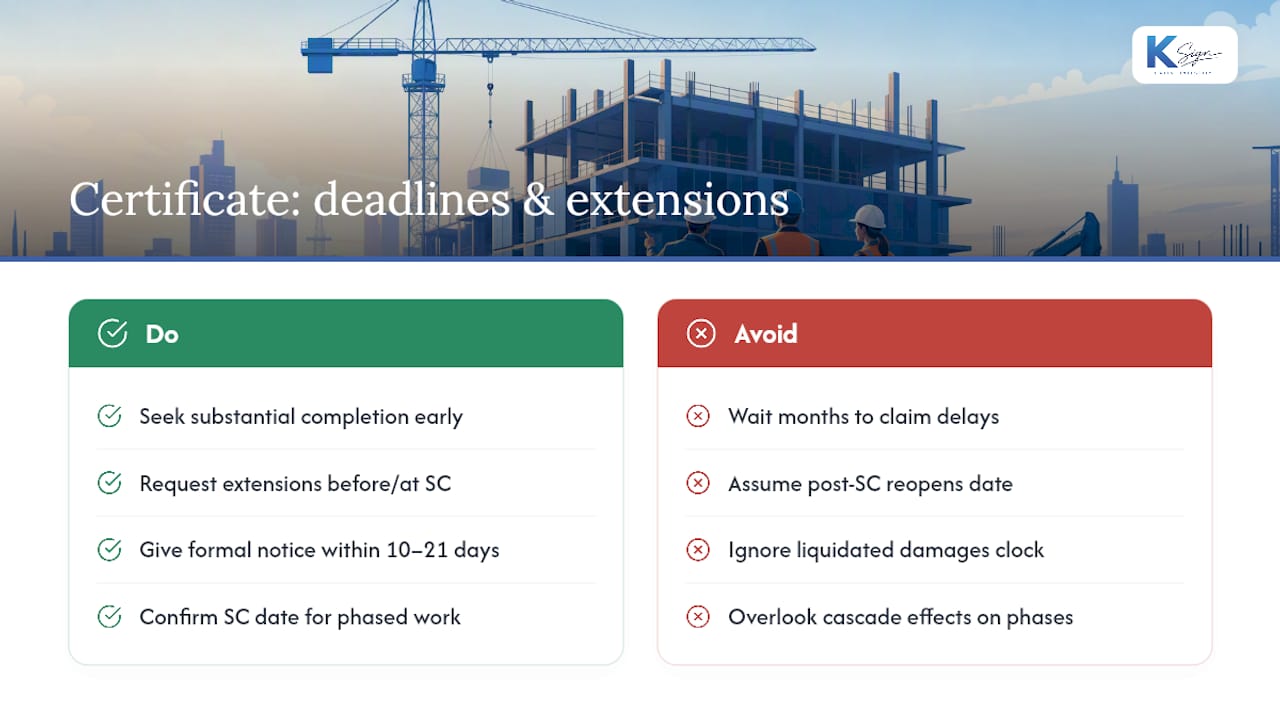
The substantial completion date is frequently the reference point for calculating liquidated damages, so getting that date wrong, in either direction, has direct financial consequences. If a contract sets a completion deadline with daily penalties for delay, the certified date is what stops that clock. A contractor who disputes an owner’s refusal to certify substantial completion is often disputing a live financial penalty, not an abstract administrative point.
Time extensions typically need to be requested and documented before or at substantial completion, not retrofitted afterward. Weather delays, owner-caused delays, or differing site conditions usually require formal notice within a set window under the contract, often 10 to 21 days from the triggering event. Wait until the certificate discussion to raise a three-month-old delay claim, and you’ve likely forfeited it under most standard contract language.
The certificate date also affects subsequent phases on multi-phase projects. If Phase 2 can’t start until Phase 1 reaches substantial completion, a delayed or disputed certificate cascades through the whole schedule. On projects with sequential trades or tenant fit-outs tied to base building completion, that cascade effect is often more expensive than the original point of dispute.
Extensions of time granted after substantial completion don’t typically reopen the certified date itself. They usually apply to remaining punch list or final completion work, which is why nailing the substantial completion date early matters more than it might seem at the time.
Do substantial completion rules differ by contract or jurisdiction?
Definitions shift depending on which standard form the contract uses, and on which US state’s law applies to the project. AIA-based contracts define substantial completion by reference to the point where the owner can occupy or use the work for its intended purpose. ConsensusDocs contracts use closely aligned language but structure the acknowledgement step slightly differently through the 280 form.
Public works contracts frequently diverge from private ones. State procurement rules can impose specific inspection procedures, notice periods, or retainage percentages that don’t appear in standard AIA or ConsensusDocs language at all. A state agency form built for public infrastructure work often includes fields, like bonding confirmations or prevailing wage certifications, that a private commercial certificate never needs.
Contract type matters as much as jurisdiction. Design-build agreements sometimes define substantial completion around performance testing or commissioning benchmarks rather than a straightforward occupancy standard, particularly on projects with complex mechanical or process systems. Cost-plus contracts may tie substantial completion to a different payment mechanism than fixed-price agreements, since there’s no lump sum retainage structure to release in the same way.
Read the definitions section of your specific contract before assuming a generic standard applies. “Substantial completion” is a defined term in almost every construction contract, and that definition, not a general industry understanding, governs your project.
Does the certificate trigger lien or claims deadlines?
In many US states, the substantial completion date starts the clock on mechanic’s lien filing deadlines for contractors, subcontractors, and suppliers who haven’t been paid. These deadlines are typically counted in a fixed number of days from substantial completion or from the last date labour or materials were furnished, and they vary meaningfully by state.
This makes the certified date more than an administrative formality for subcontractors down the payment chain. If a sub hasn’t been paid and the lien filing window is tied to the substantial completion date, an owner or general contractor delaying certification can inadvertently, or deliberately, compress that filing window. Subcontractors watching for payment issues should track the certified date closely, not just their own invoice due dates.
Statute of limitations periods for construction defect claims often run from substantial completion as well, though some jurisdictions use final completion or the date of occupancy instead. This is one more reason the date needs to be accurate and properly documented at the time it’s set, rather than reconstructed later from memory or informal correspondence.
Because so much downstream legal timing depends on this single date, treat the certificate as a document with consequences well beyond the current payment application. Get it signed properly, get it distributed to every party with a stake in the timeline, and keep the signed original somewhere all sides can retrieve it years later if a claim surfaces.
Practitioner perspective: the mistakes that cause the most damage
The costliest error isn’t a missing signature. It’s teams treating substantial and final completion as interchangeable, which quietly erodes punch list accountability. A weak punch list, vague items, no dates, no named owner, causes more disputes than any legal ambiguity in the certificate itself. Fix it by attaching a dated, itemised punch list to every certificate and keeping a signed distribution record, as recommended in this checklist proiectare rezidențială. Store everything. You’ll need it eventually.
— Josh
How KSign helps you close out a project without chasing paperwork
Chasing three signatures across email threads, then hunting for the punch list attachment six months later when a warranty question comes up, is the exact failure mode a form-driven workflow is built to avoid. KSign turns your closeout details into a structured form that auto-populates the certificate, attaches the punch list, and routes it for signature from owner, contractor, and architect or engineer in one sequence.
If you’re vetting a workflow tool for this, check for mobile-friendly signing so site supervisors can sign from the job, a tamper-evident audit trail for the signed record, a template library that doesn’t force you to rebuild forms from scratch, and payment capture if retainage release ties into the same document. KSign’s contract automation tools handle the form-to-document step, and its eSignature workflows manage the joint sign-off. Set up your first closeout template and see how much faster the punch list stops living in someone’s inbox.
Sources
- ConsensusDocs 280 substantial completion acknowledgement form
- Division of Engineering and Architectural Services substantial completion checklist (Washington state)
- OBC-20D Certificate of Substantial Completion (New Jersey)
- DFCM Certificate of Substantial Completion (Utah)
FAQ
What is a substantial completion certificate?
It’s the signed document that records the date a construction project became usable for its intended purpose, even with minor punch list items outstanding, and it typically triggers warranty start and retainage release.
How do I get my completion certificate?
The contractor generally requests a joint inspection with the owner and architect or engineer, and once all parties agree the work meets the substantial completion standard, the three sign the certificate together.
Can I create my own certificate of completion?
You can, but standard forms like AIA G704 or ConsensusDocs 280 already cover the contractual triggers that matter, so a bespoke document risks missing a field that later becomes a dispute point.
Who initiates substantial completion?
The contractor typically requests the inspection once the work looks ready, though on design-bid-build projects the architect or engineer often issues the formal notice and coordinates the walkthrough.
Does signing the certificate waive defect claims?
No. Signing off on substantial completion does not waive claims for latent defects that weren’t visible at inspection, a point some state agency forms, including Utah’s DFCM template, state explicitly.