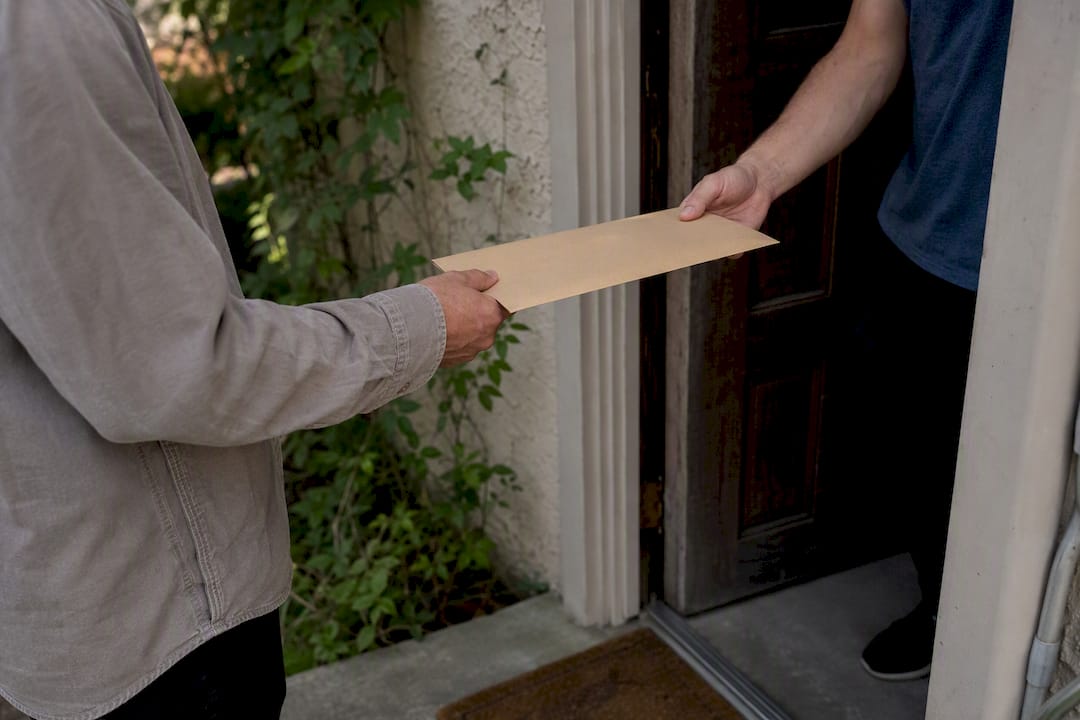
A notice of eviction is a written, pre-court document that legally starts the eviction timeline. Get the notice type, wording, or service method wrong, and a court can dismiss the entire case before it begins. This single document carries more weight than most landlords or tenants realise, and state court self-help guidance consistently flags it as the most common point of failure in eviction proceedings.
Before you draft or respond to anything, work through this:
- Confirm the correct notice type for the actual reason (non-payment, lease breach, no-fault, or holdover)
- Check your state and local rules for required wording and minimum notice period
- Serve it using a method your jurisdiction recognises, and keep proof
- Keep dated copies of everything, including any communication about the issue
If you are the tenant who received one, note the deadline immediately, photograph or scan the notice, and work out whether you can cure the problem or need legal advice before the clock runs out.
Key Takeaways
A compliant notice of eviction depends on choosing the correct notice type, stating precise deadlines and amounts, and proving proper service under your state’s rules.
| Point | Details |
|---|---|
| Match the notice to the reason | Pay-or-quit, cure-or-quit, unconditional quit, and no-fault notices each require different wording and timelines. |
| Get every required field right | Include the exact deadline, amount owed, lease clause or statute, and signed service statement. |
| Notice periods vary widely | Common ranges run from 3 to 14 days for breaches up to 90 or more days for no-fault terminations. |
| Serve it properly and document it | Personal delivery, substitute service, or posting and mailing all need an affidavit or photographic proof. |
| Check moratoriums and local ordinances | Public health orders and city rules can extend deadlines or add requirements beyond state law. |
| Digital workflows reduce disputes | Tools like Ksign turn form answers into signed, stored notices with payment collection and a full audit trail. |
Table of Contents
- What are the different types of eviction notices?
- What must a valid eviction notice include?
- How long is the notice period before eviction?
- How do you serve a notice so it holds up in court?
- What happens after the eviction notice period ends?
- Sample wording you can adapt for your own notice
- What mistakes make an eviction notice invalid?
- What should you do if you receive an eviction notice?
- How do public health emergencies or moratoriums affect eviction notices?
- What legal defences can tenants raise after a notice is served?
- Why do eviction notice rules differ so much by state?
- How Ksign helps you produce a compliant notice faster
- Frequently asked questions
- Sources
What are the different types of eviction notices?
Every eviction notice ties to a specific legal reason, and using the wrong one is an easy way to lose a case before it starts.
- Pay-or-quit notice. Used for unpaid rent. It states the exact amount owed and gives the tenant a set number of days to pay in full or move out.
- Cure-or-quit (comply-or-vacate) notice. Used for a fixable lease violation, such as an unauthorised pet or noise complaints. Many jurisdictions apply a right to cure, meaning a tenant who fixes the problem within the notice window can stay.
- Unconditional quit notice. Reserved for serious or repeated breaches, illegal activity, or significant property damage. There is no opportunity to fix the issue; the tenant is told to leave.
- No-fault notice to vacate. Covers lease non-renewal, an owner moving into the unit, or planned renovations. No breach is alleged.
Colorado’s official JDF 99B form is a useful example of how states structure this. It uses checkboxes to specify the reason, the move-out date, the service method used, and whether mediation applies, all on one standardised page.
What must a valid eviction notice include?
A notice that is missing a required field is often as good as no notice at all. Courts look for specific, unambiguous information, not general complaints about the tenant.
- A clear deadline. State the exact move-out date or cure deadline, not a vague timeframe like “soon” or “within a reasonable period.”
- A specific reason. Reference the lease clause or statute the breach relates to, rather than a general accusation.
- The exact amount owed, for rent-related notices, broken down by period if more than one month is outstanding.
- Landlord contact details, the property address, and a signature.
- A statement of how the notice will be, or was, served.
Avoid vague threats, added conditions not supported by the lease, or language implying self-help eviction (changing locks, shutting off utilities). Courts read these as red flags, and some jurisdictions treat them as separate violations against the landlord.
Pro Tip: Draft the notice using the same wording your state’s official form uses, even if you’re not required to use that exact form. Courts default to trusting language that mirrors statute.
How long is the notice period before eviction?
Notice periods vary by reason and jurisdiction, but most fall into a handful of common bands.
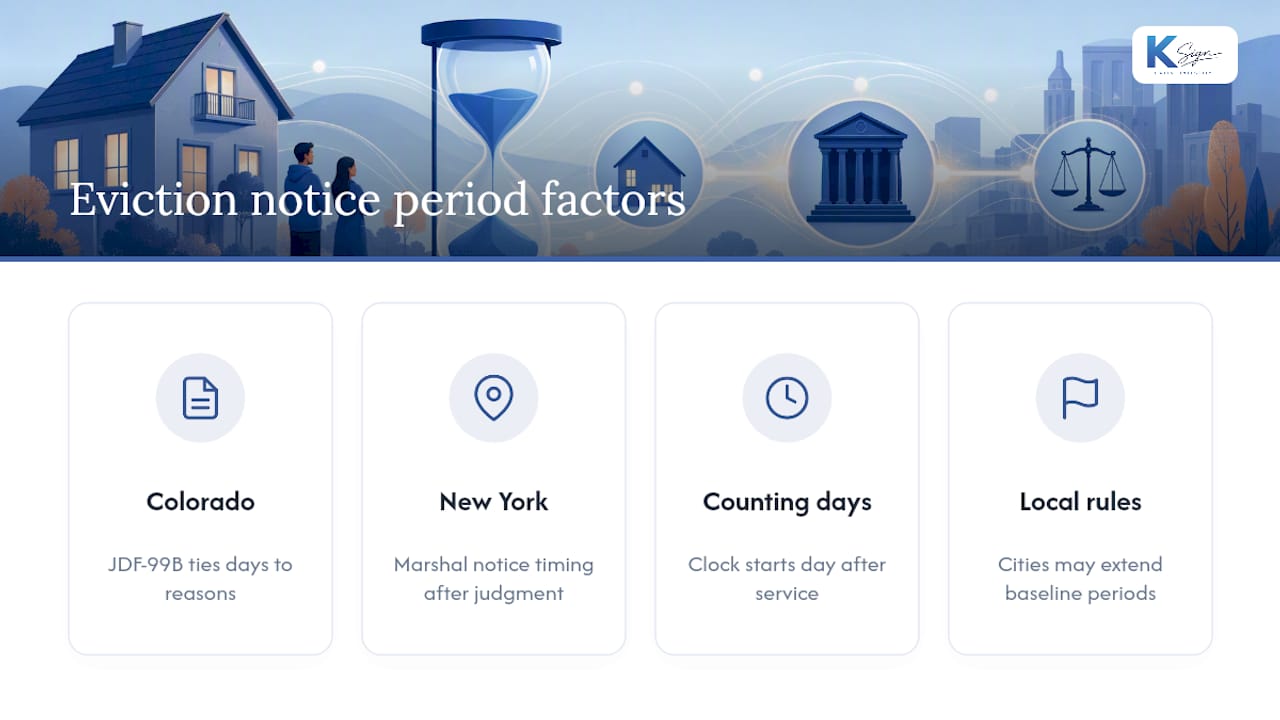
Colorado’s JDF 99B ties specific day counts to specific reasons on the form itself, so the timeline is built into the document rather than left to interpretation. In New York, once a court judgment is entered, a marshal’s notice carries its own separate timing rules, covered in the next section.
Counting days trips people up more than any other part of this process. Most statutes start the clock the day after service, not the day of service, and some exclude weekends or holidays from the count. Miscounting even by one day can void an otherwise correct notice. Local tenant-protection ordinances in some cities also extend these baseline periods, so always check municipal rules on top of state law before finalising a date.
How do you serve a notice so it holds up in court?
Serving the notice correctly matters just as much as writing it correctly. A perfectly worded notice that was served improperly gives the tenant an easy defence.
- Personal delivery. Handing the notice directly to the tenant is the strongest method and the hardest to dispute.
- Substitute service. Delivering to another adult at the property, often paired with mailing a copy, when the tenant isn’t available.
- Posting and mailing. Affixing the notice to the door and mailing a copy, used when personal delivery fails after reasonable attempts.
- Certified mail. Common for documentation purposes, though rarely sufficient on its own without another method.
- Electronic service, but only when the lease or local statute explicitly permits it. Don’t assume email or text counts.
Whichever method you use, document it: complete an affidavit of service, photograph the posted notice, keep certified mail receipts, and note the date, time, and any witness present.
Pro Tip: If more than a few weeks pass between serving the notice and filing in court, check whether your jurisdiction considers it “stale.” Re-serving is cheaper than having a case thrown out.
What happens after the eviction notice period ends?
If the tenant hasn’t paid, cured, or moved out by the deadline, the landlord’s next move is filing an unlawful detainer or eviction case with the court. The judge checks two things above almost everything else: whether the notice itself was valid, and whether it was served correctly. This is exactly where defective notices get cases dismissed, sending the landlord back to square one with a fresh notice and a fresh deadline.
From there, outcomes generally split three ways:
- The case is dismissed on a technicality or the landlord withdraws it
- The court enters judgment for possession in the landlord’s favour
- The parties settle, often with a payment plan or agreed move-out date
If the landlord wins, execution isn’t automatic. In New York, a marshal’s notice or warrant of eviction must be served after judgment, and physical eviction can occur on or after the fifteenth day following that notice. Wait too long between the earliest eviction date and actual execution, and some marshals require fresh notice before proceeding, which resets the clock again.
Sample wording you can adapt for your own notice
Templates only work when they’re adapted to your actual state statute, but having a starting structure saves time and reduces errors.
- Pay-or-quit sample: “You are hereby notified that rent in the amount of $[exact figure] for the period of [dates] remains unpaid. You have [X] days from the date of service to pay this amount in full or vacate the premises. Failure to comply may result in legal action to recover possession.”
- Cure-or-quit sample: “You are in violation of [specific lease clause or statute]. You have [X] days from the date of service to remedy this violation or vacate the premises. This right to cure applies once per violation type under [reference].”
- No-fault sample: “Your tenancy will terminate on [date], pursuant to [statutory authority or lease clause]. No breach is alleged. Please vacate and return keys by the stated date.”
Before using any template, check your state statute for required language, insert your actual service method, and keep a dated copy for your own file. A lease extension agreement is worth reviewing too if the tenancy could be resolved without ending it at all.
| Template Type | Key Field to Customise | Common Mistake |
|---|---|---|
| Pay-or-quit | Exact amount and period owed | Rounding the figure instead of itemising it |
| Cure-or-quit | Specific lease clause referenced | Citing “bad behaviour” instead of a clause |
| No-fault | Statutory authority for termination | Omitting the legal basis entirely |
What mistakes make an eviction notice invalid?
Most dismissed eviction cases trace back to one of a handful of avoidable errors.
- Missing statutory language or the wrong cure period. Using a generic notice instead of one that matches your state’s minimum days.
- Incorrect service or weak proof of delivery. No affidavit, no photo, no witness, nothing to show the tenant actually received it.
- Copying a template without adapting it. A notice written for one state rarely satisfies another state’s requirements.
- Overbroad or unlawful threats. Mentioning lockouts, utility shutoffs, or other self-help remedies not permitted by law.
Before serving anything, run through a short checklist: correct notice type, correct deadline, correct amount if applicable, correct service method, and a signed copy kept for your records. Many of these errors trace back to the same lease-drafting habits covered in common lease-signing mistakes property managers tend to repeat.
What should you do if you receive an eviction notice?
Getting a notice is stressful, but the first hour matters more than the emotion does.
- Identify the notice type and count the deadline yourself, don’t just trust the date written on the page.
- Confirm how and when it was served, since improper service can be a valid defence.
- If it’s a pay-or-quit notice, pay the exact amount stated and get a receipt, ideally one that specifies the payment cleared the balance in full.
- If it’s a cure-or-quit notice, document the fix with photos, receipts, or written confirmation, and keep copies.
- If the notice looks defective, you can contest it in court, and many areas have free tenant legal aid clinics worth contacting before the deadline passes.
- Sometimes moving out voluntarily, even when you could fight it, avoids a formal eviction judgment on your record, which can matter more long-term than winning a technical argument.
How do public health emergencies or moratoriums affect eviction notices?
Eviction moratoriums, most visibly during the COVID-19 period, don’t eliminate the notice requirement. They typically layer extra conditions on top of it. A landlord might still need to serve a valid notice, but the notice period could be extended, the reasons for eviction restricted, or an additional declaration required from the tenant claiming financial hardship before the case can proceed.
The practical problem is that these rules change fast and vary enormously by city and county, not just by state. A notice that was perfectly compliant six months ago can become invalid overnight if a local emergency order shifts the required notice period or adds a mandatory disclosure. Landlords who serve notices during an active moratorium without checking current local orders risk an automatic dismissal, regardless of how legitimate the underlying reason for eviction is.
For tenants, an active moratorium can be a genuine defence even against a technically correct notice, particularly for non-payment cases tied to documented income loss. That defence usually has to be raised affirmatively, meaning the tenant needs to notify the court or the landlord that a moratorium or protection applies, rather than assuming it will be applied automatically.
The safest approach for either side is the same: check the specific state and municipal eviction moratorium status at the time of service, not at the time the lease was signed or the rent became due. Court self-help pages and legal aid organisations tend to publish moratorium updates faster than general legal blogs, so they’re the better first stop when a public health order is potentially in play.
What legal defences can tenants raise after a notice is served?
A tenant facing an eviction notice isn’t without options, and several defences come up repeatedly in unlawful detainer cases.
The most common is defective notice or improper service, meaning the notice was missing required information, understated the cure period, or wasn’t delivered using a method the jurisdiction recognises. Courts take this seriously enough that it remains one of the most frequent reasons cases get dismissed outright.
A second common defence is retaliation, where a tenant argues the notice was issued because they reported a habitability issue, joined a tenant organisation, or exercised another legal right, rather than for the stated reason. Timing often matters here; a notice served shortly after a complaint invites scrutiny.
Breach of the warranty of habitability is another frequent defence in non-payment cases, where the tenant argues rent was withheld because the landlord failed to maintain the property in a liveable condition. Some jurisdictions allow partial rent withholding tied directly to unresolved repair issues.
Tenants sometimes also raise waiver, arguing the landlord accepted rent after the notice period began, which can undercut the notice’s validity depending on the state. And where a curable violation exists, successfully demonstrating the cure was completed within the window remains a straightforward, often successful defence on its own.
None of these defences are automatic wins. They need to be raised properly, usually in a written response or at a court hearing, and the burden of proof varies by defence and by state.
Why do eviction notice rules differ so much by state?
Eviction law is built almost entirely at the state level, with cities and counties frequently adding their own layer on top. That’s why a notice period considered generous in one state might be barely legal in another for the identical reason.
Washington’s state guidance lays out specific notice categories tied to specific violations, and the required days differ meaningfully from what you’d find in Colorado’s official JDF 99B form or in New York’s court process. Some states mandate a right to cure for nearly every fixable violation; others limit it strictly to non-payment. Some require specific statutory language printed word-for-word on the notice; others only require the substance of that language to be present.
Local ordinances add another layer entirely. A city with strong tenant protections might require relocation assistance for certain no-fault evictions, mandate a longer notice period than the state minimum, or restrict no-fault evictions altogether during specific circumstances such as a declared emergency. None of this is optional for the landlord to skip because the state form didn’t mention it.
The practical takeaway is straightforward: never assume a notice template or timeline that worked in one jurisdiction will transfer cleanly to another, even a neighbouring one. Checking your specific state’s court self-help page or official form, and then separately checking your city or county for additional requirements, is the only reliable way to confirm what actually applies before you serve anything.
On the ground: a property manager’s workflow note
Digital templates paired with a signed audit trail cut disputes dramatically, because there’s no argument over what was sent or when. I’d keep every served notice, proof of service, and payment record for at least the length of your state’s statute of limitations on the lease itself. A workflow that turns form answers into the finished notice tends to produce faster, cleaner cure outcomes than emailing PDFs back and forth.

How Ksign helps you produce a compliant notice faster
There are other ways to put a notice together, a Word template, a downloaded PDF, a lawyer on retainer for every draft, and each has its place. What none of them do particularly well is connect the notice to what happens next: proving it was served, collecting a cure payment, and keeping all of it in one place if the case ends up in court.

Ksign turns your form answers directly into a completed notice, whether that’s a pay-or-quit, cure-or-quit, or no-fault template, then routes it for e-signature and stores the signed copy alongside a full audit trail of when it was sent, opened, and acknowledged. If a tenant needs to pay a rent cure or a deposit to resolve the notice, embedded payment collection captures that payment and generates a receipt automatically, so you’re not chasing a separate invoice on top of everything else. For landlords managing several properties, that means fewer disputes over what was served and when, and a cleaner paper trail if a case does reach court.
If you’re preparing a notice right now, start by building your notice template inside Ksign’s contract automation tools and adapt the wording to your state before you serve it.
Frequently asked questions
What is a notice of eviction? A notice of eviction is a written, pre-court document a landlord serves on a tenant that states a reason for ending the tenancy and a deadline to pay, cure, or vacate before a court case can be filed.
Is a notice to quit the same as an eviction notice? Yes, in most jurisdictions “notice to quit” and “eviction notice” refer to the same document, though some states use “notice to quit” specifically for no-fault or unconditional terminations.
Can a landlord evict a tenant without a written notice? No. Nearly every state requires a valid written notice before an eviction case can be filed, and skipping this step typically gets a case dismissed immediately.
How many days’ notice is required before eviction? It depends entirely on the reason and your state. Non-payment notices often run 3 to 14 days, while no-fault terminations commonly require 30, 60, or even 90 days or more.
Can a tenant fight an eviction notice? Yes. Tenants can raise defences such as improper service, a defective notice, retaliation, habitability issues, or a completed cure, and many areas offer free legal aid to help prepare a response.
What happens if I ignore an eviction notice? Ignoring it doesn’t stop the process. The landlord can file for eviction once the notice period expires, and appearing in court to respond is almost always better than doing nothing.
This article is general information, not a substitute for advice from a qualified lawyer. Consult a qualified legal professional about your own circumstances before acting on anything here.
Sources
- Types of eviction notices landlords | California Courts | Self Help Guide
- Cure or quit | Cornell Law School Legal Information Institute
- JDF 99 B Notice to Terminate Tenancy Residential Eviction Notice (Colorado)
- NYC Housing Court eviction guidance | New York courts
- Eviction notices | Washington Law Help