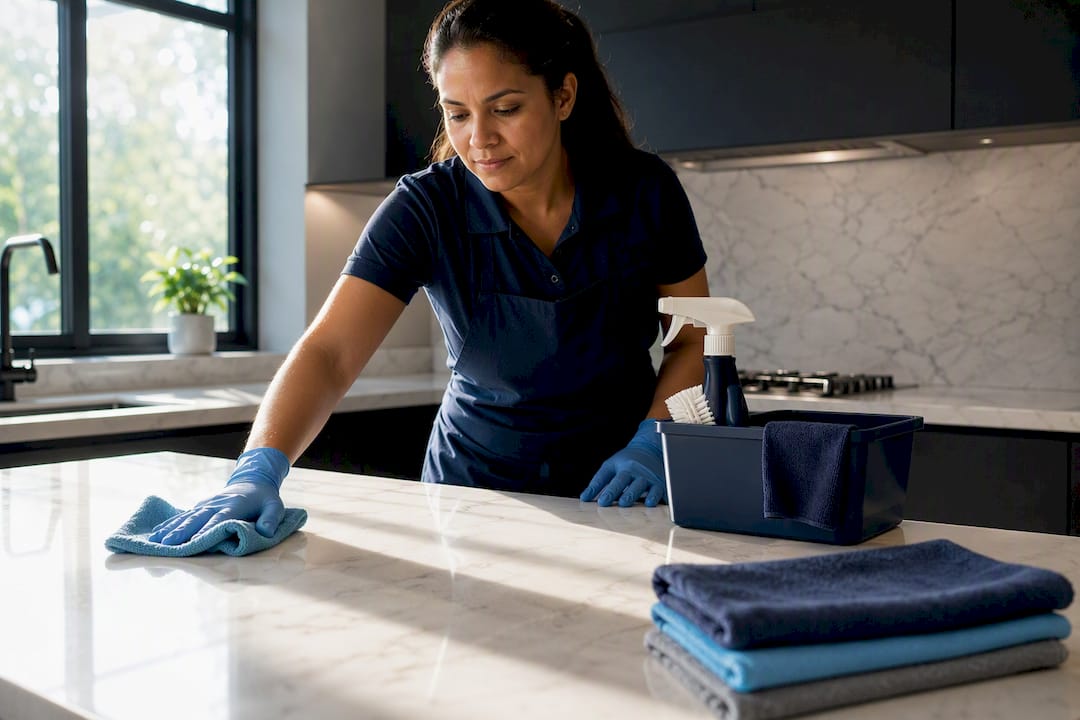
Use this editable cleaning service agreement template as your starting point: an editable Word file and a fillable PDF, both ready for you to complete. Your first move is filling in Exhibit A (the scope of work) and locking down your insurance fields, because those two sections cause more disputes than pricing ever does. Once those are set, you can send it for signature and, if you want the whole thing done digitally, run it through a form→contract→sign→pay workflow instead of chasing emails.
TL;DR:
- Including a detailed scope of work in Exhibit A with specific tasks and frequencies helps prevent scope creep and disputes over service expectations.
- Requiring current insurance certificates and building clauses for coverage lapses protect you from exposure and meet client expectations.
- Using a digital, automated workflow for contract generation, signing, and deposit collection saves time, reduces errors, and keeps records organized.
- Having clients sign the scope of work before the first visit and documenting property condition minimizes future disagreements and liabilities.
- Customizing pricing models, supplies, and add-on charges ensures clarity and profitability tailored to your cleaning business operations.
Table of Contents
- What to include in a cleaning service agreement template
- Downloading and adapting the sample template
- Customising the template for your business
- Insurance, liability and tax checks before you sign
- Getting the contract signed and the deposit paid
- Speeding up signing and payment with a form-to-contract workflow
- One change that cuts disputes fast
- Turn your cleaning contract into a signed, paid job in minutes
- Sources
- FAQ
What to include in a cleaning service agreement template
A cleaning contract isn’t just a formality you attach to an invoice. It’s the document that decides who wins when a client claims you “never cleaned the skirting boards” or disputes a late fee. The strongest agreements follow a fairly consistent structure, and CleanerHQ’s commercial cleaning contract breakdown lays out a twelve-clause version that covers the ground properly: scope, schedule, pricing, insurance, indemnification, performance standards, and termination among them.
Here’s what a genuinely complete house cleaning service agreement or commercial cleaning agreement needs:
- Parties and effective date — full legal names, business addresses, and the date the contract starts.
- Scope of work with Exhibit A — a separate schedule listing every area, task, and cleaning frequency, plus explicit exclusions (nobody’s moving furniture or cleaning inside ovens unless it’s written down).
- Schedule and access — visit days, time windows, and how your crew gets in: keys, gate codes, or after-hours arrangements.
- Term, renewal, and termination — how long the agreement runs, whether it auto-renews, and the notice period for ending it with or without cause.
- Pricing and payment terms — rate, deposit amount, invoicing schedule, late fees, and any clause allowing price adjustments after a set period.
- Supplies and equipment — who provides cleaning products and machinery, with a note on Safety Data Sheets (SDS) if chemicals are involved.
- Insurance and bonding — your certificate of insurance (COI) details and, where a client requires it, janitorial bond coverage.
- Indemnity and liability caps — who’s responsible if something breaks or someone’s injured, and to what dollar limit.
- Personnel and independent contractor status — a clause confirming you or your crew operate as contractors, plus a non-solicitation term stopping clients poaching your staff.
- Performance standards and cure period — how quality issues get reported and how long you have to fix them before it counts as a breach.
- Governing law and signatures — which state’s law applies, how amendments get made, and where everyone signs.
Naming a primary contact on both sides is a small detail that ABS Cleaning’s guidance on commercial cleaning contracts flags as worth the extra line. When something goes wrong on-site, having one named person to call beats guessing who’s authorised to make a decision.
Pro Tip: Treat your scope of work as a living document. Build a simple change-order line into the contract so add-on requests (a one-off carpet clean, extra bathroom detail) get priced and approved in writing instead of just becoming “part of the job” for free.
Downloading and adapting the sample template
The template comes in two formats, and you’ll use both. The editable Word (.docx) file is where you draft: swap in your business name, adjust clause wording, and build your Exhibit A. Once it’s finalised, save a fillable PDF version for the copy you actually send to clients for signature. Sites like ConsumerShield’s cleaning service agreement generator offer similar editable formats if you want a second reference point before finalising your own.
Adapting it takes four steps:
- Copy the Word file and rename it for the client or job type.
- Edit party names, pricing, and the Exhibit A table.
- Set your insurance and deposit figures.
- Export a fillable PDF for signing and keep the Word original for future edits.
Every clause in the checklist above should map to a section in the file. If a template you’ve found online is missing an Exhibit A, an insurance clause, or contractor language, that’s a sign it’s a generic template that hasn’t been built for cleaning work specifically.
A basic Exhibit A table might look like this:
| Area | Tasks | Frequency |
|---|---|---|
| Kitchen | Wipe surfaces, sanitise sink, empty bins, mop floor | Every visit |
| Bathrooms | Clean toilet, shower, sink, mirror, restock supplies | Every visit |
| Living areas | Dust surfaces, vacuum carpets, mop hard floors | Every visit |
| Windows (interior) | Wipe glass and sills | Monthly |
| Carpets | Deep extraction clean | Quarterly, billed separately |
Listing frequency next to each task, rather than a vague “regular cleaning,” is what stops scope creep before it starts. If a client later asks why you’re not doing something weekly that the table lists as monthly, you point to Exhibit A instead of arguing from memory.
Customising the template for your business
The base template works for most house cleaning service agreement and commercial cleaning agreement situations, but pricing and service structure are where you’ll want to adjust for your own operation.
- Pick a pricing model that matches the job. Hourly rates suit unpredictable or one-off jobs but make clients nervous about blowouts. Per-visit flat rates work well for recurring residential cleans where the scope is stable. A monthly retainer suits commercial clients who want one predictable invoice regardless of visit count. Whichever you choose, state the deposit rule clearly, whether that’s a flat amount or a percentage of the first invoice.
- Decide who supplies materials. Some cleaners bring everything; others expect clients to stock basics. Either way, write it into the supplies clause so there’s no last-minute scramble over who owns the vacuum.
- Price add-ons separately. Deep cleans, carpet extraction, and window washing shouldn’t hide inside your standard rate. Give them their own line items in Exhibit A so a client requesting extras understands it’s additional cost, not scope creep on your part.
- Write a real cure period, not a vague promise. A workable structure is: client reports an issue, you get 48 hours to correct it, and the correction gets logged. CleanerHQ’s contract guidance frames this kind of structured inspection and correction process as far more effective than a generic “satisfaction guaranteed” line, because it gives both sides a documented process instead of a subjective argument.
Pro Tip: If you offer optional add-ons, list them as a menu at the bottom of Exhibit A with prices attached. Clients can tick what they want at signing, which avoids the awkward mid-contract negotiation over “how much extra for that.”
Insurance, liability and tax checks before you sign
Insurance is where cleaning service contracts either protect you or quietly expose you. Most commercial clients expect three things before your crew sets foot on-site: commercial general liability cover, workers’ compensation where you employ staff, and in some cases a janitorial bond or employee-theft coverage. ABS Cleaning notes that missing or lapsed coverage is often an outright deal-breaker for property managers, not a minor paperwork gap.
Ask for a current certificate of insurance (COI) before the first visit, and build a clause requiring the client to be notified if coverage lapses or changes. This isn’t excessive caution. It’s the standard commercial clients already expect, and requesting it upfront removes a hurdle before it becomes a dispute later.
- Commercial general liability, at a level appropriate to the property size and risk.
- Workers’ compensation, where you have employees rather than solo contracting.
- Janitorial bond or theft coverage, often requested for offices and retail sites.
- A current COI on file, with a notification clause for changes.
On the tax side, eForms’ guidance on cleaning service contracts points out that a written independent contractor clause helps establish your classification correctly, though contract language alone isn’t determinative. Courts and tax authorities also look at how the work actually operates day to day, so pair the clause with genuine contractor practices: setting your own hours, using your own equipment, and working for multiple clients. If you’re unsure how this applies to your setup, get advice from a tax professional before you rely on the clause alone. For context on typical pay and job structures in the sector, the Bureau of Labor Statistics’ data on janitors and building cleaners is a useful reference point when you’re setting competitive rates.
Getting the contract signed and the deposit paid
Once the document is ready, how you deliver it matters almost as much as what’s in it. You’ve got three realistic options: email a fillable PDF and wait for a signed copy back, meet the client in person with a printed copy, or run the whole thing through an online form and e-signature workflow that captures a deposit at the same time.
Deposit and cancellation clauses only work if they’re specific. Vague language like “a deposit may be required” gives you nothing to enforce. State the amount, when it’s due, and what happens on a no-show or late cancellation, ideally a flat fee or a percentage of the missed visit.
Whichever delivery method you choose, keep records tight:
- Save every signed PDF, COI, and invoice in one place, not scattered across email threads.
- Keep an audit trail of who signed, when, and from what device.
- Log service reports for each visit, especially in the first few weeks of a new contract.
- Send the contract with everything attached: Exhibit A, payment instructions, and access notes, so nothing gets chased up after the fact.
Speeding up signing and payment with a form-to-contract workflow
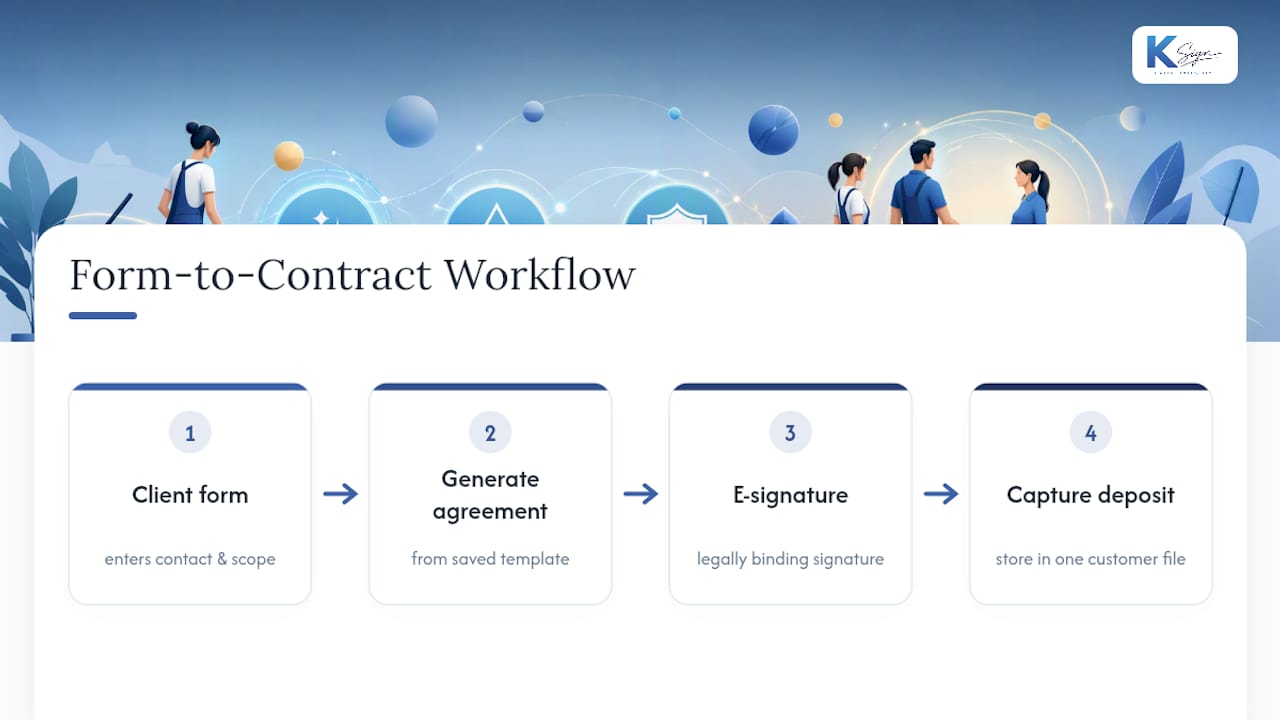
Chasing a signed cleaning contract back through email is where a lot of small operators lose time, and sometimes lose the job entirely when a client goes quiet mid-negotiation. A guided digital form that asks for the client’s details, service address, and scope preferences, then auto-generates the contract from those answers, cuts that back-and-forth down to minutes.
A digital platform can build this workflow specifically: a client fills out a short form, the platform generates the agreement from your saved template, sends it for a legally binding e-signature, and collects the deposit in the same step. For a mobile cleaning business, that means less time at a laptop drafting one-off contracts and fewer jobs started without paperwork signed. Signed agreements, COIs, and payment records sit together in one customer file instead of across email, texts, and a filing folder.
One change that cuts disputes fast
If there’s a single operational habit worth adopting from everything above, it’s this: get the client to sign Exhibit A before your crew’s first visit, not after. A checklist agreed to in advance is worth more than any dispute clause, because it removes the argument over what “clean” was supposed to mean.
Pair that with a short photo log from the first visit, a handful of shots showing the property’s condition before you start. It costs you two minutes and gives you a baseline if a client later claims something was missed or damaged. Try this on one client before rolling it out across your whole book. It’s a small enough change that you’ll know within a fortnight whether it’s saving you the arguments it’s meant to.
— Josh
Turn your cleaning contract into a signed, paid job in minutes
A platform offers an alternative to drafting contracts from scratch every time a new client signs on: one guided form captures the client’s details and scope preferences, generates the agreement from your saved template, sends it for e-signature, and takes the deposit, all in a single pass instead of four separate tools. That matters most for solo operators and small crews who don’t have an afternoon to spend on paperwork between jobs.
Instead of emailing a fillable PDF and waiting days for a reply, you send one link. The client fills in their details, reviews the scope you’ve built into Exhibit A, signs, and pays their deposit before they close the tab. Signed agreements and certificates of insurance land straight in that client’s record, so you’re not digging through old emails when a renewal or dispute comes up.
If you’re still sending Word documents back and forth, start with KSign’s contract automation to turn your cleaning service agreement template into a reusable form, and pair it with KSign’s web forms to capture client details before the contract’s even generated. For businesses building out their online presence alongside better paperwork, Baby Love Growth’s cleaning service SEO guidance is worth a look too, since a sharp contract means little if clients can’t find you in the first place.
Sources
- Commercial cleaning contract: what to include & avoid — ABS Cleaning
- Janitors and building cleaners — Occupational Outlook Handbook, BLS
FAQ
How do I write a cleaning service agreement?
Start with parties and dates, then build a detailed scope of work as a separate Exhibit A listing tasks, areas, and frequency. Add payment terms, insurance requirements, an independent contractor clause, and a termination process, then have both parties sign.
How do I find cleaning contracts without paying for leads?
Direct outreach to local property managers and small offices, paired with a professional-looking contract and COI ready to send on request, often converts better than paid lead lists. A polished agreement signals you run a legitimate operation, which matters more to commercial clients than price alone.
How much can I pay a house cleaner before I need to report it for tax purposes?
Tax reporting thresholds for household workers vary by jurisdiction and change periodically, so check current rules with a tax professional or your relevant tax authority rather than relying on a fixed figure here. A written independent contractor agreement, as eForms notes, helps clarify the working relationship but doesn’t replace proper tax advice.
Can you give an example of a cleaning service agreement?
A typical example includes party details, a scope of work with an Exhibit A table, pricing and payment terms, insurance requirements, an independent contractor clause, and a termination notice period, structured similarly to CleanerHQ’s sample template. Using a platform like KSign lets you turn that structure into a reusable digital template you send, sign, and get paid on without redrafting each time.