
Every cleaning client should sign a written service agreement before the first paid visit. That single step protects your cashflow, controls what you are and are not responsible for, and gives you a clear legal basis to act when something goes wrong. Without it, you are relying on memory and goodwill — neither of which holds up in a dispute or a collections conversation.
The three things to lock in before any job starts:
- Scope: exactly what tasks are included, how often, and what is excluded
- Payment: price, deposit amount, invoice schedule, and late-payment consequences
- WHS and access: who holds keys, how hazards are reported, and what the client must do before your team arrives
Contracts formalise relationships, define rights, and make expectations enforceable — they are the primary legal tool for reducing commercial risk. A handshake deal might feel friendlier, but it leaves you exposed on every one of those three fronts. Replacing verbal agreements with a short, plain-English service agreement is a low-cost way to professionalise your operations and reduce disputes from day one.
Pro Tip: Keep your contract to two pages or fewer for residential clients. A shorter document gets read, understood, and signed faster — which means fewer objections and a cleaner paper trail.
Table of Contents
- What is a cleaning services agreement?
- Why signed contracts protect your cleaning business
- What to include in a cleaning contract: clause-by-clause checklist
- Australian legal must-knows: ACL, WHS, and employment implications
- How to get contracts signed reliably and reduce admin
- Practical implementation: form to contract to signature to payment
- Simple sample contract outline and boilerplate clauses you can copy
- How to introduce contracts to clients and get buy-in
- Key takeaways
- The honest view on contracts in cleaning
- Ksign makes the form-to-contract workflow practical for cleaning businesses
- Useful sources and templates
What is a cleaning services agreement?
A cleaning services agreement is a written contract between your business and a client that records the scope of work, timing, price, each party’s responsibilities, and the process for resolving disagreements. It is not a quote — it is the document that makes the quote enforceable.
Three formats cover most cleaning businesses:
- Single-job agreement: used for one-off jobs such as bond cleans, exit cleans, post-renovation cleans, or property cleanouts. The document is job-specific: it names the property, the tasks, the price, and the date.
- Recurring service agreement: the standard format for weekly, fortnightly, or monthly domestic or commercial cleaning. It sets the ongoing schedule, pricing, and renewal terms, and typically runs for a fixed initial term (three or six months) with automatic rollover.
- Terms of trade attached to a work order: common in commercial and strata cleaning, where a master terms document governs the relationship and individual work orders confirm each visit or project. This model suits clients who need purchase-order approval before work begins.
Choosing the right format affects how you onboard and invoice. A single-job agreement is issued once and archived. A recurring agreement needs a renewal or review clause so pricing stays current. The terms-of-trade model requires a clean process for issuing and approving work orders — which is where a digital workflow pays for itself quickly.
| Format | Best for | Onboarding note |
|---|---|---|
| Single-job agreement | Bond, exit, post-reno cleans | Issue with quote; collect deposit at signing |
| Recurring service agreement | Weekly/fortnightly domestic or commercial | Include renewal clause and price-review date |
| Terms of trade + work order | Strata, commercial, facility management | Master terms signed once; work orders per job |
Why signed contracts protect your cleaning business
Signed service agreements do more than satisfy a legal formality. They are operational tools that protect your margins, control scope, and build the kind of client trust that drives retention.
-
Payment protection. A signed agreement with clear invoicing terms, a deposit clause, and a late-payment fee gives you a documented basis to chase overdue accounts. Without it, a client can dispute the amount, the scope, or even whether the work was agreed at all. A deposit collected at signing also filters out clients who were never serious.
-
Scope control. Scope creep is one of the most common margin killers in cleaning. A client who started with a weekly office clean gradually adds bathrooms, a kitchen, and a storage room — without any conversation about price. A written scope with a variation process stops that pattern. Any additional work is documented, priced, and signed off before it happens.
-
WHS and site access. Your staff have legal protections under Safe Work Australia’s framework, and so do you. A contract clause that sets out who holds keys, how hazards are reported, and what the client must do before your team enters (secure pets, remove fragile items, disclose chemical storage) creates a shared safety record. If an incident occurs, that clause is your first line of evidence.
-
Insurance, liability, and pre-existing damage. Commercial templates frequently include minimum insurance requirements and liability caps tied to recent invoice values. Without a cap, a client can theoretically claim unlimited damages for a broken item — even one that was already damaged before your team arrived. A pre-existing damage clause and a sensible monetary cap close that exposure.
-
Professionalism and procurement. Commercial clients — strata managers, facility managers, corporate offices — often require a signed agreement before they can raise a purchase order. Turning up without written terms signals that your business is not ready for that tier of work. A clean, professional contract is part of the pitch.
-
Dispute resolution. Contracts reduce misunderstandings and align expectations about tasks and pricing. When a disagreement does arise, a signed document gives both parties a reference point that is far cheaper to resolve than a tribunal claim.
A cleaning company working for a strata manager without a written agreement discovered the hard way that “fortnightly common area clean” meant different things to each party. The client expected car park sweeping and bin area pressure washing; the cleaner had quoted only internal corridors. A signed scope-of-work table, with explicit exclusions, would have resolved the ambiguity before the first invoice was disputed.
Multiple industry guides recommend replacing handshake deals with short, plain-English contracts to reduce risk and improve client perception — and the operational evidence supports that advice. Clarity on paper translates directly to fewer calls, fewer disputes, and faster payment.

What to include in a cleaning contract: clause-by-clause checklist
A well-drafted cleaning services agreement covers eight core areas. Miss any one of them and you create a gap a client can exploit — intentionally or not.
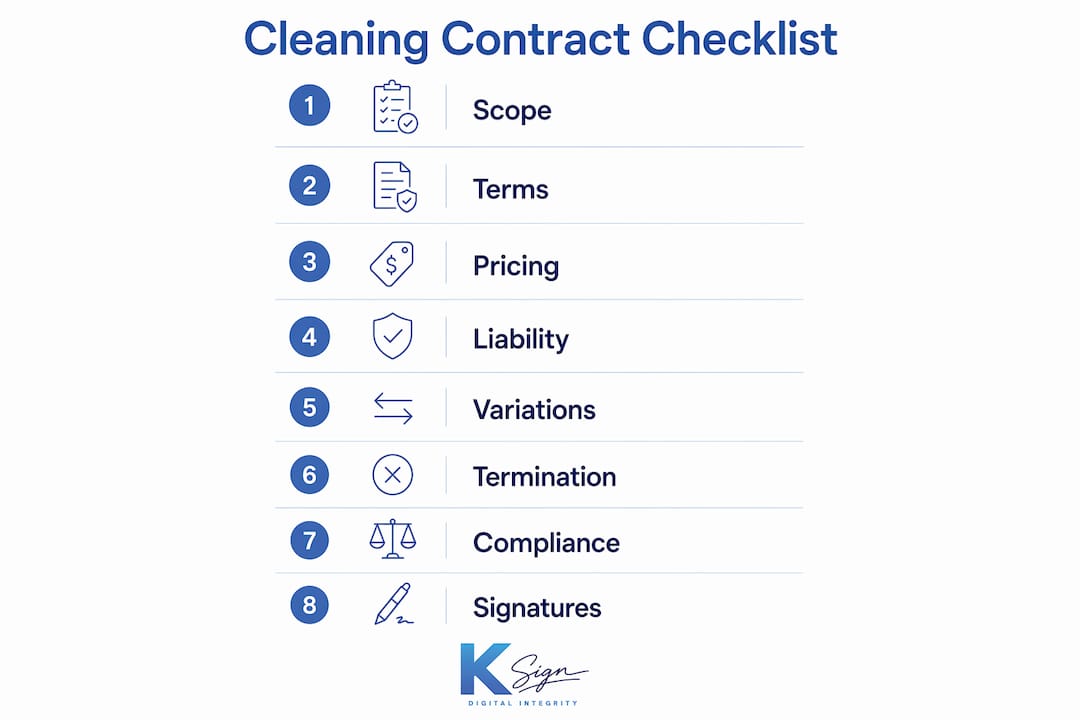
Pro Tip: Draft every clause in plain English, then read it aloud. If you would not say it that way in a conversation, rewrite it. Plain-English clauses survive client negotiation better than legal boilerplate because clients actually read them.
| Clause | Purpose | Red flag to avoid |
|---|---|---|
| Parties and effective date | Identifies who is bound and when | Vague “trading as” names without ABN |
| Scope of work and task list | Defines exactly what is included and excluded | Generic “general cleaning” with no task list |
| Schedule and access | Sets frequency, timing, and key/alarm arrangements | No mention of after-hours access or key return |
| Pricing, invoicing, deposits | States price, payment terms, deposit, and late fees | No late-payment fee or deposit clause |
| Variation/change orders | Documents how extra work is approved and billed | Verbal approval only — no written sign-off |
| WHS and hazard reporting | Allocates safety duties and reporting obligations | No mention of client’s duty to disclose hazards |
| Insurance and liability cap | Sets minimum insurances and caps total liability | Unlimited liability with no monetary ceiling |
| Cancellation and termination | States notice periods, no-show fees, and exit rights | No minimum notice period for either party |
| Privacy and confidentiality | Covers data handling and site access confidentiality | No mention of key codes or alarm data handling |
| Dispute resolution | Sets the process before legal action is taken | No step process — jumps straight to litigation |
Short boilerplate prompts you can adapt:
- Scope: “The services are limited to the tasks listed in Schedule A. Any additional tasks require a written variation order signed by both parties before work commences.”
- Variation: “Any variation to the agreed scope must be documented in a Variation Order, priced, and signed by the client before the additional work is performed.”
- Deposit: “A deposit of [X]% of the quoted price is payable upon signing. Work will not commence until the deposit is received.”
- Cancellation: “Cancellations with fewer than [48] hours’ notice will incur a cancellation fee of [X]% of the scheduled service value.”
- Liability cap: “The total liability of the service provider under this agreement is limited to the value of the most recent invoice issued to the client.”
- WHS: “The client must notify the service provider of any known hazards, restricted areas, or chemical storage at the site prior to the commencement of each service visit.”
A written change order signed by both parties is the single most effective tool for making variation billing enforceable. Without it, a client can simply deny they agreed to the extra work.
Australian legal must-knows: ACL, WHS, and employment implications
Australian cleaning businesses operate under a specific legal framework that makes written contracts not just useful but genuinely protective. Three areas carry the most risk.
Australian Consumer Law and unfair contract terms
The Australian Consumer Law (ACL), administered by the ACCC, applies to most cleaning service contracts. Under the ACL, terms that create a significant imbalance in the parties’ rights, are not reasonably necessary to protect a legitimate business interest, and would cause detriment if relied upon can be declared unfair and void. Sprintlaw recommends tailored, plain-English agreements to protect margins and avoid unfair contract terms issues — and that advice applies whether your client is a household or a small business.
Practical compliance checklist:
- Write terms in plain English, not legal boilerplate copied from an unrelated industry
- Balance termination rights — if you can exit with 7 days’ notice, the client should have a similar right
- Avoid automatic price escalation clauses that are not clearly disclosed upfront
- Do not include terms that limit the client’s right to seek legal redress
- Review your standard terms annually, especially after any ACL amendments
WHS obligations for cleaners on client sites
Under Safe Work Australia’s framework, your business has a duty of care to workers even when they are on a client’s premises. A contract clause that requires the client to disclose hazards, secure restricted areas, and provide a safe working environment before your team enters is not just good practice — it is part of your WHS due diligence. If a worker is injured because a client failed to disclose a known hazard, a documented contractual obligation strengthens your position considerably.
Employment vs contractor status
A service agreement alone does not determine whether a worker is an employee or an independent contractor. The ATO and Fair Work Commission look at the totality of the working arrangement: who controls the hours, who supplies the equipment, whether the worker can subcontract, and whether they bear financial risk. If your contracts with individual cleaners give you significant operational control, those workers may be employees regardless of how the agreement is labelled. Seek specific advice if you are engaging workers on a contractor basis — the consequences of misclassification include superannuation liability and penalty rates.
A legal health check from a firm experienced in small business service contracts is worth the cost before you roll out standard terms to a large client base. The ACCC and Safe Work Australia both publish free guidance that is a useful starting point.
How to get contracts signed reliably and reduce admin
The biggest barrier to signed agreements is friction. If getting a contract signed requires printing, scanning, emailing, and chasing, most small cleaning businesses simply stop doing it after the first few difficult clients. The fix is a workflow that makes signing the path of least resistance.
Stepwise workflow:
- Send a digital intake form to collect client details, site address, frequency, and any known hazards
- Use the form responses to auto-generate a tailored service agreement
- Send the agreement for e-signature via a mobile-friendly link
- Collect the deposit as part of the same signing step
- Store the signed PDF with a date/time-stamped audit trail linked to the client record
E-signatures are legally valid in Australia under the Electronic Transactions Act 1999 (Cth) and its state equivalents, provided the signatory’s identity can be reasonably verified and they have consented to sign electronically. A platform that captures IP address, timestamp, and email confirmation satisfies that standard for most commercial cleaning agreements.
Practical tips for deposits and conditional starts:
- Require a deposit before confirming the first visit — not after
- State clearly in the agreement that the booking is not confirmed until the deposit clears
- For recurring agreements, take the first fortnight’s fee as the deposit and apply it to the final invoice
Pro Tip: For returning clients, pre-fill the form with their existing details and send only the fields that have changed (new site, updated price). A two-minute signing experience gets a far higher completion rate than a blank form.
Common client objections and short responses:
- “I don’t sign contracts for cleaning.” — “This is a short two-page document that protects both of us. It sets out exactly what we’ll do and what happens if either of us needs to change the arrangement.”
- “Can’t you just send an invoice?” — “The agreement comes first so we’re both clear on scope and price before work starts. The invoice follows each visit.”
- “I’ll sign it after the first clean.” — “We confirm bookings once the agreement is signed and the deposit is in. That’s how we keep the schedule reliable for all our clients.”
Practical implementation: form to contract to signature to payment
The most reliable way to get every client signed up is to remove the manual steps between quoting and confirming. A form-native workflow does exactly that.
-
Client completes a digital intake form. The form captures site address, access details (key, alarm code, after-hours access), cleaning frequency, any known hazards, and the agreed price. This takes two to three minutes on a phone.
-
The form responses auto-generate a tailored contract. Fields like site address, frequency, price, and special hazard notes are inserted automatically. The document is consistent, complete, and ready to send without manual editing.
-
The client receives a mobile-friendly signing link. They review the agreement, sign with a finger or stylus, and pay the deposit in the same session. No printing, no scanning, no separate payment link.
-
A signed PDF and audit trail are stored automatically. The record includes the signatory’s name, email, IP address, and timestamp — sufficient evidence for a collections conversation or a tribunal claim.
-
The signed agreement links to the job record and invoice schedule. When the first invoice is issued, the scope and price are already confirmed in writing.
Which contract fields should be auto-filled from the intake form:
- Site address and access instructions
- Cleaning frequency and scheduled day/time
- Agreed price and deposit amount
- Special hazard notes (e.g. “client has a dog; secure before entry”)
- Exclusions confirmed during quoting
For small teams, contract automation with default templates and role-based access means a team member can send a contract from a phone without needing to understand the legal structure behind it. The template carries the compliance; the form carries the client-specific detail.
What to look for in a tool:
- Mobile signing that works on any device without an app download
- Payment gateway integration so the deposit is collected at signing
- Template variables that auto-fill from form responses
- Secure, searchable storage with audit trails
- The ability to send reminders without manual follow-up
| Feature | Why it matters for cleaning businesses |
|---|---|
| Mobile signing | Clients sign on-site or from their phone immediately after quoting |
| Payment at signing | Deposit collected before the first visit; no separate payment step |
| Template variables | Site address, price, and hazards auto-filled; no manual editing |
| Audit trail | Date/time stamp and IP address support collections and disputes |
| Secure storage | Signed PDFs linked to client records; no lost agreements |

Simple sample contract outline and boilerplate clauses you can copy
A practical cleaning services agreement does not need to be long. The structure below covers every essential element in a format that fits two pages for residential clients and three for commercial.
Sample contract structure:
- Title: Cleaning Services Agreement
- Parties: full legal names, ABNs, and contact details
- Effective date and initial term
- Schedule A: scope of work (task list, frequency, exclusions)
- Schedule B: pricing, deposit, invoicing, and late-payment terms
- Variation process
- Access and site rules
- WHS obligations
- Insurance and liability cap
- Cancellation and termination
- Dispute resolution
- Signatures (client and service provider, with date)
Copy-ready boilerplate snippets:
- Scope exclusion: “The following are not included in the agreed services unless confirmed in a signed Variation Order: oven cleaning, exterior windows above ground level, carpet steam cleaning, and removal of builder’s waste.”
- Late payment: “Invoices unpaid after [14] days will attract a late-payment fee of [X]% per month on the outstanding balance.”
- Pre-existing damage: “The service provider is not liable for damage to items that were already damaged, fragile, or improperly secured at the time of the service visit, provided the service provider notifies the client of the condition before commencing work.”
- Termination: “Either party may terminate this agreement by providing [14] days’ written notice. The client remains liable for services performed up to the termination date.”
For specialised outdoor or lanai cleaning and similar site-specific work, add a clause requiring the client to clear the area and secure loose items before each visit — this protects both the worker and the client’s property.
Version control note: name each template version with a date (e.g. “Cleaning Services Agreement v2 — March 2026”) and update it whenever your pricing, WHS obligations, or ACL requirements change. Run a legal health check before rolling out a revised template to your full client base.
How to introduce contracts to clients and get buy-in
Most clients accept a contract without resistance when it is presented as a normal part of your process — not as something new you are imposing on them. The framing matters as much as the document.
Opening scripts:
For residential clients: “Before we confirm your first clean, I’ll send through a short service agreement — it just sets out what we’ll do, the price, and how we handle changes or cancellations. It takes about two minutes to sign online and protects both of us.”
For commercial clients: “As part of our onboarding, we issue a service agreement that covers scope, pricing, WHS responsibilities, and our variation process. I’ll send it through with the quote so your team can review it before we start.”
Handling pushback:
- Price pushback: acknowledge the concern, then redirect to the variation process. “The price in the agreement is for the scope we’ve discussed. If you need anything added, we document it as a variation so you always know what you’re paying for.”
- Scope negotiation: use the scope table as a negotiation tool, not a take-it-or-leave-it document. Walk through the task list together and adjust it before signing.
- “We’ve never needed a contract before”: “Most of our clients say the same thing — and most of them also say they wish they’d had one the one time something went wrong. It’s a short document and it protects you as much as it protects us.”
Timing the signature request:
- Residential: send the agreement with the quote confirmation, before the first visit is scheduled
- Commercial: send with the formal proposal; make signing a condition of booking the start date
- On-site quoting: use a mobile signing link so the client can sign on the spot while you are still there
Steps for staff collecting signatures on site or via mobile:
- Open the intake form on your phone and complete it with the client
- Confirm the scope table and price before generating the contract
- Send the signing link to the client’s email or phone number
- Wait for the signature confirmation before leaving the site
- Confirm the deposit has been received before scheduling the first visit
Key takeaways
Signed service agreements protect your income, control scope, and satisfy your WHS and ACL obligations — and the admin burden drops significantly once you have a repeatable workflow in place.
- Adopt a short written contract immediately. Use a two-page agreement for residential clients and a three-page terms-of-trade model for commercial work.
- Require an e-signature before the first job. Verbal confirmation is not enforceable; a signed document with a date/time stamp is.
- Collect a deposit at signing. A deposit confirms intent, protects cashflow, and filters out uncommitted clients.
- Include a WHS clause. Require the client to disclose hazards and secure the site before each visit — this is both a safety obligation and a liability protection.
- Review your standard terms annually. ACL requirements and WHS obligations change; a template that was compliant two years ago may not be today. Seek legal advice before wide rollout.
- Track outcomes after three months. Measure disputes raised, invoices paid on time, and time spent chasing overdue accounts. The improvement is usually visible within the first quarter.
This article provides general information only and does not constitute legal advice. Confirm your contract terms with a qualified legal professional or review the ACCC and Safe Work Australia guidance for your specific situation.
The honest view on contracts in cleaning
The most common objection I hear from cleaning business owners is that contracts will put clients off. The opposite is usually true. A professional, plain-English service agreement signals that your business is organised, that you take your work seriously, and that you will hold up your end of the deal. Clients who baulk at signing a two-page document that protects them as much as it protects you are often the same clients who dispute invoices, cancel without notice, and ask for extras without paying for them.
The rollout challenge is not client resistance — it is internal consistency. The businesses that struggle are the ones that introduce contracts for new clients but keep running old clients on verbal arrangements. That creates a two-tier operation where your most established relationships are also your most exposed. The fix is a single, simple workflow that applies to everyone: new client, returning client, commercial account, one-off job. Same form, same contract, same signing step.
Measure success by three things: the number of invoice disputes in a quarter, the average days to payment, and the number of scope conversations that escalate into arguments. All three should improve within 90 days of consistent contract use. If they do not, the issue is usually in the scope table — it is too vague, and clients are reading ambiguity as permission.
Ksign makes the form-to-contract workflow practical for cleaning businesses
Getting every client signed up is straightforward when the process takes two minutes instead of twenty. Ksign combines a guided digital intake form, automatic contract generation, legally binding e-signature, and deposit collection into one mobile-friendly workflow — so your team can go from quote to signed agreement to confirmed booking without touching a PDF or chasing an email.
For cleaning businesses, that means a client completes your intake form on their phone, your service agreement is generated with their site details and agreed price already filled in, they sign and pay the deposit in the same session, and the signed record is stored with a full audit trail. No manual editing, no separate payment link, no lost agreements. Ksign’s document generation and payment collection features are built for exactly this kind of repeatable field-service workflow.
Get your first cleaning contract template set up and start collecting signatures today. Ksign is currently offering 50% off all e-signature plans — the fastest way to put a signed agreement in front of every new client before the next job starts.
Useful sources and templates
A short list of trusted sources for deeper reading, regulatory guidance, and template downloads:
- Sprintlaw — Cleaning Services Agreements for Australia: practical legal guidance on drafting compliant, plain-English cleaning contracts under Australian law. sprintlaw.com.au
- Sprintlaw — What to include in a cleaning contract: clause-by-clause guidance on scope, payment, WHS, and termination terms. sprintlaw.com.au
- ACCC — Unfair contract terms: the ACCC’s guidance on which standard-form terms may be declared unfair and void under the ACL. accc.gov.au
- Safe Work Australia — Cleaning industry guidance: WHS obligations for cleaning businesses, including risk management for workers on client sites. safeworkaustralia.gov.au
- MioCommerce — Cleaning service contract guide: operational guidance on scope tables, variation processes, and template structures. miocommerce.com
- Ksign — E-signature software for small business: product overview for form-to-contract-to-signature-to-payment workflows. ksign.co
| Source | What it covers | Best used for |
|---|---|---|
| Sprintlaw (cleaning agreements) | ACL compliance, plain-English drafting | Legal health check before rollout |
| ACCC unfair contract terms | Which terms may be void under ACL | Reviewing standard-form clauses |
| Safe Work Australia | WHS duties for cleaners on client sites | Drafting the WHS clause |
| MioCommerce contract guide | Scope tables, variation orders, templates | Building your first template |
| Ksign product overview | Form, contract, signature, payment workflow | Implementing a digital signing process |
Before rolling out any standard-form contract to a large client base, have a solicitor experienced in small business service agreements review your terms. A one-hour legal health check costs far less than a single disputed invoice that goes to the Victorian Civil and Administrative Tribunal or its equivalent in your state.