
A care plan acknowledgement is a documented confirmation that a patient or an authorised person has received, discussed, and understood a named care plan. It matters because it converts a plan sitting in a folder into evidence: evidence of participation, evidence of shared understanding, and a record you can produce when a regulator, family member, or auditor asks what was actually agreed.
The purpose is straightforward, but the execution rarely is. A rushed signature on a form nobody read proves compliance on paper while doing nothing for genuine understanding or risk mitigation. What follows covers:
- What a properly built acknowledgement records
- Who should give one, and when
- Why it protects both the patient and the provider
- How to make it meaningful, not just signed
- The digital workflow standards that keep it auditable
Key Takeaways
A care plan acknowledgement only carries weight when it names the exact plan version reviewed, records who reviewed it and how, and is stored where it can be found again.
| Point | Details |
|---|---|
| Definition | An acknowledgement confirms a plan was received, discussed, and understood, with a version reference and signer identity attached. |
| Right timing | Collect it at admission, after major changes, at transfers, at discharge, and during periodic reviews. |
| Right signer | Use the patient when they have capacity; use an authorised representative and note why when they don’t. |
| Make it meaningful | Pair the signature with a plain-language summary and a recorded teach-back result, not just a signature line. |
| Digital workflow | Ksign generates the acknowledgement from the same form that produces the plan, linking signer identity, timestamp, and plan version automatically. |
Table of Contents
- What does a care plan acknowledgement record?
- Who should give an acknowledgement, and when?
- Why acknowledgements matter for compliance and risk
- Best practices for a meaningful acknowledgement
- Digital workflows and the audit trail they need
- A quick template and checklist you can copy
- Practitioner perspective: common pitfalls and quick fixes
- Making acknowledgements part of your standard workflow
- Sources
What does a care plan acknowledgement record?
An acknowledgement is only as good as the fields behind it. A signature line with no context proves almost nothing if challenged later. Care plans themselves are dynamic, individualised documents that get reassessed as a patient’s needs change, so the acknowledgement tied to one must be just as specific.
A complete acknowledgement should capture:
- Plan identity — the plan’s title, its version number, and the dates it covers.
- Reviewer identity — full name and relationship to the patient (self, family member, legal guardian, power of attorney).
- Statement of understanding — plain confirmation the person reviewed the plan’s goals and interventions, plus any discussion notes.
- Consent markers — where the acknowledgement also functions as consent to specific interventions, this should be flagged separately.
- Signature type, timestamp, and witness field — who signed, how, and when, with a witness recorded where policy requires one.
- Storage location — a direct link or reference back into the clinical record, not a standalone file nobody can find later.
Structured resources like FHIR’s CarePlan model already build in fields for participants, activities, and version references, which is a useful benchmark even for teams not running a full electronic health record.
Who should give an acknowledgement, and when?
Get the acknowledgement from the patient whenever they have decision-making capacity. That is the default, not the exception. When capacity is lacking or diminished, the acknowledgement should come from an authorised representative, such as a legal guardian or someone holding power of attorney, and the record should note why that substitution happened.
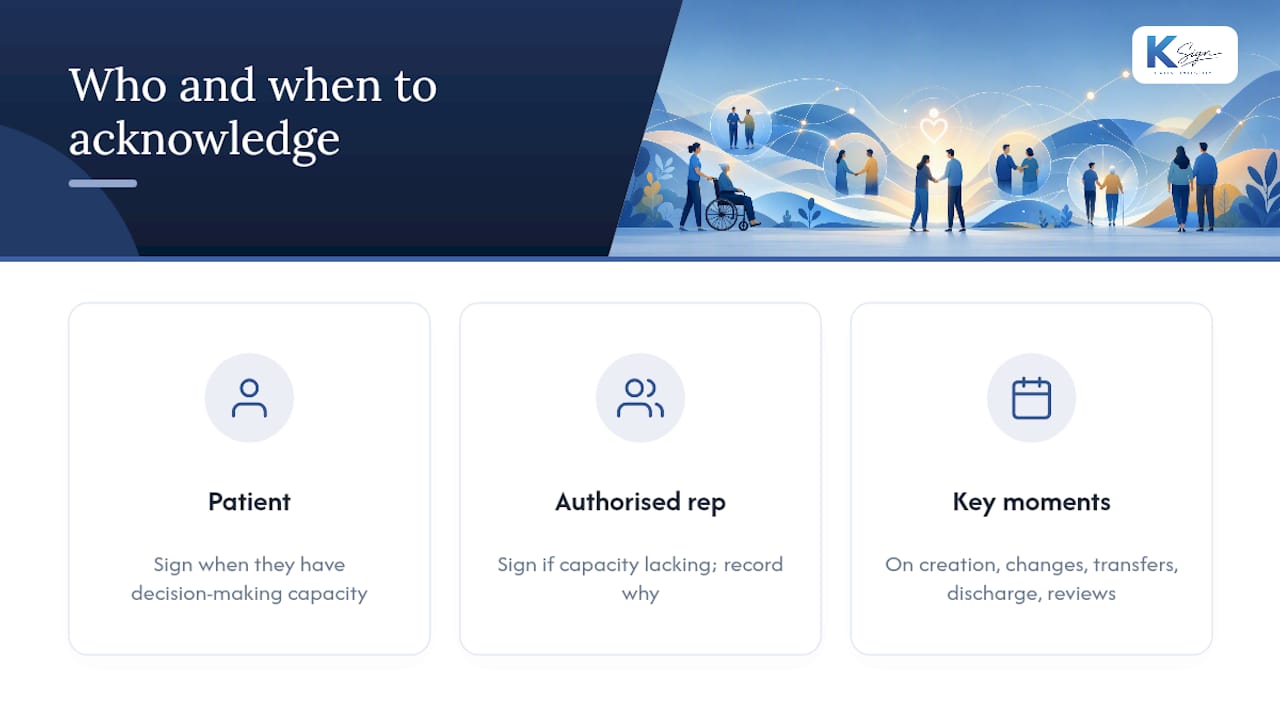
Timing matters as much as who signs. Collect an acknowledgement whenever a care plan is first created, after significant changes, during transfers of care, at discharge, and during routine periodic reviews.
If someone defers or refuses to acknowledge the plan, document that decision and the reasoning behind it. A refusal recorded with context is far more defensible than a missing signature with none.
Why acknowledgements matter for compliance and risk
Auditors and accreditation reviewers look for evidence that care was discussed, not just delivered. An acknowledgement with a plan version, a date, and a signer’s name is exactly that evidence, and its absence is one of the more common findings in documentation reviews.
It also reduces disputes. When a family later disagrees about what was agreed, a dated acknowledgement referencing the specific plan version settles the question quickly, rather than relying on memory or a verbal account.
- Supports audit and accreditation evidence trails
- Helps prevent and resolve disputes about agreed care
- Reinforces professional accountability under nursing and allied health record keeping obligations
Documentation quality directly affects audit outcomes. Guidance on the nurse care planning process shows that poor or incomplete records undermine both safe care and the ability to demonstrate it after the fact.
One caveat worth flagging: an acknowledgement is not a substitute for informed consent where a specific procedure or intervention legally requires its own consent process. Treat the two as related but separate obligations.
Best practices for a meaningful acknowledgement
A signature that follows genuine understanding is worth far more than one collected on autopilot. A few practical shifts turn acknowledgements from a formality into something that would actually hold up under scrutiny.
- Write a one-page plain-language summary of the care plan specifically for the person signing, separate from the full clinical document.
- Use a teach-back script. Ask the person to explain the plan back in their own words, and record the result, not just that teach-back happened.
- Offer alternative formats — large print, translated summaries, or an interpreter — for anyone who needs them.
- Record the context of the discussion: who was present, what questions came up, and any follow-up actions agreed.
- Link the acknowledgement explicitly to the exact care-plan version reviewed, not just “the current plan.”
Person-centred, shareable plans consistently produce more meaningful acknowledgements than static documents handed over without discussion, a point reinforced in NHS England’s personalised care and support planning guidance.
Pro Tip: Keep the plain-language summary to one page and reuse the same template every time. Consistency helps signers recognise what they’re looking at, and it makes teach-back faster for staff who are running it dozens of times a week.
Digital workflows and the audit trail they need
Paper acknowledgements get lost, filed in the wrong folder, or signed without a clear link to which plan version was actually reviewed. Moving to a digital acknowledgement fixes the traceability problem, provided the workflow captures the right metadata from the start.
At minimum, a digital acknowledgement should record:
- Signer identity and role, alongside a verifiable e-signature
- A timestamp for when the review and signing occurred
- A stable link or embedded copy of the exact plan version reviewed
- Audit metadata such as device or access details where feasible
- Retention rules and access controls appropriate for the clinical record
The strongest digital acknowledgements don’t just capture a signature. They capture who reviewed the plan, which version they saw, and when, so the whole exchange can be reconstructed months later without relying on anyone’s memory.
Electronic documentation systems that address versioning and metadata properly tend to produce better audit-ready records than manual processes, and tools built around digital policy acknowledgement forms show how much simpler this becomes once the workflow is built for it rather than bolted on. Basic security expectations still apply: authentication for the signer, encryption in transit and storage, and clear versioning so nobody can dispute which document was signed.
A quick template and checklist you can copy
Keep the fields simple enough to complete in under two minutes, and specific enough to survive an audit.

Template fields: plan title and version, date reviewed, signer name and role, statement of understanding, signature type, witness (if required), and free-text notes for discussion context.
Staff checklist:
- Confirm the summary was offered in an accessible format
- Confirm teach-back occurred and note the outcome
- Confirm the signer’s relationship to the patient is recorded
- Log any refusal or partial understanding with the reason given, not just the fact of it
Practitioner perspective: common pitfalls and quick fixes
The most common failure I see isn’t a bad template. It’s a paper-only process that quietly falls apart the moment a file goes missing or a signature page gets separated from the plan it belongs to. Nobody notices until an audit or a dispute forces the question, and by then the damage is done.
The fix is rarely complicated. A one-page plain-language summary, a teach-back note built into the standard workflow, and a digital link that ties the acknowledgement to a specific plan version solve most of the problem on their own. Form-native workflows, where the acknowledgement is generated directly from the plan rather than copied across separately, remove the gap where things get lost in the first place.
— Josh
Making acknowledgements part of your standard workflow
Most of the pitfalls above come down to the same root cause: the acknowledgement lives apart from the plan it’s meant to confirm. Ksign closes that gap by generating the acknowledgement directly from the same guided form that produces the care plan itself, so there’s no copying, no separate file, and no version mismatch to untangle later.
A guided form captures signer identity and role up front, the plan document is generated automatically from those answers, and the e-signature carries a timestamped audit trail linking straight back to the exact version reviewed. That covers the core requirements this article has walked through: plan identity, signer identity, timestamp, and a stable link between the two. If a service also collects a fee or deposit alongside the acknowledgement, payment collection can sit in the same workflow rather than a separate step. Teams handling this manually can see how electronic consent workflows work in practice, or go straight to the Ksign product overview to try a template against their own care plan process.