
Both UETA and the ESIGN Act make electronic signatures legally effective across the United States, and neither one lets a court throw out your contract just because it was signed on a screen instead of paper. ESIGN is the federal baseline; UETA is the state-level model law most jurisdictions have adopted. The practical takeaway for any business: the law rarely decides these disputes, your consent, intent, and audit trail evidence does.
TL;DR:
- Most states have adopted UETA closely following the original model law, but some use their own statutes, affecting procedural requirements.
- ESIGN preempts inconsistent state laws for consumer transactions, but most business-to-business contracts are governed mainly by UETA.
- Both laws emphasize that the method of signing is not prescribed, as long as intent and attribution are clearly demonstrated through a solid audit trail.
- Electronic signatures are not limited by specific technologies; emphasis should be on capturing consent, intent, and retaining verifiable records.
- The enforceability of electronic signatures hinges more on workflow quality, including consent, timestamps, authentication, and durable storage, than on which law applies.
Table of Contents
- UETA vs ESIGN: what each law actually is
- What the federal ESIGN Act actually requires
- Where UETA and ESIGN actually agree
- Key differences between UETA and ESIGN that actually matter
- Practical compliance checklist for electronic signatures
- UETA and ESIGN state adoption: the current landscape
- Operational lessons from building signing workflows
- Historical development and legislative background of UETA and ESIGN
- How UETA and ESIGN affect interstate and international transactions
- Common misconceptions and myths about UETA and ESIGN
- Enforcement challenges and legal precedents under each law
- Why the “which law applies” question misses the point
- How KSign helps you meet ESIGN and UETA requirements
- Primary texts and authoritative commentary
- Sources
UETA vs ESIGN: what each law actually is
UETA, the Uniform Electronic Transactions Act, is not a single federal statute at all. It’s a model law drafted by the Uniform Law Commission, a body of legal experts who write template legislation for states to adopt individually. States then pass their own version through their legislature, sometimes word for word, sometimes with local tweaks.
UETA is deliberately technology neutral. It doesn’t care whether a signature was captured with a stylus, a typed name, a click box, or a biometric scan. The law focuses on procedure: was there intent to sign, was there attribution to a specific person, and was the record retained in a form that can be reproduced accurately. That procedural focus is what makes it so durable, it hasn’t needed rewriting every time a new signing technology appears.
Because each state adopts UETA on its own, local variations exist. Some points worth knowing:
- Most states enacted UETA close to the original ULC text.
- A handful of states, including Illinois, New York, and Washington, use their own electronic transactions statutes instead of adopting UETA outright.
- State legislatures can add exclusions or extra formalities beyond the model text, particularly for family law or estate documents.
- Because UETA operates at state level, the exact rules governing your contract depend on which state’s law applies, not just whether “UETA” is in force.
What the federal ESIGN Act actually requires
ESIGN, short for the Electronic Signatures in Global and National Commerce Act, is a genuine federal statute passed in 2000. Its core rule is blunt: a signature, contract, or record can’t be denied legal effect purely because it exists in electronic form, according to Public Law 106-229. That single sentence is the reason electronic contracting scaled nationally instead of staying a patchwork of inconsistent state approaches.
ESIGN goes further than UETA in one specific area: consumer protection. When a business deals with a consumer rather than another business, ESIGN imposes disclosure obligations before that consumer can be asked to sign electronically. Key requirements include:
- Consumers must consent to receiving records electronically, and that consent has to be obtained in a way that demonstrates they can actually access electronic records.
- Businesses must disclose the consumer’s right to withdraw consent and receive paper records instead.
- ESIGN generally preempts inconsistent state law, but where a state has adopted UETA, the two statutes are designed to work together rather than compete.
Where UETA and ESIGN actually agree
Most of the legal comparisons published online exaggerate the tension between these two laws. In practice, businesses rarely have to choose one over the other, because they overlap heavily on the fundamentals. Three things both laws guarantee:
- Neither law mandates a specific signing technology. A scanned signature, a typed name, or a click-to-accept button can all satisfy the legal standard, provided the surrounding process shows genuine intent.
- Neither law lets a party dismiss a signature purely because it’s electronic. That’s the load-bearing principle of both statutes, and it’s why electronic contracting is enforceable nationwide rather than jurisdiction by jurisdiction.
- Both require proof of intent and consent in practice, even though neither spells out exactly what that proof must look like. Courts fill that gap by looking at the workflow: did the signer take a deliberate action, and was that action tied to them specifically?
Legal commentary from the American Bar Association treats UETA and ESIGN as complementary layers rather than competing frameworks. Courts generally enforce electronic signatures when the paper trail, so to speak, shows deliberate action and identifiable attribution.
Key differences between UETA and ESIGN that actually matter
The similarities get most of the attention in generic comparisons, but the differences are what actually shape how you build a signing workflow. Three areas deserve real attention.
Scope and exclusions. Both laws carve out categories where electronic execution isn’t enough on its own. Wills, testamentary trusts, certain family law documents (divorce, adoption), and specific provisions under the Uniform Commercial Code sit outside both frameworks, according to the UETA model text. If your business touches any of these document types, treat electronic signing as unsuitable rather than merely risky.
Consumer disclosure obligations. ESIGN’s “ability to access” requirement is more demanding than most businesses realise. It’s not enough to email a PDF, you need a process that confirms the consumer can genuinely open, read, and retain that record on their own hardware and software. This matters most for consumer-facing service agreements, subscription terms, and anything where a regulator might later ask whether the customer truly understood what they signed.
State variation and preemption. Because UETA is adopted state by state, a business operating across multiple states can face genuinely different procedural rules depending on which state’s law governs the contract. ESIGN acts as a federal floor beneath all of them, but it doesn’t erase those local differences.
- Consumer transactions carry heavier disclosure burdens than business-to-business ones under ESIGN.
- Wills, certain family law matters, and some UCC transactions generally fall outside both laws’ protection.
- A contract’s governing-law clause can determine which state’s UETA variation applies, even in a fully remote transaction.
Pro Tip: If your business operates in more than one state, add a governing-law clause to your standard contract template. It removes the guesswork about which state’s UETA variation controls the agreement if a dispute ever lands in court.
Practical compliance checklist for electronic signatures
Legal theory is only half the picture. What actually protects a business in a dispute is the quality of the workflow that produced the signature, not which statute technically applies. A concise compliance guide identifies the operational pieces that make an e-signature genuinely defensible, and they map neatly onto both laws’ requirements.
- Capture affirmative consent, and keep the record of it. Where consumer disclosure rules apply, don’t bury consent in fine print, make it an explicit, logged step in the flow.
- Design the signing action to demonstrate intent. A distinct click-to-sign button or a typed name tied to a confirmation step does more legal work than a passive checkbox pre-ticked by default.
- Log timestamps and delivery events. When was the document sent, when was it opened, when was it signed, and from what IP address or device.
- Record the authentication method used. Email verification, SMS codes, or knowledge-based checks all leave a trail that supports attribution to a specific signer.
- Retain the executed record durably and make it instantly retrievable. A signed contract sitting in someone’s inbox isn’t retention, a system that can reproduce the document and its audit trail on demand is.
One insight from practice guidance is worth calling out directly: a robust audit trail that combines timestamps, delivery and open events, and identity linkage is often the single most decisive piece of evidence when a signature’s validity gets challenged. Match your authentication method to the risk of the document, a low-value service quote doesn’t need the same rigour as a six-figure services agreement, but document that decision either way.
UETA and ESIGN state adoption: the current landscape
UETA has been adopted, in some form, by the vast majority of US states. It’s the closest thing to a national standard for electronic transaction procedure, even though it technically operates state by state rather than federally.
A small number of states never adopted the ULC’s model text and instead run their own electronic transactions statutes. In those jurisdictions, ESIGN still applies as the federal floor, so electronic signatures remain enforceable, just under a slightly different procedural framework than UETA states.
Where both UETA and ESIGN technically apply within a state, UETA generally governs the day-to-day procedural detail, while ESIGN sits underneath as the federal guarantee that electronic form alone can’t invalidate the agreement.
- Most states: UETA adopted, closely following the ULC model.
- A handful of states: separate state statute instead of UETA, with ESIGN as the federal backstop.
- Multi-state contracts: a governing-law clause avoids ambiguity about which state’s rules control.
Operational lessons from building signing workflows
Watching small businesses actually sign documents day to day teaches you something the statutes don’t spell out: compliance breaks down at the messy, human moments, not the legal theory. A tradesperson sending a quote from a job site, a clinic collecting a treatment consent form, a bookkeeper onboarding a new client, these are the transactions where “we’ll sort the audit trail later” quietly becomes “we never captured one.”

KSign’s form to contract to signature to payment workflow was built around that exact failure point. When a customer fills out a guided form, that data flows straight into the generated agreement, and the signing action itself is logged alongside timestamps, device information, and payment confirmation. Nothing sits in a separate email thread waiting to go missing.
Pro Tip: If you’re a field service business collecting quote approvals on-site, the strongest audit trail is the one captured automatically at the point the customer says yes, not the one you try to reconstruct from email later, as explained in how cleaning contracts are structured.
Historical development and legislative background of UETA and ESIGN
UETA emerged first, drafted by the Uniform Law Commission in 1999 as courts and legislatures grappled with a genuine problem: existing contract law assumed paper and wet-ink signatures, and electronic commerce was outgrowing that assumption fast. The ULC’s answer was a model act designed to slot into each state’s existing contract law without rewriting it, extending settled principles of intent and attribution to electronic form rather than inventing new legal categories.
States began adopting UETA almost immediately, but adoption wasn’t universal or instant, and Congress grew concerned that interstate commerce would fracture into fifty different electronic signature standards. That concern produced the ESIGN Act, passed in 2000, which gave electronic signatures a federal floor of validity regardless of whether a particular state had adopted UETA yet.
The two laws were deliberately built to interlock. ESIGN includes provisions that step back in states that had already adopted UETA, letting the state law govern procedural detail while the federal statute guaranteed the baseline nationally. This is why you rarely see the two laws described as competitors in serious legal commentary, they were drafted with each other in mind from the outset, not retrofitted together after the fact. The result was a hybrid legal architecture that’s unusual in American law: a federal statute and a state model law, running in parallel, deliberately designed not to contradict each other.
How UETA and ESIGN affect interstate and international transactions
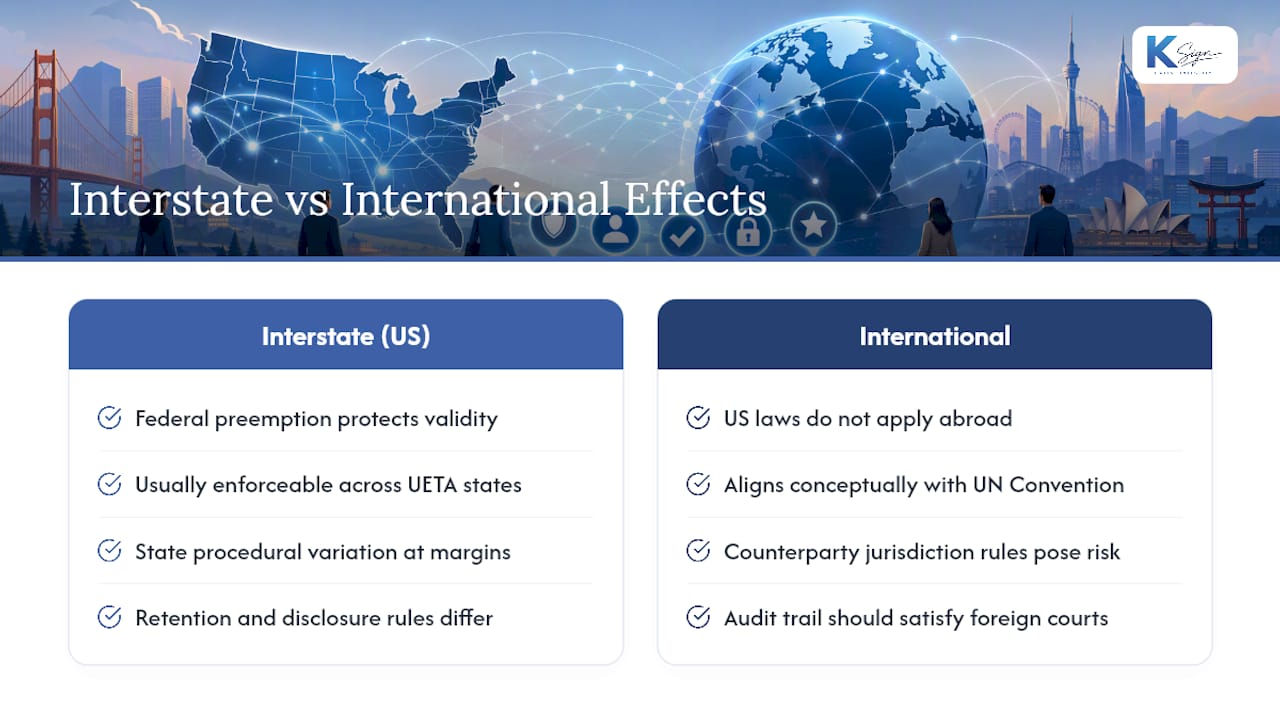
A signature valid in Texas needs to remain valid in New York for interstate commerce to function, and both statutes were written with exactly that problem in mind. ESIGN’s federal preemption role means a business can’t be caught out simply because a customer or supplier sits in a state with a different UETA variation, the federal floor holds regardless.
That said, state-level variation still creates friction businesses need to plan for. A contract executed between parties in two different UETA-adopting states will usually be enforceable in both, but the exact procedural requirements, what counts as adequate retention, what disclosure a consumer needs, can differ at the margins. This is precisely why governing-law clauses matter more for electronic contracts than paper ones ever needed them to.
Internationally, ESIGN and UETA don’t extend US procedural rules abroad, but they do align conceptually with frameworks like the UN Convention on the Use of Electronic Communications in International Contracts, which shares the same technology-neutral, intent-based philosophy. A US business signing agreements with an overseas supplier or client generally isn’t blocked by either law, the bigger practical risk is usually the counterpart jurisdiction’s own signature requirements, not anything in US statute. Cross-border service agreements, in particular, benefit from an audit trail robust enough to satisfy whichever jurisdiction ends up reviewing it, since you often can’t predict in advance which country’s court a dispute might land in.
Common misconceptions and myths about UETA and ESIGN
The biggest myth is that businesses have to pick between UETA and ESIGN, as if they’re competing standards you choose between like software vendors. They’re not. They’re layered protections, and in states that have adopted UETA, both apply simultaneously to most transactions.
A second common misconception: that a specific signature technology, like a particular e-signature platform or a certain type of digital certificate, is legally required. Neither law mandates a technology. What matters is whether the process shows intent and consent, a scanned signature on a PDF can be just as defensible as a sophisticated cryptographic signature, provided the surrounding audit trail supports it.
A third myth worth killing off: that “the signature is electronic” is itself a legal risk. It isn’t, that’s the exact scenario both laws were written to protect against. The real risk sits elsewhere, in weak consent flows, missing audit trails, or applying electronic signing to a document type that’s excluded from both laws’ protection, like a will.
Finally, many small business owners assume ESIGN’s consumer disclosure requirements only apply to large regulated industries like banking or insurance. They don’t. Any business dealing with individual consumers, a cleaning service, a photography studio, a allied health clinic, needs to think through the “ability to access” requirement before assuming a signed PDF satisfies it.
Enforcement challenges and legal precedents under each law
Disputes over electronic signatures rarely turn into arguments about UETA versus ESIGN in the abstract. They turn into arguments about evidence: did this specific person actually intend to sign this specific document, and can the business prove it. Courts consistently ask for the same things, regardless of which statute technically governs, attribution, intent, and record integrity.
Under UETA, litigation tends to focus on whether the signing “process” meets the state’s specific procedural requirements, since each state can add its own wrinkles. A business relying on a signature captured in one state but disputed in another may find itself navigating small but consequential differences in what that state’s UETA variation demands for retention or attribution.
Under ESIGN, the more common enforcement flashpoint is the consumer disclosure requirement, particularly the “ability to access” standard. Businesses that skip proper consent capture for consumer transactions face real exposure if a customer later claims they never agreed to sign electronically or couldn’t retrieve their copy of the record.
Legal commentary consistently emphasises that outcomes hinge less on which statute applies and more on workflow quality: audit trails, consent records, and authentication logs decide these cases far more often than statutory interpretation does, according to the American Bar Association. That’s a useful reframe for any business worried about legal exposure, the statute rarely fails you, a weak process does.
Why the “which law applies” question misses the point
Most articles on this topic treat UETA and ESIGN like two competing products a business has to choose between. That framing is backwards, and it leads business owners to spend energy on the wrong question. The right question isn’t “does UETA or ESIGN cover my contract,” it’s “can I prove this specific person intended to sign this specific document on this specific date.”
Where conventional advice falls short is in treating legal compliance as a one-time decision rather than an ongoing workflow discipline. I’d argue the consent step gets underweighted across almost every compliance guide I’ve read on this topic. Everyone talks about audit trails and retention, fewer talk about the moment before the signature, where a consumer actually agrees to transact electronically in the first place. Get that step sloppy and everything downstream, however well documented, sits on a shaky foundation.
If you take one thing from this comparison, prioritise consent capture first, intent-evidencing signing actions second, and durable retention third. Attribution and audit logging matter enormously, but they’re easier to bolt onto a workflow after the fact than genuine, demonstrable consent is.
— Josh
How KSign helps you meet ESIGN and UETA requirements
Reading the statutes tells you what “defensible” looks like on paper, building it into daily operations is the harder part. KSign is built around exactly that gap. Consent gets captured as a required step in the form itself, not an afterthought bolted onto a PDF. Every signing action generates a timestamped audit trail, and completed documents sit in durable storage you can pull up instantly if a dispute ever surfaces.
Because the workflow starts with the form rather than a finished document, contract automation generates the agreement straight from the customer’s own answers, cutting the manual re-entry errors that create attribution problems later. Deposit or payment collection can sit inside the same signing step, so there’s no separate email thread to lose. Have a look at how web forms turn customer intake into a signed, paid agreement, and see whether it fits the way your business already works.
Primary texts and authoritative commentary
For the statutory detail itself, read the ESIGN Act’s federal text and the UETA model act directly rather than relying on paraphrases. For interpretation and practical implication, the American Bar Association’s commentary and ArentFox Schiff’s compliance guidance explain how courts actually apply these principles in disputes.
This article is general information, not a substitute for advice from a qualified lawyer. Consult a qualified legal professional about your own circumstances before acting on anything here.
Sources
- Public Law 106-229 — Electronic Signatures in Global and National Commerce Act
- Uniform Electronic Transactions Act (UETA) — Uniform Law Commission
- Comment concerning use of electronic signatures and third-party opinion letters — American Bar Association
- E-signatures: When they’re legal and best practices for implementation — ArentFox Schiff