
Signed service contracts are the legal foundation beneath every SaaS customer relationship. Without one, you have no enforceable record of what was promised, what was paid for, or who owns what when something goes wrong. For Australian SaaS businesses, the stakes are concrete: disputes without contracts cost significantly more to resolve, and payment collection rates decline sharply when no written agreement exists.
The case for signed agreements goes well beyond avoiding disputes. A well-constructed service contract clarifies recurring billing cycles, pricing structures, service level commitments, update obligations, and termination conditions before any misunderstanding can take root. It also assigns intellectual property ownership clearly, which matters enormously when contractors or co-founders are involved. Written agreements improve compliance, build trust, and speed up negotiations by giving both parties a shared reference point from day one.
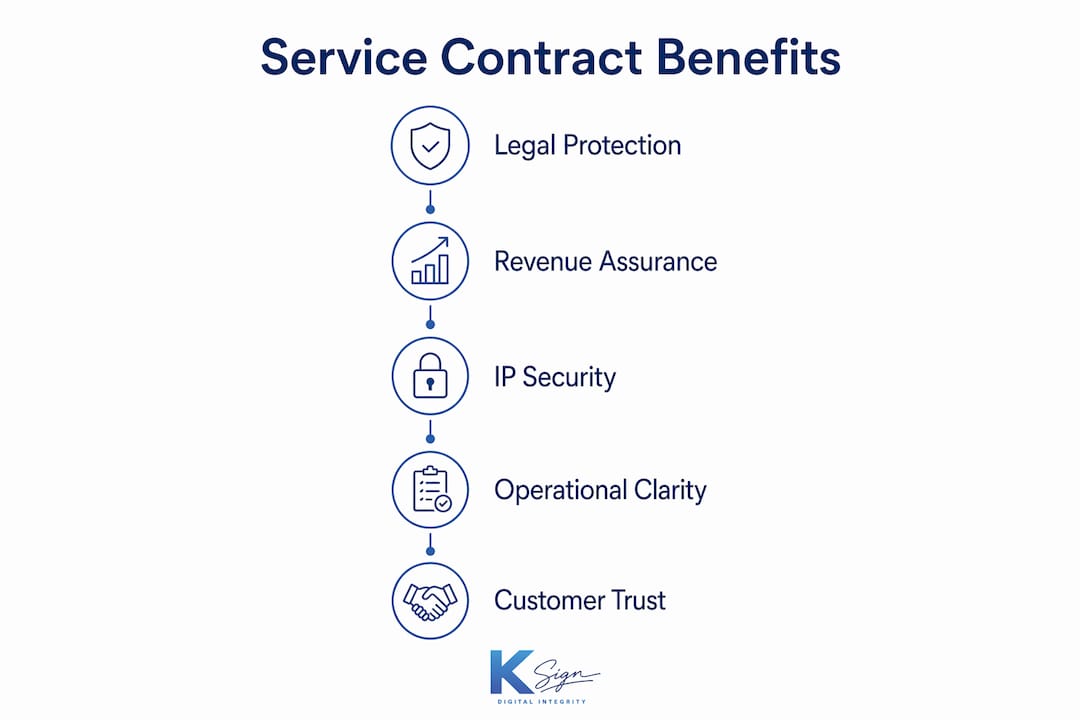
Here is what signed service contracts protect for Australian SaaS providers:
- Legal enforceability: Courts give written contracts far greater weight than verbal arrangements, giving you a clear path to enforce payment or remedy a breach.
- Revenue protection: Contract disputes cause notable revenue declines in the affected business line and delay projects for extended periods, as outlined in the Dealer program starter kit | Atlas Kings.
- Operational clarity: Contracts define access rights, billing mechanics, SLA commitments, and support boundaries so every team works from the same rulebook.
- IP ownership: Without a formal agreement, contractors may retain ownership of work they create for your platform, creating legal and operational exposure.
- Compliance: Australian privacy and consumer law obligations, including data handling requirements, belong in your service agreement before you onboard a single customer.
- Dispute resolution: A signed contract with a defined resolution mechanism avoids the expensive discovery process required to establish terms after the fact.
- Negotiation control: Entering an enterprise deal with your own startup-friendly MSA means you set the starting point, not the customer’s 80-page vendor agreement.
- Renewal efficiency: Well-drafted agreements reduce friction at renewal time, turning what could be a renegotiation into a routine process.
Pro Tip: Treat your service agreement as a live operational document, not a one-time legal formality. When your product evolves, your contract should too.
Generic templates rarely fit SaaS realities. They assume one-time service delivery rather than continuous access, miss recurring billing mechanics, and leave SLA remedies vague. Custom-drafted agreements aligned with how your product actually operates build customer trust and reduce the friction that stalls enterprise deals. Enterprise procurement teams read service agreements as risk documents; a contract that reflects your real service model signals maturity and shortens review cycles considerably.

For self-serve customers under roughly $5,000 ARR, a click-through Terms of Service paired with an order confirmation is usually sufficient. Once a customer’s procurement or legal team gets involved, they want a negotiated, signed MSA stored in their contract management system. Having that document ready before the conversation starts is the difference between closing a deal in days and watching it go quiet.
Ksign makes signed SaaS contracts simple for Australian SMBs
Most SaaS businesses in Australia are still stitching together forms, PDFs, email threads, and separate payment links to get a contract signed. Ksign replaces that entire chain with one workflow: your customer completes a guided form, their answers generate the correct service agreement automatically, they sign it with a legally binding electronic signature, and they pay a deposit, all without leaving the process.
Ksign’s contract automation is built specifically for service businesses that need repeatable, professional documentation without enterprise pricing or complexity. There are no per-envelope fees, no hidden add-ons, and no requirement to have a finished PDF before you start. Visit ksign.co to see how quickly you can have your first signed SaaS service agreement in place.
Key takeaways
Signed service contracts protect Australian SaaS businesses from costly disputes, revenue loss, and IP exposure while giving every customer relationship a clear, enforceable foundation.
| Point | Details |
|---|---|
| Revenue at risk without contracts | Payment collection rates decline sharply and disputes cause notable revenue declines in the affected business line. |
| Dispute costs multiply | Resolving a dispute without a written agreement costs significantly more than resolving one with a contract in place. |
| IP ownership requires written terms | Without a formal agreement, contractors may retain ownership of work created for your platform. |
| Custom agreements outperform templates | Generic templates miss recurring billing, SLA remedies, and update obligations specific to SaaS products. |
| Ksign automates the full workflow | Ksign turns customer form responses into signed, paid service agreements without disconnected tools. |