
A tax return sign-off is the formal, documented approval confirming that a tax return is accurate, complete, and ready for submission to the Australian Taxation Office. It is not simply a signature collected at the end of a process. It is the final quality checkpoint in a professional accounting workflow, establishing accountability, creating a verifiable audit trail, and protecting both the accountant and the client from compliance risk.
Table of Contents
- What does a tax return sign-off actually mean?
- Why sign-off compliance protects your accounting practice
- How Australian small businesses handle sign-off in practice
- Key takeaways
What does a tax return sign-off actually mean?
The sign-off step carries real legal weight. The signing preparer holds primary responsibility for the overall substantive accuracy of the return, regardless of what advice third parties may have contributed. A common misconception is that relying on a financial adviser or specialist removes that liability. It does not. Preparers can rely on third-party advice in good faith, but only after vetting it against a reasonable practitioner standard. Blind reliance is not a defence.
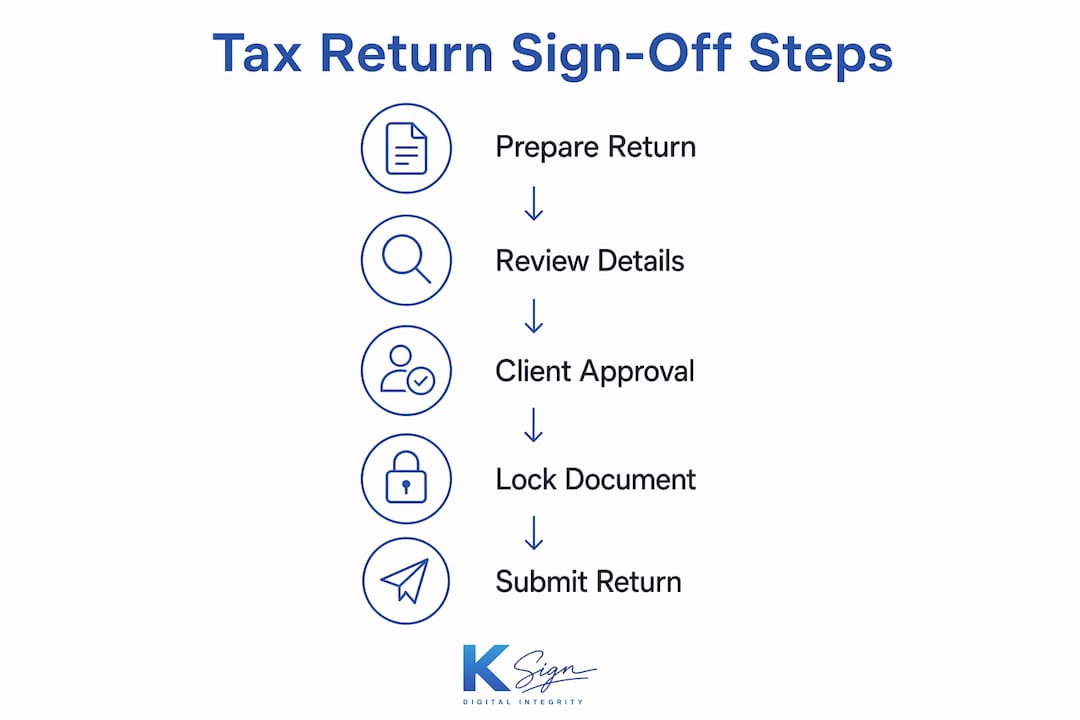
In Australian small business accounting, the sign-off process typically involves:
- Internal review by a senior accountant or partner before the client sees the return
- Client review and written approval confirming they have examined the final version
- A signed authorisation form linking the client’s approval to the exact document being filed
- Secure archiving of the signed record and any supporting correspondence
Digital platforms have made this process traceable in ways paper workflows never could. When a client signs a tax return online, the timestamp, IP address, and document version are all captured automatically, creating an audit trail that holds up under ATO scrutiny.
Why sign-off compliance protects your accounting practice
Treating sign-off as a formality is one of the more costly mistakes an accounting practice can make. Accounting practice guides are clear: sign-off is the final gatekeeping step in quality assurance, not a box-ticking exercise. Firms that dismiss it expose themselves to audit failures, professional liability claims, and reputational damage.
Pro Tip: Lock the return in your document management system immediately after client approval. Any unauthorised edit after sign-off invalidates the electronic authorisation and corrupts the audit trail.

Multi-tier review workflows reduce preparation errors before the return ever reaches the client. The standard path runs from staff preparer through senior reviewer to partner sign-off, with each tier documented. Firms enforcing this structure report fewer errors and stronger compliance outcomes. Version control is non-negotiable: the authorisation form must be explicitly linked to the final filed version, not an earlier draft.
Key compliance obligations for Australian accountants include:
- Retaining signed authorisation records in line with ATO document retention requirements
- Confirming the client has reviewed the return before approving, not just received it
- Documenting the date and method of client approval
- Maintaining audit trails for signed documents that can be produced during a compliance review
How Australian small businesses handle sign-off in practice
Consider a sole trader running a home services business. Their accountant prepares the annual return, routes it through an internal review, then sends a digital approval request via a platform like Ksign. The client receives a link, reviews the return on their phone, and signs electronically. The signed document, timestamp, and approval record are stored automatically. Businesses like Sorted Home Solutions represent exactly this kind of small operator: time-poor, mobile-first, and reliant on their accountant to make compliance straightforward.
For a small business with a more complex structure, the process adds a layer. The accountant may send a summary of key figures alongside the return, request written confirmation that the client has read it, and only then collect the formal sign-off. That confirmation becomes part of the retained record. Ksign’s accounting and tax workflow tools support this kind of structured, repeatable approval process without the friction of email chains and PDF attachments.
Key takeaways
A tax return sign-off is a formal compliance step that establishes legal accountability, creates a verifiable audit trail, and protects both accountant and client from ATO scrutiny.
| Point | Details |
|---|---|
| Sign-off is a legal obligation | The signing preparer holds ultimate responsibility for substantive accuracy, regardless of third-party advice. |
| Multi-tier review reduces errors | Routing returns through senior and partner review before client approval produces fewer compliance failures. |
| Version control is mandatory | Locking the return after client approval prevents unauthorised edits that invalidate electronic authorisation. |
| Digital audit trails are essential | Timestamps, IP records, and document version links are captured automatically in digital sign-off workflows. |
| Document retention is required | Signed authorisation forms must be retained per ATO requirements and linked to the exact filed return version. |