
A ready-to-use non-compete agreement template for Australian small businesses is available below. Copy the clause, tailor the bracketed fields to the specific role, and execute it correctly — the enforceability of any restraint of trade in Australia depends on protecting a legitimate business interest and being reasonable in scope, duration, and territory. That is not a formality; it is the legal test every Australian court applies.
Quick-use template snippet (adapt before signing):
RESTRAINT OF TRADE

During employment and for after the
termination of employment for any reason, the Employee must not, within
, directly or
indirectly:

(a) carry on, be employed by, or provide services to any business that
    competes with the Employer in; or

(b) solicit or approach any client of the Employer with whom the Employee
    had direct contact in the 12 months prior to termination.

The Employee acknowledges that this restraint is reasonable and necessary
to protect the Employer's legitimate business interests, including
.
Before you use this clause, note the following:
- Tailor every bracketed field to the actual role — generic durations and territories are the most common reason clauses fail in court.
- Identify the legitimate interest you are protecting (confidential information, client connections, trade secrets) and document it in a schedule or role description.
- Enforceability is assessed at the time the contract is signed, not when you try to enforce it — overbroad clauses cannot be fixed later outside New South Wales.
- Seek legal review for senior hires, sales roles, or high-value business sales where the stakes justify professional advice.
- The checklist, sample clauses, and execution guidance below will help you tailor and sign the agreement correctly.
This article provides general information, not legal advice. Confirm current rules with a qualified Australian employment lawyer before relying on any clause.
Table of Contents
- Which non-compete template do you need?
- Are non-compete agreements enforceable in Australia?
- What must your non-compete clause include?
- Two sample clauses you can adapt right now
- How to execute the agreement and avoid common traps
- How Ksign’s form-to-contract workflow produces tailored non-competes faster
- Key takeaways
- The case for using non-competes sparingly
- Ksign makes non-compete agreements faster and safer to produce
- Useful Australian sources and further reading
Which non-compete template do you need?
The right starting point depends on the relationship and the risk you are managing. Three template families cover most Australian small business scenarios.
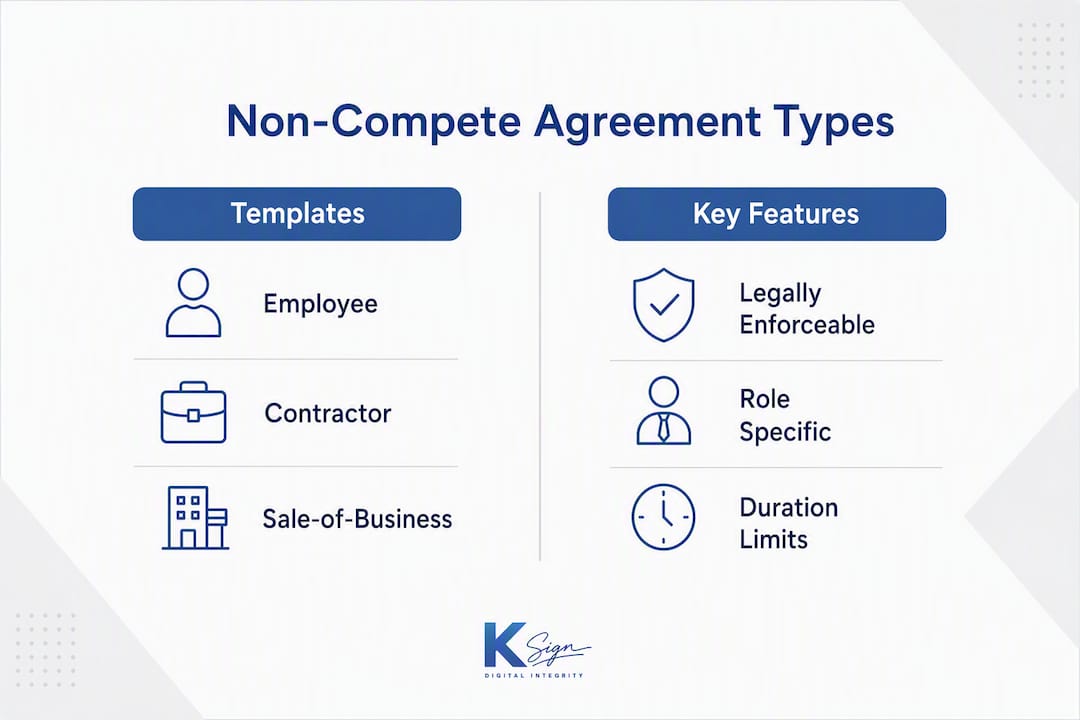
Employee non-compete
Used when hiring a direct employee, particularly one who will access client lists, pricing, proprietary methods, or confidential operational data. A sales representative who manages your top ten accounts, a senior manager who knows your supplier margins, or a technician trained in a proprietary process are all candidates. The restraint sits inside the employment contract or a standalone deed signed at the time of hire.

Contractor restraint
Independent contractors are not employees, so the legal framework differs slightly, but the restraint-of-trade doctrine still applies. Use a contractor restraint when engaging a consultant, freelancer, or specialist who will access confidential client data or build direct relationships with your customers. The clause belongs in the services agreement, not a separate employment document.
Sale-of-business restraint
When you buy a business, you are paying partly for goodwill — the seller’s client relationships and reputation. A sale-of-business restraint stops the vendor from immediately setting up a competing operation and taking those clients back. Courts generally apply a more generous reasonableness standard here because the vendor has received consideration (the sale price) in exchange for the restriction.
Decision flow — which template fits your situation?
- Hiring a permanent or casual employee? Use the employee non-compete inside the employment contract.
- Engaging a contractor or consultant? Use the contractor restraint inside the services agreement.
- Buying or selling a business? Use the sale-of-business restraint in the sale agreement.
- Worried mainly about poaching clients or staff, not industry competition? Prefer a non-solicitation clause — it is narrower, more defensible, and often sufficient.
- Worried mainly about confidential information leaking? A confidentiality (NDA) clause may be all you need, with no restraint on where the person works.
The non-solicitation and confidentiality alternatives are worth considering seriously. A blanket industry ban is harder to enforce and more likely to attract legal challenge than a targeted clause that addresses the actual risk.
Are non-compete agreements enforceable in Australia?
Yes, but only within strict limits. Under Australian common law, a restraint of trade is presumptively void — the starting position is that it is unenforceable. The employer carries the burden of proving two things: first, that the restraint protects a legitimate business interest; and second, that it is no wider than reasonably necessary to protect that interest.
Courts assess reasonableness by looking at the role’s seniority, the geographical area covered, the length of the restriction, and whether the employer can point to a concrete protectable interest such as trade secrets or specific customer connections. General employee skill, experience, or industry knowledge does not qualify — the interest must be proprietary to the employer.
Legitimate interests courts will protect:
- Confidential information and trade secrets (pricing models, client data, proprietary processes)
- Specific customer connections built during employment
- Workforce stability in limited circumstances
- Goodwill in a business sale
What courts will not protect:
- General industry knowledge or skills the employee brought to the role
- The employer’s desire to limit competition broadly
- Clauses whose main function is to intimidate rather than protect — courts actively disfavour “in terrorem” clauses used to scare ex-employees rather than protect genuine interests
The NSW difference
New South Wales is the only Australian jurisdiction with a statutory read-down power. Under the NSW Restraints of Trade Act 1976, a court can modify an overbroad clause to make it reasonable rather than striking it out entirely. In every other state and territory, the blue-pencil rule applies: courts can sever text but cannot rewrite it. An overbroad clause in Queensland or Victoria is simply void. This makes governing-law choice meaningful — if your business operates across multiple states, NSW governing law gives you a safety net that other jurisdictions do not.

The Parliamentary Library’s 2025–26 research brief also flags proposed federal reforms that would restrict non-competes below a high-income threshold, effective from 2027 subject to legislation. If you are drafting restraints for lower-paid roles today, that reform risk is worth factoring in.
Pro Tip: Start with the interest, not the restraint. Before drafting a single clause, write down in plain English what specific information or client relationship you are protecting and why losing it would cause real harm. That document becomes your evidence if you ever need to enforce the clause.
What must your non-compete clause include?
A defensible non-compete clause is narrow by design. Courts will only enforce a restraint that is no wider than reasonably necessary to protect the identified interest — which means every element you include should be there for a specific reason, not because a template had it.
Must-have clause elements:
- Protected activities: Define the specific work the employee cannot do, tied to their actual role. “Competing in the electrical services industry” is too broad for a residential sparky; “providing residential electrical installation services to retail customers in the Greater Brisbane area” is defensible.
- Territory: Match the geography to where the employee actually operated. A state-wide restriction for a technician who only worked in one suburb will not survive scrutiny.
- Duration: Set a timeframe proportionate to the interest. See the table below for guidance by role type.
- Consideration: The restraint must be supported by consideration — typically the offer of employment itself (if signed at hire) or a specific payment or benefit (if added later).
- Exceptions: Carve out activities that pose no real risk, such as working in an unrelated industry or for a non-competing division of a large employer.
- Cascading rungs: Structure the clause with multiple tiers (e.g., 12 months nationwide, then 6 months statewide, then 3 months within 50 km) so a court has narrower alternatives to uphold if the broadest rung fails.
- Governing law: Specify NSW if you want the read-down safety net; otherwise, use the state where the employee primarily works.
- Severability: Include a standard severability clause so that if one element is struck out, the rest of the agreement survives.
Duration guidance by role
| Role type | Recommended duration | Rationale |
|---|---|---|
| Junior / entry-level | 3–6 months | Limited client exposure; short enough to be reasonable |
| Client-facing / sales | 6–12 months | Time to re-establish client relationships; proportionate to connection risk |
| Senior manager / executive | 12–24 months | Access to strategy, pricing, and key accounts justifies longer period |
| Sale-of-business vendor | 2–5 years | Vendor received consideration; courts accept longer periods for goodwill protection |
Evidence to keep on file:
- A signed role description confirming the employee’s access to confidential data or client lists
- Records of any specific training investment or proprietary system access granted
- A copy of the signed agreement with date and witness details
- Any schedule or attachment identifying the specific legitimate interest
Pro Tip: Use cascading restraints in every jurisdiction, not just NSW — but back each rung with evidence showing why that level of restriction is needed. A cascading clause without supporting facts is still vulnerable; the tiers just give a court more options to work with.
Two sample clauses you can adapt right now
The two clauses below cover the most common small business scenarios. Copy the one that fits, replace the bracketed text, and review the notes before signing.
Clause A: Narrow, role-based restraint (recommended starting point)
RESTRAINT OF TRADE — CLAUSE A

For a period of [6 months] after the termination of the Employee's
employment for any reason, the Employee must not, within [the
metropolitan area of Melbourne], directly or indirectly carry on,
be employed by, consult to, or have a financial interest in any
business that provides [residential plumbing and drainage services
to residential property owners].

This clause does not prevent the Employee from working in an
unrelated trade or industry.
Plain-English notes:
- “For a period of [6 months]” — replace with the duration from the table above that matches the role’s seniority and client exposure. Six months is defensible for most client-facing trades roles.
- “within [the metropolitan area of Melbourne]” — use the actual geographic footprint of the business, not the broadest possible territory. If your business only operates in two suburbs, say so.
- “provides [residential plumbing and drainage services]” — this is the critical specificity. Name the actual service category, not the industry broadly.
- “does not prevent the Employee from working in an unrelated trade” — this exception signals to a court that you are protecting a specific interest, not trying to lock the person out of their livelihood.
Clause B: Broader restraint with cascading rungs (for senior or sales roles)
RESTRAINT OF TRADE — CLAUSE B

The Employee must not, during the Restraint Period and within the
Restraint Area, directly or indirectly solicit, service, or accept
business from any Restricted Client.

"Restraint Period" means the first of the following periods that
a court holds to be reasonable: (i) 18 months; (ii) 12 months;
(iii) 6 months; (iv) 3 months after termination of employment.

"Restraint Area" means the first of the following areas that a
court holds to be reasonable: (i) Australia; (ii) [State];
(iii) [City/Region].

"Restricted Client" means any client of the Employer with whom
the Employee had material contact in the 24 months prior to
termination.
Plain-English notes:
- The cascading structure gives a court narrower alternatives rather than forcing a binary void-or-enforce decision. This is particularly valuable outside NSW.
- “material contact” is more defensible than “any contact” — it limits the clause to clients the employee actually built a relationship with.
- This clause targets client solicitation rather than a blanket industry ban, which courts view more favourably.
- When to avoid Clause B: if the role has limited client exposure or the employee is junior, Clause B is likely overbroad. Use Clause A or a standalone confidentiality clause instead.
How to execute the agreement and avoid common traps
Getting the clause right is only half the job. Execution errors are a separate, common reason restraints fail.
Step-by-step execution checklist:
- Time the signing correctly. Present the restraint with the initial offer of employment, before the employee starts. Adding a restraint after employment has begun requires fresh consideration — a pay rise, a promotion, or a specific payment — or the clause may be unenforceable for lack of consideration.
- Choose deed or contract. A deed does not require separate consideration and is harder to challenge on that basis. Execute as a deed when adding a restraint to an existing employment relationship or when the consideration is not clearly documented.
- Witness the signature. Both parties should sign in the presence of an independent adult witness who is not a party to the agreement. The witness signs and prints their name and address.
- Keep a signed copy. Store the executed agreement securely with the employee’s personnel file. A digital audit trail (timestamp, IP address, identity verification) strengthens your position if you ever need to prove the agreement was signed.
- Attach the role description. A signed schedule describing the employee’s access to confidential information or client relationships is the single most useful piece of supporting evidence.
- Review before termination. If you are considering terminating an employee who is subject to a restraint, get legal advice first. Wrongful termination often prevents an employer from relying on post-employment restraints.
Common enforcement traps:
- Signing a restraint after employment starts without providing fresh consideration
- Using a boilerplate clause that covers activities the employee never actually performed
- Failing to document the specific legitimate interest the clause protects
- Terminating the employee in breach of contract, then trying to enforce the restraint
- Applying the same clause to every hire regardless of seniority or role
Pro Tip: Attach a one-page schedule to every restraint agreement that identifies, in plain language, the specific confidential information or client relationships the clause is designed to protect. That document is your first line of evidence if you ever need to go to court.
How Ksign’s form-to-contract workflow produces tailored non-competes faster
Boilerplate restraints are the most common drafting failure in small business employment contracts. Legal experts consistently note that clauses lacking an identified legitimate interest are frequently vulnerable in litigation — and the vulnerability usually traces back to a generic template that was never tailored to the actual role.
Ksign’s form-to-contract workflow addresses this directly. Rather than starting with a finished PDF, the workflow begins with a guided form that prompts you to input the role-specific details that determine enforceability: the protected activities, the territory, the duration, the legitimate interest, and the consideration. Those inputs populate the clause automatically, producing a document that reflects the actual hire rather than a generic placeholder.
What the workflow covers for non-compete agreements:
- Guided form prompts for role title, access to confidential data, client exposure, and geographic footprint
- Automatic clause generation from form inputs, with cascading rung options built in
- E-signature collection with witness fields and timestamp audit trail
- Secure storage of the signed agreement and supporting schedule
- Repeatable templates for different role types (junior, client-facing, senior) so each new hire gets the right clause, not the same one
For home service businesses and client-facing trades roles where client relationships drive growth, the ability to capture evidence of client exposure at the point of hire is particularly valuable. The form answers become part of the audit trail — not just the signed clause, but the documented reason it was needed.
Key takeaways
A narrow, role-specific non-compete clause tailored to a documented legitimate interest is the only kind Australian courts will enforce — boilerplate restraints without identified interests are routinely struck down.
| Point | Details |
|---|---|
| Pick the right template | Choose employee, contractor, or sale-of-business based on the relationship type before drafting. |
| Document the legitimate interest | Identify the specific confidential information or client connection the clause protects and attach it as a signed schedule. |
| Match duration to seniority | Use 3–6 months for junior roles, 6–12 months for client-facing staff, and 12–24 months for senior executives. |
| Execute correctly | Sign at the time of hire, witness properly, and store a digital audit trail — adding a restraint later requires fresh consideration. |
| Use Ksign for tailored drafts | Ksign’s guided form workflow prompts role-specific inputs and captures evidence, replacing generic boilerplate with defensible, tailored clauses. |
The case for using non-competes sparingly
Most small businesses reach for a non-compete clause out of habit rather than necessity. The honest position is that a well-drafted confidentiality clause or non-solicitation clause will cover the actual risk in the majority of hires — and both are considerably easier to enforce than a full restraint of trade.
The situations where a tailored non-compete genuinely earns its place are specific: a senior sales manager who personally owns the relationships with your top clients; a technical specialist trained in a proprietary process that took years to develop; a business sale where the vendor’s goodwill is a material part of the purchase price. In those cases, the investment in careful drafting and proper execution is justified. The clause needs to name the interest, fit the role, and be signed correctly — not because the law demands paperwork for its own sake, but because the factual specificity is what makes the restraint credible to a court.
For most other hires, a confidentiality clause that protects your pricing, client lists, and operational data will do the job without the enforceability risk. Pair it with a non-solicitation clause for client-facing roles, and you have covered the realistic threat without overreaching.
The practical lesson from Australian case law is that employers who lose restraint disputes usually lose on the facts, not the law. The clause was too broad for the role, the interest was never documented, or the employer’s own conduct undermined the agreement. Getting those three things right is not complicated — it just requires treating the restraint as a specific, evidenced decision rather than a standard contract clause.
Ksign makes non-compete agreements faster and safer to produce
Producing a tailored, Australia-ready non-compete agreement no longer requires a law firm on retainer or hours spent editing Word templates. Ksign’s contract automation workflow guides you through the inputs that matter — role title, protected activities, territory, duration, and the specific legitimate interest — and generates a clause that reflects the actual hire, not a generic placeholder.
The full workflow covers everything from guided data collection through to legally binding e-signature, witness fields, secure document storage, and a timestamped audit trail. For small businesses managing multiple hires or contractor engagements, repeatable role-specific templates mean every new agreement starts from the right clause, not the same boilerplate. Subscription plans are designed for small business budgets, with tiered options and a trial available — visit ksign.co to see current pricing and start building your first workflow.
Useful Australian sources and further reading
The sources below are the primary authorities for Australian non-compete law. Consult them if you need deeper legal certainty or are tracking the proposed federal reforms.
| Source | What you will find |
|---|---|
| Parliamentary Library Policy Brief (2025–26) | Overview of non-compete prevalence, economic modelling, and proposed federal reforms including the 2027 income-threshold ban |
| ANU Crawford School working paper | Research on the growth of non-competes across income groups and the case for regulatory response |
| Law Council of Australia submission | Reform options including income thresholds, mandatory identification of legitimate interests, and compensation requirements |
| NSW Restraints of Trade Act 1976 | The NSW statute that gives courts the read-down power; essential reading if you are choosing NSW as governing law |
| Clayton Utz — Restraints of trade in employment | Practical guidance on cascading clauses, the reasonableness test, and drafting for enforceability |
| Hall Payne — Non-compete clauses | Employee-side perspective on enforcement, wrongful termination risks, and in terrorem clauses |
| UNSW Law Journal (2023) | Academic analysis of the restraint-of-trade doctrine and proposals for resolving legal uncertainty |