
When you need a lease agreement for office space in Australia, the practical path is this: source a solid commercial lease template, agree your headline commercial deal in an Offer to Lease before detailed drafting begins, then have a solicitor review the final document before you sign anything. That sequence protects you from the two most common mistakes — signing a landlord’s standard form without negotiation, and letting lawyers draft a long-form lease before the commercial deal is actually settled.
Before you open any template, run through this quick checklist of must-have clauses:
- Lease term and options to renew — confirm the initial period and how many renewal options you hold
- Base rent, payment frequency and rent review mechanism — CPI, fixed percentage, or market review
- Outgoings — what you pay, how they are estimated, and whether you have audit rights
- Permitted use — the exact description of what your business can do in the space
- Make-good obligations — what condition you must return the premises in at lease end
- Security — bond amount, bank guarantee details, and return conditions
- Assignment and subletting — consent process and whether you remain liable after assignment
Pro Tip: Download a template from a reputable Australian source such as LawDepot Australia, but treat it as a starting point. Every clause you accept without negotiation is a clause the landlord drafted in their favour. State retail-lease rules in NSW, Queensland, Victoria and other jurisdictions add mandatory protections for certain premises — check whether your tenancy qualifies before you rely on a generic commercial template.
Key takeaways
A sound lease agreement for office space in Australia requires agreeing the commercial deal first, documenting it in an Offer to Lease, and having a solicitor review the formal lease before signing — with a digital workflow ensuring every signed document and condition report is stored with a verifiable audit trail.
| Point | Details |
|---|---|
| Agree commercial deal first | Record rent, term, outgoings basis, make-good scope and security in an Offer to Lease before formal drafting begins. |
| Use an AFL when works are needed | An Agreement for Lease protects you when landlord works or approvals must be completed before the lease commences. |
| Scrutinise the outgoings clause | “Gross” and “net” labels are not standardised in Australia; read the clause itself and model a 10–20% outgoings increase over the term. |
| Document condition at handover | Attach a photographic condition report to the signed lease at commencement — it is your primary evidence at make-good. |
| Always get targeted legal review | Outgoings drafting, make-good scope, assignment release and guarantor provisions require solicitor input regardless of template quality. |
| Ksign for the signing workflow | Ksign’s form-to-contract-to-signature-to-payment workflow reduces admin and produces a verifiable, auditable signed lease package. |
Table of Contents
- What is a commercial office lease in Australia and why does the wording matter?
- What clauses does every Australian office lease agreement need?
- How do gross and net leases work in Australia, and what is your real occupancy cost?
- What lease term should you choose, and how do renewal options and break clauses work?
- What do you need to know about fit-out works, handover and make-good?
- What should you know about assignment, subletting and personal guarantees?
- How do you negotiate an office lease and use an Offer to Lease effectively?
- Pre-signing checklist: final checks and realistic costs
- How do you customise a lease template safely and when do you need a lawyer?
- How does a digital workflow turn your template into a signed, auditable lease?
- Ksign makes lease signing faster from template to signed document
- Sources
What is a commercial office lease in Australia and why does the wording matter?
A commercial lease is a legally binding agreement between a landlord (lessor) and a tenant (lessee) that grants the tenant the right to occupy premises for a defined period in exchange for rent. The parties, the premises, the term, and the rent are the four pillars — but the wording of every other clause determines your actual financial exposure over the life of the tenancy.
The most important distinction in Australian leasing is retail versus non-retail. Retail leases — broadly, premises used for the sale of goods or services to the public — attract state-specific statutory protections under legislation such as the Retail Shop Leases Act 1994 (QLD). Those protections can include mandatory disclosure documents, restrictions on recoverable outgoings, and limits on the landlord’s ability to pass through certain costs. Office tenancies that are not retail premises generally fall outside those Acts, which means the lease wording carries even more weight — there is no statutory safety net to fall back on.
Business Queensland advises tenants not to rush the process or feel pressured into quick decisions. That guidance applies with particular force to office leases, where the absence of retail-lease protections means a poorly worded clause can expose you to costs that were never part of your commercial expectation.
For state-specific legislation and official forms, the federal portal at Legislation links through to each state and territory’s statutory text. Queensland’s publications portal also provides official lease forms under the Retail Shop Leases Act for tenancies that do fall within the retail regime.
What clauses does every Australian office lease agreement need?
Lease terms such as rent reviews, make-good, outgoings and assignment are the most frequent sources of disputes and materially shape a tenant’s financial exposure. A thorough clause checklist is your first line of defence.
Core clauses to check in any office lease contract:
- Parties and premises — full legal names of lessor and lessee, precise description of the premises (floor, area in square metres, car parks, storage)
- Lease term and options — commencement date, expiry date, number and duration of renewal options, and the notice period required to exercise each option
- Base rent and payment frequency — annual rent, GST treatment, payment date, and bank account details
- Rent review mechanism — CPI (using ABS CPI data for the relevant city), fixed percentage increase, or market review; frequency of reviews; whether reviews can move downward
- Outgoings recovery — which outgoings the tenant pays, how estimates are issued, how reconciliation works, and whether the tenant has audit rights over the landlord’s outgoings records
- Permitted use — a precise description; too narrow restricts your operations, too broad may conflict with other tenants’ exclusivity rights
- Fit-out approvals and landlord works — who does what, to what specification, and by when; attach plans and specs as schedules
- Make-good obligations — the standard to which you must return the premises; whether this means restoring to original condition or a lesser standard
- Assignment and subletting — consent process, grounds on which consent can be withheld, timeframes, and whether the original tenant is released on assignment
- Security deposit or bank guarantee — amount, form, conditions for draw-down, and return timeline
- Personal guarantees — who guarantees, any cap on liability, and release events
- Insurance — public liability minimum (typically $20 million for commercial tenancies), plate glass, and any landlord-required covers
- Repairs and maintenance — what the landlord maintains (structure, base building services) versus what the tenant maintains (fit-out, internal fixtures)
- Default and remedies — notice periods, cure periods, and re-entry rights
- Dispute resolution — mediation first, then arbitration or court proceedings; state retail-lease tribunals where applicable
- Signage and access — building directory rights, after-hours access, and any restrictions on external signage
- Handover condition report — a photographic record of the premises at commencement, attached as a schedule
Example wording to aim for:
Rent review (CPI): “The annual rent shall be reviewed on each anniversary of the commencement date by reference to the percentage change in the Consumer Price Index (All Groups, [relevant capital city]) published by the Australian Bureau of Statistics for the 12-month period ending on the review date, provided that the reviewed rent shall not be less than the rent payable immediately before the review date.”
Permitted use: “The tenant shall use the premises solely as offices for the conduct of [specific business description] and for no other purpose without the prior written consent of the landlord.”
Make-good: “At the expiry or earlier termination of the lease, the tenant shall, at its own cost, remove all fit-out items installed by the tenant and restore the premises to the condition described in the handover condition report, fair wear and tear excepted.”
Pro Tip: Agree the commercial deal first — rent, term, incentives, make-good scope, and security amount — and record those points in an Offer to Lease or Heads of Agreement. Then instruct your solicitor to draft or review the formal lease to reflect exactly what was agreed. Sprintlaw recommends this mark-up-and-summary approach precisely because it prevents the formal lease from quietly expanding the landlord’s rights beyond what you negotiated.
How do gross and net leases work in Australia, and what is your real occupancy cost?
Labels like ‘gross’ and ‘net’ are not consistently defined in Australia; tenants must scrutinise the outgoings clause rather than rely on the label. A lease described as “gross” may still require the tenant to pay increases in outgoings above a base year, or to contribute to specific items such as land tax. A “net” lease typically passes through all outgoings directly. In practice, most Australian office leases sit somewhere in between — often called a modified gross structure — where the base rent covers some costs and the tenant pays others separately.
Common outgoings that landlords seek to recover include:
- Council rates and charges
- Building insurance premiums
- Strata levies (where applicable)
- Land tax (check carefully — some states restrict this for retail leases)
- Common area cleaning and maintenance
- Building management fees
- Lift maintenance and essential services compliance
Worked example: Suppose your base rent is $60,000 per annum for 200 square metres. The landlord issues an outgoings estimate of $120 per square metre per annum, totalling $24,000. Your total occupancy cost before fit-out and utilities is therefore $84,000 per annum. At lease end, the landlord reconciles actual outgoings against estimates — if actual outgoings were $130 per square metre, you owe an additional $2,000.
Sensitivity check: Model what happens if outgoings increase by 10–20% over your lease term. On the example above, a 15% increase in outgoings adds $3,600 per annum to your cost base. Over a five-year term, that is $18,000 in additional exposure — enough to matter for a small business budget. Tenants should insist on specific definitions and audit rights in outgoings recovery clauses, and consider negotiating caps or exclusions for capital expenditure items where possible.
Always request a breakdown of the prior year’s actual outgoings before you sign. That figure is the most reliable predictor of what you will actually pay.
What lease term should you choose, and how do renewal options and break clauses work?
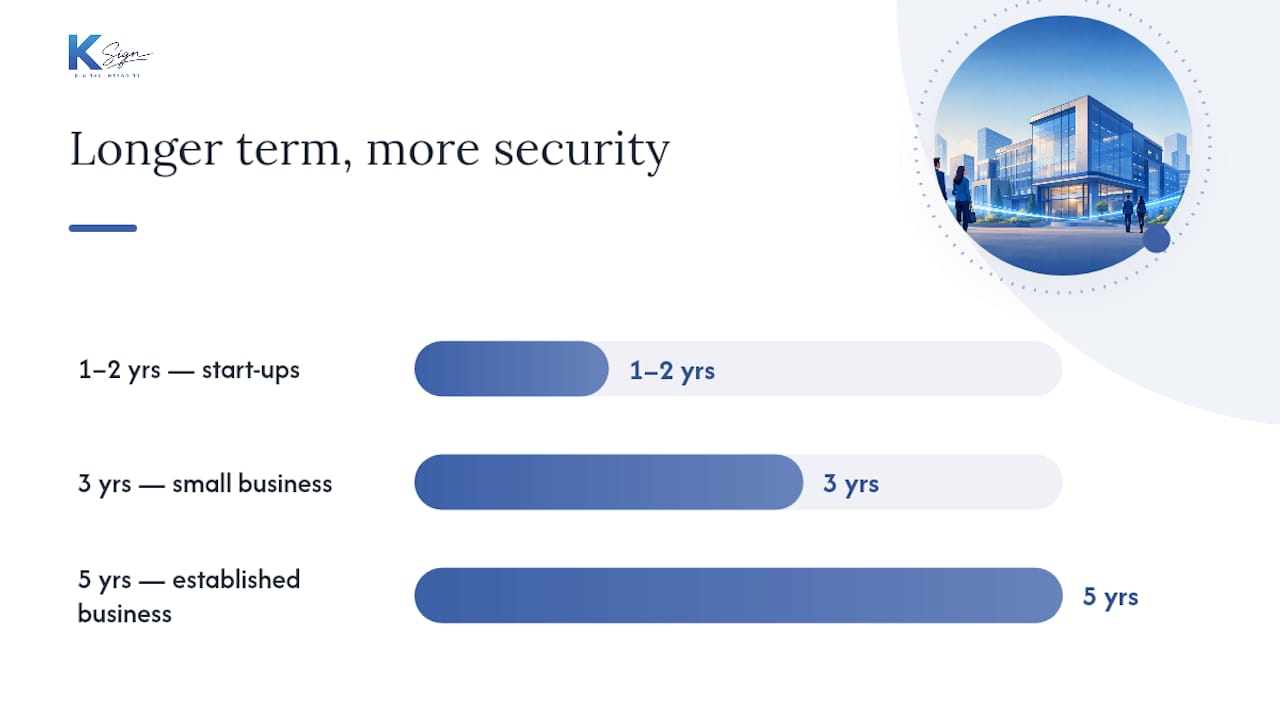
Choosing the right term is a balance between the security you need to justify fit-out investment and the flexibility your business model requires. The table below sets out common term structures and their typical rationale.
| Term | Typical use case | Key considerations |
|---|---|---|
| 1–2 years | Start-ups, businesses testing a new location, or those using serviced offices as a bridge | Minimal fit-out investment; limited negotiating leverage on rent; landlord unlikely to offer significant incentives |
| 3 years | Small businesses with modest fit-out needs and moderate certainty about growth | Reasonable balance of security and flexibility; options to renew give upside without locking in a long initial term |
| 5 years | Established businesses with significant fit-out investment or client-facing premises | Stronger negotiating position on rent-free periods and fit-out contributions; options to renew are standard |
| 7–10 years | Larger tenancies, anchor tenants, or businesses with major capital fit-out | Maximum landlord incentives; market rent reviews at renewal carry more risk if market moves against you |
Options to renew must be exercised strictly within the notice window specified in the lease — typically three to six months before expiry. Missing that window can forfeit your right to renew entirely, leaving you to renegotiate from scratch or vacate. Diary the deadline the day you sign.
Rent review at renewal is where ratchet clauses create real risk. A ratchet clause prevents the reviewed rent from falling below the rent payable immediately before the review, even if market rents have dropped. Always check whether the market review mechanism allows a downward adjustment and negotiate downward-review protection if the market is volatile or your term is long.
Break clauses — rights to terminate early on notice — are uncommon in standard Australian office leases but can be negotiated, particularly in longer terms. If you secure one, confirm the notice period, any make-good obligations triggered on early exit, and whether a break fee applies.
What do you need to know about fit-out works, handover and make-good?
The sequence from offer to handover is where most small-business tenants lose money through poor documentation. Follow this order:
- Negotiate the commercial deal — agree rent, term, incentives, and the scope of landlord works and tenant fit-out in the Offer to Lease or Heads of Agreement.
- Execute an Agreement for Lease (AFL) if works are required — an AFL protects tenants when landlord works, planning approvals, or tenant fit-out timing are required before lease commencement. The AFL sets conditions precedent, milestone dates, landlord works specifications, and a long-stop date after which either party may terminate.
- Attach plans and specifications — the AFL and the formal lease should both reference approved fit-out drawings as schedules. Vague references to “the tenant’s fit-out” without attached plans create disputes at make-good.
- Early access for fit-out — negotiate an early access period before rent commences so your fit-out contractor can work. Confirm in writing what the tenant can and cannot do during early access.
- Practical completion and defects list — when landlord works are complete, inspect and record any defects. Handle practical completion sign-off electronically so the defects list is timestamped and attached to the lease file immediately.
- Rent commencement — confirm the exact rent start date in writing. Where rent commences on practical completion of landlord works, the definition of “practical completion” in the AFL is critical.
- Handover condition report — photograph every wall, floor, ceiling, and fixture at commencement. Attach the report and photos to the signed lease. This document is your evidence at make-good.
- Make-good scope at lease end — the lease should specify exactly what “make good” requires: removal of fit-out items, patching and painting, reinstatement of services, or return to base-building condition. Vague language defaults to the most expensive interpretation.
Common pitfalls include accepting a make-good clause that requires “original condition” when the premises were already tired at commencement, and failing to document who owns the fit-out at lease end (which affects whether the landlord can require removal).
Pro Tip: Negotiate a fixed cash make-good cap or an agreed schedule of works attached to the lease. A cap converts an open-ended liability into a known cost. Without it, make-good can be the most expensive surprise at lease end — and it arrives at exactly the moment you are trying to move on.
What should you know about assignment, subletting and personal guarantees?
Assignment transfers the lease to a new tenant; subletting creates a sub-tenancy while you remain the head tenant. Both require landlord consent in virtually every Australian office lease, and the key question is what grounds the landlord can use to withhold that consent.
In retail leases, state legislation typically requires that consent not be unreasonably withheld and sets timeframes within which the landlord must respond. For non-retail office leases, the standard is whatever the lease says — which is often more permissive for the landlord. Negotiate “not to be unreasonably withheld or delayed” language into the assignment clause before you sign, not after you need to use it.
The more dangerous issue is ongoing liability after assignment. Unless the lease expressly releases the original tenant on assignment, you may remain liable for the assignee’s obligations for the remainder of the term. That exposure can run for years.
Negotiate a release mechanism into the lease at the outset. A well-drafted assignment clause will provide that the original tenant is released from ongoing liability once the landlord has approved the assignment and the assignee has demonstrated equivalent financial capacity. Without that release, assignment is a trap: you hand over the keys but keep the risk.
Guarantor considerations deserve equal attention. Landlords routinely require a director’s personal guarantee for the full term of the lease. That guarantee can expose personal assets — home, savings, investments — to a claim if the business defaults. Negotiate:
- A cap on the guarantee (e.g., limited to six or twelve months’ rent)
- Release events (e.g., automatic release after two years of on-time payments, or on assignment with an approved assignee)
- A bank guarantee as an alternative to a personal guarantee, which limits exposure to the guaranteed amount and keeps personal assets separate
How do you negotiate an office lease and use an Offer to Lease effectively?
The Offer to Lease (sometimes called Heads of Agreement or a Letter of Intent) is the document that records the commercial deal before lawyers get involved. Getting this stage right saves time, money, and the frustration of a formal lease that does not reflect what you actually agreed.
Sprintlaw recommends the mark-up-and-summary approach: agree commercial points in the Offer to Lease, then instruct lawyers to draft the formal lease to mirror those points. The Offer to Lease should cover:
- Premises description and area
- Lease term and renewal options
- Base rent and GST treatment
- Rent-free period (if any) and commencement date
- Outgoings — gross, net, or modified gross, and any caps
- Fit-out contribution or landlord works
- Make-good scope (agreed at this stage, not left to the formal lease)
- Security amount and form (bond or bank guarantee)
- Permitted use
- Any exclusivity rights
One caution: Heads of Agreement and Offers to Lease can be legally binding depending on their wording and the parties’ conduct. Treat them as potentially binding and have your solicitor review the document before you sign, particularly if it contains conditions precedent or deposit obligations.
When to use an Agreement for Lease: Where landlord works, planning approvals, or fit-out timing mean the lease cannot commence immediately, an AFL is the right instrument. It sets out the conditions that must be satisfied before the formal lease commences, the milestone dates for landlord works, and a long-stop date. Without an AFL, you may find yourself committed to a lease with no premises ready to occupy.
Negotiation checklist — have these ready before you sit down:
- Target rent and the maximum you will pay
- Rent-free period expectation (typically one month per year of term for a fitted space, more for a bare shell)
- Fit-out contribution or landlord works scope
- Make-good cap or agreed scope
- Security amount and preference for bank guarantee over personal guarantee
- Key dates: early access, rent commencement, option exercise windows
Pre-signing checklist: final checks and realistic costs
Before you sign any office tenancy agreement, work through these checks:
- Entity names match the intended contracting party (not a trading name or the wrong company)
- Premises definition includes all areas you are paying for (car parks, storage, common areas)
- Rent start date is unambiguous and reflects the agreed rent-free period
- Security amount and form match the Offer to Lease
- Insurance limits are specified and achievable (confirm with your broker)
- Fit-out access period is documented and early access conditions are clear
- Approved plans and condition report are attached as schedules
- Make-good scope is specific, not open-ended
- Solicitor has reviewed the final draft, not just the Offer to Lease
Typical timeline: From signed Offer to Lease to executed formal lease, allow four to eight weeks for a straightforward tenancy. Where an AFL is required, add four to twelve weeks for landlord works and approvals. Fit-out typically runs four to twelve weeks after early access, depending on scope.
Typical upfront costs to budget:
- Legal fees for solicitor review: $1,500–$5,000 depending on complexity and negotiation required
- Bank guarantee or bond: typically three to six months’ rent
- Rent in advance: one month on signing, plus any outgoings estimate
- Fit-out: highly variable, budget appropriately for a modest commercial fit-out in a major Australian city.
How do you customise a lease template safely and when do you need a lawyer?
A template from a reputable Australian source — LawDepot Australia, for example — gives you a structurally sound starting point. Using it safely means following a clear sequence.
Step-by-step:
- Identify your commercial deal points from the signed Offer to Lease and list them against the template clauses.
- Mark up the template with redlines showing every change you want, and attach a short commercial summary that states the agreed deal in plain language.
- Check state retail-lease triggers — if your premises might qualify as retail under your state’s Act, confirm with a solicitor before proceeding on a generic commercial template.
- Negotiate required changes with the landlord’s representative, using the commercial summary as the reference document.
- Instruct a solicitor for targeted review before signing — not a full redraft, but a focused review of the clauses that carry the most financial risk.
Clauses that typically require lawyer input regardless of template quality:
- Outgoings drafting (definitions, audit rights, exclusions)
- Make-good scope and any agreed cap
- Unusual liability or indemnity language
- Assignment release mechanics
- Guarantor drafting and cap provisions
This is general information, not legal advice. Always confirm current requirements with a qualified solicitor before signing a commercial lease.
How does a digital workflow turn your template into a signed, auditable lease?
The administrative burden of a commercial lease — collecting information, generating the document, chasing signatures, collecting a deposit, and filing the signed copy — is where small businesses lose hours they cannot recover. A structured digital workflow removes that friction at every step.
- Build an intake form that captures all commercial deal points: party names, premises details, rent, term, outgoings basis, security amount, and permitted use. Ksign’s guided web forms collect this data in a structured format that feeds directly into document generation.
- Auto-generate the lease from the form answers using contract automation, so the document reflects the agreed commercial deal without manual transcription errors.
- Attach the commercial summary and condition report as annexures to the generated lease. Photos from the handover inspection upload directly into the document package.
- Send for e-signature to all parties. Ksign’s e-signature workflow captures each party’s signature with an IP address and full audit trail, giving the signed lease evidentiary strength equivalent to a wet-ink document under Australian electronic transactions legislation.
- Collect the bond or deposit via integrated payment collection as part of the same workflow — no separate invoice, no chasing a bank transfer.
- Store the signed lease with its audit trail, condition report, and commercial summary in one place. Every party receives a copy automatically.
Checklist for evidentiary strength:
- Signed commercial summary or Offer to Lease attached as an annexure
- Condition report with timestamped photos attached at commencement
- Copies of any planning approvals or fit-out consents
- Bank guarantee details recorded in the lease file
- E-signature audit trail showing IP address, timestamp, and identity verification for each signatory
Pro Tip: Keep the commercial summary and the Offer to Lease as annexures to the signed formal lease. Any third party — a bank, an incoming assignee, or a court — can then read the commercial deal and the formal lease together. It removes ambiguity about what was actually agreed and makes the document package self-contained.
For building contracts and fit-out approvals during the works phase, the same digital workflow applies — as shown in how to get building contracts signed digitally.
What a cautious approach to office leases actually looks like
The pattern I see most often with small-business tenants is not recklessness — it is misplaced confidence in a label. They see “gross lease” and assume they know their total cost. They see “standard form” and assume it is balanced. Neither assumption holds in Australian commercial leasing.
The pragmatic rules I apply when reviewing leases for small businesses are simple: read the outgoings clause as if the landlord drafted it to maximise recovery (because they did), treat the make-good clause as a future liability that needs a dollar figure attached to it today, and never let the Offer to Lease expire before the formal lease is ready to sign. The Offer to Lease is your leverage. Once you are in a formal lease negotiation without a signed Offer, you are negotiating against a document the landlord’s solicitor has already drafted in the landlord’s favour.
The digital workflow matters here too. A signed, timestamped Offer to Lease attached to the formal lease as an annexure is a far stronger evidentiary anchor than an email chain. That is where a platform like Ksign earns its place — not as a substitute for legal advice, but as the infrastructure that makes the paper trail verifiable and the signing process fast.
Ksign makes lease signing faster from template to signed document
Getting a lease agreement for office space across the line involves more moving parts than most business owners expect: intake data, document generation, multi-party signatures, deposit collection, and a filed audit trail. Ksign brings all of those steps into one workflow — form, contract, signature, payment — so you spend less time chasing and more time on the business itself.
Build your Offer to Lease intake form, capture the commercial deal points, auto-generate the lease document, attach your condition report and photos, collect the bond via integrated payments, and secure legally binding e-signatures from all parties — all without switching between tools or sending PDFs back and forth by email. The signed lease, audit trail, and supporting documents are stored together and accessible immediately.
Ksign is not a substitute for legal advice, and every commercial lease should be reviewed by a qualified solicitor before signing. What Ksign removes is the administrative overhead that surrounds that legal review — so your solicitor reviews a clean, complete document package rather than a half-finished email thread.
Start with a 50% discount on e-signature plans and see how quickly a lease workflow comes together.
Sources
The sources below cover the primary legislation, official forms, and practical commentary relevant to office and retail leasing across Australian jurisdictions.
- Signing a business premises lease
- Commercial Lease Contract: Review and Negotiate | Sprintlaw Australia
- Understanding common terms and conditions in Australian commercial leasing - Mondaq