
A payment plan agreement is a short client contract paired with a policy page that locks in your fees, billing schedule, cancellation rules and enforcement rights, and links directly to automated payment capture. Done well, it gives your tutoring business predictable cashflow, enforceable terms and far fewer disputes. Done poorly, it leaves you chasing invoices and absorbing no-show costs with no legal recourse.
Here are the three actions to take right now:
- Pick your billing model (prepaid package, monthly subscription, pay-as-you-go, or retainer) and document it before you onboard another client.
- Add the core contract clauses covering fees, GST, payment timing, cancellations, refunds and guardian consent for minors, written in plain language your clients can understand in one read.
- Enable an automated payment workflow with signed authorisation, so card-on-file or direct debit charges happen without manual follow-up. A platform like Ksign can handle the form, contract, e-signature and payment capture in one workflow. Have your client-facing template reviewed by an Australian lawyer before you go live, and check that your terms comply with the Australian Consumer Law (ACL) before you use them.
Key takeaways
A tutoring business that combines a plain-language payment plan agreement with an automated form-to-payment workflow captures predictable cashflow, reduces disputes and spends less time on admin.
| Point | Details |
|---|---|
| Pick your billing model first | Choose prepaid package, subscription, instalment, retainer or pay-as-you-go before drafting any clause. |
| Core clauses must be plain and visible | Include fees, billing date, cancellation rules, refund policy and card authorisation in a short, readable agreement. |
| Automate the full workflow | Connect intake form, contract generation, e-signature and recurring billing so payment happens without manual follow-up. |
| Keep records for BAS and disputes | Store the signed agreement, invoices, receipts and attendance records together in one client file. |
| Ksign supports the end-to-end process | Ksign’s form-native contract automation and integrated payments handle onboarding and billing in one workflow. |
Table of Contents
- What clauses must every tutoring payment plan agreement include?
- Which payment model suits your tutoring business?
- What Australian legal obligations apply to tutoring payment agreements?
- Sample clauses you can adapt for your tutoring agreement
- How do you set up billing operations that actually collect reliably?
- How do you handle non-payment and disputes without damaging client relationships?
- How do you onboard families so they understand and accept the agreement?
- How do you build a digital form-to-payment workflow for tutoring onboarding?
- When should you review and update your tutoring agreement?
- What actually changed when we got the agreement right
- Ksign makes the form-to-payment workflow practical for tutoring businesses
- Sources
What clauses must every tutoring payment plan agreement include?
A short, readable client agreement paired with a policy page that answers common family questions reduces disputes. The agreement itself should be one to two pages; the policy page handles the detail. Together they need to cover every clause below.
Mandatory clauses checklist:
- Parties and contact details. Full legal names of the tutoring business and the client (or guardian if the student is a minor), plus emergency contact for minors.
- Scope of services. Subject areas, year level, session format (in-person, online, hybrid) and any exclusions. Avoid vague language like “general tutoring support.”
- Session length and format. State duration in minutes, platform for online sessions (Zoom, Google Meet, or your own portal), and whether sessions are one-to-one or group.
- Schedule and recurring bookings. Day, time, frequency, and whether the slot is guaranteed or subject to availability.
- Fees and GST treatment. Hourly or session rate, package price, or monthly subscription amount. State whether GST is included or added. Consult your accountant on GST registration thresholds.
- Accepted payment methods. Card on file, direct debit, BPay, PayID, or invoice with payment link. Specify which methods are accepted and any surcharges.
- Billing frequency and due dates. Weekly, fortnightly, monthly, or per-package. State the exact due date and what triggers the charge.
- Authorisation to charge. Explicit written consent to charge the nominated card or bank account on the agreed schedule. This clause is what makes automated billing enforceable.
- Package terms and expiry. If you sell prepaid sessions, state how many weeks sessions must be used within and what happens to unused sessions at expiry.
- Refund and credit policy. Under what conditions a refund is issued versus a credit applied. Be specific: “unused sessions cancelled with more than 48 hours’ notice will be credited, not refunded.”
- Cancellation and no-show rules. Notice period required (commonly 24 or 48 hours), fee charged for late cancellation or no-show, and how many no-shows trigger a review.
- Late fees and service suspension. The fee charged for overdue payments (state a fixed dollar amount or percentage, not an open-ended penalty) and the number of days before services are paused.
- Pause and holiday policy. Whether clients can pause their subscription or package, how much notice is required, and any limits on pause duration per year.
- Termination rights. How either party ends the agreement, notice period required, and what happens to prepaid sessions on termination.
- Liability limits. Cap your liability to fees paid in the relevant period. Do not promise academic outcomes you cannot guarantee.
- Privacy and data handling. How you store and use client data, consistent with the Australian Privacy Principles (APPs). State that payment details are held by your payment processor, not on your own servers.
- Guardian consent for minors. Confirm the signatory has authority to enter the agreement on behalf of the student and consents to the services described.
Pro Tip: Keep the client-facing agreement to one or two pages and move detailed policy rules (make-up session procedures, dispute resolution steps, full cancellation matrix) to a linked policy page. Families read the short agreement; the policy page protects you.
Which payment model suits your tutoring business?
Recurring billing options each carry operational trade-offs; the right model depends on your delivery format, client mix and growth stage. Most tutoring businesses use one primary model and offer a secondary option for clients who need flexibility.
The five common models:
- Prepaid packages. Client pays for a block of sessions upfront (e.g., 10 sessions for $850). Strong cashflow, high commitment signal, but requires clear expiry and refund rules. Best for test-prep programmes and structured courses with a defined end date.
- Monthly subscription. Fixed monthly fee charged automatically on a set date, covering a defined number of sessions per week. Predictable for both parties, easy to automate, but requires clear auto-renewal and cancellation notice language. Best for ongoing weekly tutoring at small centres.
- Instalment plans. A larger programme fee split into two or three payments over the course of a term or semester. Suits families who cannot pay upfront but want a structured programme. Requires explicit instalment dates and what happens if an instalment is missed.
- Retainer. Client pays a monthly retainer for a set number of hours, with unused hours either rolling over (capped) or expiring. Common for high-demand tutors with full schedules. Requires careful rollover and expiry language.
- Pay-as-you-go. Client pays per session, either in advance or within 24 hours of the session. Lowest commitment barrier, highest administrative overhead. Best for new clients or irregular scheduling needs.
A practical approach: start with pay-per-session, then introduce packages and subscriptions as trust and operational capacity grow, offering discounts or guaranteed time slots to justify the upfront ask.
| Model | Best for | Billing trigger | Key enforcement clause |
|---|---|---|---|
| Prepaid package | Test prep, structured courses | Upfront, before first session | Expiry date, no-refund after session 1 |
| Monthly subscription | Ongoing weekly tutoring | Auto-charge on fixed date | Auto-renewal notice, cancellation period |
| Instalment plan | Term-length programmes | Fixed instalment dates | Missed instalment suspension clause |
| Retainer | High-demand solo tutors | Monthly, start of period | Rollover cap, expiry on termination |
| Pay-as-you-go | New clients, irregular needs | Per session, card on file | Card authorisation, no-show fee |
Clear auto-renewal and expiry language is one of the most common recurring billing mistakes. Clients should know exactly when renewal happens, how much will be charged and how to cancel before the next cycle.
What Australian legal obligations apply to tutoring payment agreements?
Australian tutoring businesses operate under several overlapping legal frameworks. Getting these right protects you from unenforceable clauses and consumer complaints.
Australian Consumer Law (ACL) and unfair contract terms. The ACL, administered by the ACCC, prohibits unfair contract terms in standard-form consumer contracts. A clause is potentially unfair if it creates a significant imbalance in the parties’ rights, is not reasonably necessary to protect your legitimate interests, and would cause detriment to the client. Penalty clauses that are disproportionate to your actual loss are the most common ACL trap in tutoring agreements. Write late fees as a genuine pre-estimate of loss, not a punishment.
Privacy obligations under the Australian Privacy Principles (APPs). If your business has an annual turnover above $3 million, or if you handle sensitive information, the Privacy Act 1988 (Cth) and the APPs apply. Even below that threshold, best practice is to collect only the data you need, store payment details with a PCI-DSS-compliant processor, and state your data handling practices clearly in your agreement. Guardian payment details and student records both require careful handling.
GST and invoicing. Australian tutoring businesses must define pricing and ensure agreements reflect delivery realities and comply with local legal obligations. If your annual turnover reaches the GST registration threshold (confirm the current threshold with the ATO or your accountant), you must register for GST, charge it on taxable supplies, and issue tax invoices. Keep signed agreements, invoices and receipts together for BAS reporting. Tutoring services are generally taxable supplies; confirm your specific circumstances with a registered tax agent.
Guardian consent and working-with-children obligations. When the student is under 18, the agreement must be signed by a parent or legal guardian. State clearly that the signatory has authority to enter the contract on the student’s behalf. Working-with-children checks are an operational and regulatory requirement in every Australian state and territory, not a contractual one, but your agreement should note that all tutors hold current clearances.
Key compliance checklist:
- Plain-language terms that a reasonable consumer can understand in one read.
- No unfair penalty clauses; late fees tied to genuine loss.
- Privacy collection notice and data handling statement.
- Guardian signature line for students under 18.
- GST-inclusive or GST-exclusive pricing stated clearly, with tax invoices issued on request.
- Dispute resolution clause referencing a fair process.
Pro Tip: For high-value packages (above $1,000 per term) or when you operate across state lines or deliver online to clients in multiple jurisdictions, have an Australian lawyer review your template before use. A written client agreement reviewed by a lawyer is one of the highest-return investments a tutoring agency can make.
Sample clauses you can adapt for your tutoring agreement
These snippets are plain-language starting points. Have an Australian lawyer review them before use; they are not legal advice.
Fee and payment authorisation: Prepaid package terms and expiry: Monthly subscription auto-renewal and cancellation: Card-on-file authorisation: No-show and late cancellation: Refund and credit policy: Suspension for non-payment: Guardian consent for minors: Enforceable tutoring contracts pair a short client agreement with a policy page; the sample clauses above belong in the short agreement, while detailed make-up and dispute procedures sit in the policy page.
How do you set up billing operations that actually collect reliably?
Reliable payment collection is a systems problem, not a willpower problem. The right operational setup means money arrives without manual follow-up.
Operational checklist:
- Capture card or direct debit authorisation before the first session, as part of the signed agreement.
- Set up recurring payment profiles immediately after signing, tied to the agreed billing date.
- Configure automated receipts to send within minutes of each successful charge.
- Set failed-payment alerts to notify you within 24 hours of a declined transaction.
- Maintain a reconciled invoice history that matches each charge to a signed agreement and an attendance record.
Accepted payment methods in Australia and their trade-offs:
- Card on file (Stripe or similar). Lowest friction for recurring billing; surcharges may apply and must be disclosed. Best for subscriptions and packages.
- Direct debit (via BECS). Lower transaction cost than card, but slower to process and harder to dispute. Best for high-volume monthly billing.
- BPay. Familiar to Australian families, but manual and not suitable for automated recurring charges.
- PayID / Osko. Fast bank transfer, but requires manual reconciliation. Suitable for one-off payments, not recurring.
- Invoice with payment link. Flexible, but relies on the client acting. Use only for pay-as-you-go or instalment plans where you can pair it with automated reminders.
Recordkeeping is not optional. Keep the signed agreement, each invoice, each receipt and the corresponding attendance record together in one client file. This bundle is your evidence in a dispute and your source data for BAS reporting. Tie your scheduling system to billing so cancellations automatically create credits or trigger make-up rules; manual reconciliation is the biggest ongoing cost for growing centres. Ksign’s embedded payment features support card-on-file capture and recurring charge setup as part of the signing workflow, keeping the signed record and payment authorisation in the same audit trail.
Pro Tip: Reconcile failed payments daily. After two consecutive failed attempts, suspend future bookings automatically. This protects your time and signals to clients that payment is a genuine condition of service, not a suggestion.
How do you handle non-payment and disputes without damaging client relationships?
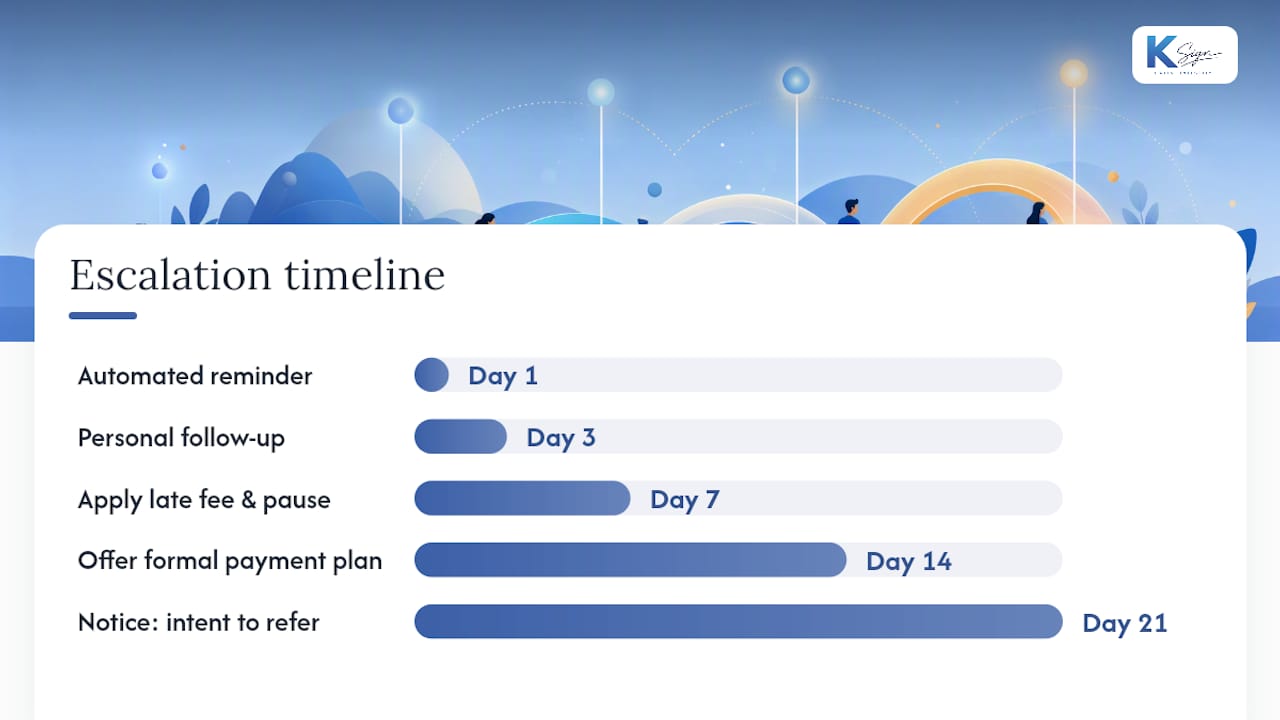
A clear escalation path protects your revenue and keeps your response consistent, which matters under the ACL’s fairness requirements.
- Day 1 after missed payment. Automated reminder sent by email or SMS: “Your payment of $[AMOUNT] was due on [DATE]. Please update your payment details or contact us to arrange payment.”
- Day 3. Personal follow-up by phone or email. Keep the tone neutral and factual. Offer to update card details or discuss a short-term arrangement if there is a genuine hardship situation.
- Day 7. Apply the late fee as stated in the agreement. Send a written notice confirming the fee and the total outstanding balance. Pause all upcoming sessions per the suspension clause.
- Day 14. Offer a formal payment arrangement in writing: a specific amount by a specific date, with the understanding that services resume on receipt of that payment.
- Day 21. Issue a formal written notice of intent to refer to a debt collection agency or pursue recovery through the relevant state small claims tribunal (NCAT in NSW, VCAT in Victoria, QCAT in Queensland, and equivalent bodies in other states). State the amount, the due date and the consequence of non-payment.
- Day 28 and beyond. Engage a debt collection agency or file a small claims application. For amounts above the small claims threshold, consult a solicitor.
What not to do. Never threaten action you are not prepared to take. Never apply a penalty that exceeds your actual loss, as this risks being an unenforceable penalty clause under Australian contract law. Never treat clients differently based on personal characteristics; apply the escalation process consistently.
Pro Tip: Keep every piece of correspondence in the client file: automated reminders, phone call notes, emails and formal notices. Consistent documentation is your defence against claims of unfair treatment and your evidence if you proceed to a tribunal.
How do you onboard families so they understand and accept the agreement?
The goal of onboarding is informed consent, not just a signature. Families who understand what they are signing dispute less and pay more reliably.
Onboarding checklist:
- Send a pre-enrolment summary email that states the fee, billing date, cancellation notice period and refund policy in plain language, before the agreement is presented.
- Attach or link a sample invoice so families know exactly what a charge will look like.
- Present the agreement with a plain-language highlights box at the top: three to five bullet points covering the most important terms (fee, billing date, cancellation rule, refund policy).
- Require the signed agreement and payment authorisation to be completed before the first session is confirmed.
- For students under 18, require the guardian’s signature and record their full name, relationship to the student, and contact details.
When sending the agreement by email or through a portal, include a short covering message: “Please review the attached agreement. The key terms are [fee], [billing date], [cancellation notice period]. If you have questions, reply to this email before signing.” Link the policy page clearly so families can find the detail without having to ask.
Pre-empt the most common parent questions in a short FAQ at the bottom of the policy page:
- “What happens if we need to cancel a session?” Covered in the cancellation clause; 48 hours’ notice required for a credit.
- “Can we pause over school holidays?” Yes, with [X] days’ notice; see the pause policy.
- “What if my child misses a session due to illness?” A medical certificate submitted within 24 hours entitles the client to a credit.
Training providers who require signed student contracts before the first session report fewer disputes and faster payment collection, because the terms are established before any service is delivered.
How do you build a digital form-to-payment workflow for tutoring onboarding?
A digital workflow removes the manual steps that create errors and delays. Here is a practical end-to-end process you can implement or hand to an assistant.
- Intake form. The client completes a guided online form capturing student name, year level, subjects, preferred schedule, contact details, guardian name (if applicable) and payment method preference.
- Auto-generate the agreement. Form responses populate a tailored contract and policy page automatically. The agreement reflects the selected billing model, session format and any package chosen.
- Present with plain-language highlights. The client receives the agreement with a summary box at the top: fee, billing date, cancellation rule, refund policy. The full policy page is linked.
- Collect e-signature and payment authorisation. The client signs the agreement electronically and authorises the card or direct debit charge. Both actions happen in the same workflow, creating a single timestamped audit trail.
- Trigger first payment and create recurring profile. On signing, the first payment (deposit or first session fee) is charged automatically. The recurring billing profile is created for subsequent charges.
- Automated receipts and reminders. Receipts are sent immediately after each successful charge. Upcoming payment reminders go out two to three days before each billing date. Failed payment alerts trigger the escalation sequence.
- Store everything in a searchable client record. The signed agreement, payment authorisation, invoices, receipts and attendance records are stored together and accessible for disputes or BAS reporting.
Connect your scheduling tool to billing so that when a session is cancelled with sufficient notice, a credit is created automatically in the client’s account. This removes the manual reconciliation step that consumes hours each week in growing centres. Online forms that generate contracts automatically reduce the risk of mismatched terms between what was discussed and what was signed.
Ksign supports this workflow natively: guided intake forms generate tailored agreements, e-signature capture and integrated payment collection happen in the same session, and the signed record with full audit trail is stored automatically. Have any template changes reviewed by an Australian lawyer before deploying to clients.
Key integration considerations:
- Scheduling system should write cancellations and attendance to the billing record automatically.
- Payment processor should support card-on-file and recurring charges with failed-payment webhooks.
- Audit trail should capture IP address, timestamp and device for each signature event.
- Client records should be exportable for BAS reporting and dispute evidence.
When should you review and update your tutoring agreement?
Agreements go stale. A clause that worked when you had five clients may be unenforceable or operationally unworkable at fifty.
Review triggers:
- Before each new academic year or term, check that fees, session formats and cancellation rules still reflect your actual delivery.
- After any rate change, update the fee clause before the new rate takes effect and notify existing clients in writing.
- When you add online delivery or a new subscription tier, confirm the agreement covers the new format and billing model.
- After a dispute or a pattern of non-payment, identify the clause that failed to protect you and rewrite it.
- When you change your payment processor or billing platform, confirm that the card authorisation and direct debit clauses still accurately describe the new process.
Update process:
- Highlight the specific clauses that are changing so clients can see exactly what is different.
- Test the updated agreement with a small group of new clients before rolling it out to your full client base.
- Publish the updated policy page and send a change notice to all existing clients with a clear effective date and at least 14 days’ notice for material changes.
Change notice template guidance: State the effective date, list the clauses that changed in plain language, and give clients a clear path to ask questions or exit if they do not accept the new terms. For minor administrative changes (updated contact details, new payment portal link), a shorter notice period is reasonable. For changes to fees, refund policy or cancellation rules, 14 to 30 days is appropriate and consistent with ACL fairness expectations.
What actually changed when we got the agreement right
There is a version of running a tutoring business where Sunday evenings are spent chasing unpaid invoices and rewriting the same explanation of your cancellation policy to different families. That version is exhausting, and it is entirely a documentation problem.
The shift that made the biggest operational difference was not the rate increase or the new scheduling software. It was separating the short client agreement from the detailed policy page, adding an explicit card-on-file authorisation clause, and connecting the signed agreement to an automated billing profile before the first session. The result: the time spent on payment follow-up dropped materially, and disputes about refunds and cancellations became rare because families had read and signed the terms before any money changed hands.
The one caveat worth flagging: this only works if the agreement is genuinely readable. A two-page document with a plain-language highlights box at the top performs better than a six-page legal document that families skim and sign without reading. Shorter, clearer, and signed before session one is the combination that holds.
Ksign makes the form-to-payment workflow practical for tutoring businesses
The workflow described in this guide, from intake form to signed agreement to automated payment, is exactly what Ksign is built for. Rather than stitching together a Google Form, a PDF template, an email chain and a separate payment link, Ksign handles the entire sequence in one place.
A tutor using Ksign would: (1) build a guided intake form that captures student details, subject, schedule and payment preference; (2) have the form responses automatically generate a tailored tutoring agreement with the correct billing model and clauses; and (3) send the agreement for e-signature and payment authorisation in a single step, with the first charge triggered on signing and the recurring profile created automatically. Every signed document, payment record and audit trail is stored in a searchable client record.
Ksign’s contract automation and e-signature capabilities are designed for small service businesses that need repeatable, professional workflows without enterprise complexity. Explore the platform at Ksign.co and, before you deploy any client-facing template, have it reviewed by an Australian lawyer.
Sources
The following sources informed this guide and are worth bookmarking for deeper review or legal checks.
- How to manage recurring payments in tutoring
- Tutoring contract template: enforceable agreements + faster payments | Tutorbase
- How to start a tutoring business in Australia
- Tutoring business model: revenue types and legal setup - LegalClarity
This article provides general information only and is not legal or financial advice. Consult an Australian lawyer before using any template with clients, and confirm GST obligations with a registered tax agent or the ATO.
This article is general information, not a substitute for advice from a qualified lawyer. Consult a qualified legal professional about your own circumstances before acting on anything here.