
Properly designed, integrated digital forms reduce per-field error rates from the range typical of manual entry down to a very low level using human-in-the-loop intelligent processing. That is not a marginal improvement. It is an order-of-magnitude shift in data integrity across every lease, tenant application, and bond transaction your business processes. For Australian small real-estate businesses still stitching together email, spreadsheets, and PDFs, the practical implication is clear: the errors are not a people problem, they are a process architecture problem, and digital forms with integrated contract generation, e-signature, and payment collection are the fix.
The human-in-the-loop model behind this accuracy gain works as follows: AI handles the majority of routine data extraction and validation; human reviewers address the remaining exceptions. The result is a system that captures structured, verified records rather than raw typed entries prone to transposition, omission, and mismatch.
Three immediate actions to start this week:
- Identify your highest-volume structured document (tenant application or contract intake) and measure your current error rate per field over 30 days.
- Build a dynamic digital form with conditional logic for that document type, replacing free-text fields with dropdowns, masks, and validation rules.
- Run a 60-day pilot using a form-to-contract workflow (Ksign supports this end-to-end) and track the five KPIs covered later in this guide.
Pro Tip: Start with tenant applications. They are high-volume, structurally consistent, and the errors they contain (mis-typed names, missing ID references, inconsistent contact details) have direct downstream cost in rework and compliance risk.
Table of Contents
- How digital forms stop the most common real-estate errors
- What the numbers say about measurable error reduction
- The rollout sequence that prevents wasted budget
- Common mistakes that erase the gains you expected
- Which real-estate workflows benefit most from digital forms
- How to measure error reduction and calculate ROI
- A property manager’s pilot: from email intake to form-to-contract workflow
- Key takeaways
- The case for starting now, not later
- Ksign gives you a practical pilot path, not a theory
How digital forms stop the most common real-estate errors
The errors that plague real-estate paperwork are almost entirely structural. They arise because humans re-key data from one system into another, because free-text fields accept anything, and because no single source of truth governs a transaction from intake to settlement.

Intelligent capture addresses this at the pipeline level. An OCR and layout-understanding layer reads the incoming document; NLP extraction pulls named fields (tenant name, property address, lease start date, bond amount); a validation and enrichment step checks those fields against defined rules before writing a structured record. The output is not a scanned PDF sitting in an inbox. It is a verified data record that can populate a contract template, trigger an e-signature request, and initiate a payment collection without a human re-typing a single character.
At the form level, field controls prevent input errors before they occur. Postcode masks reject non-numeric entries. ABN/ACN fields validate check-digit logic in real time. Date fields enforce logical sequencing (lease end cannot precede lease start). Conditional logic hides irrelevant fields and surfaces required ones based on prior answers, so a commercial lease intake never presents residential-only fields. These controls, combined with smart content fields that auto-populate from prior entries, eliminate the copy-paste errors that produce mismatched amounts across a contract, a bond lodgement, and an accounting record.
The downstream effect matters as much as the point-of-capture accuracy. When form data propagates through a single source of truth into your CRM, property management platform, and accounting system via API, transposed digits in a bond amount cannot survive to create a duplicate payment or a mismatched refund. The error is caught at entry or prevented entirely.
What the numbers say about measurable error reduction
The 2026 industry standard: human-in-the-loop processing reduces field-level error rates from 1–5% (manual entry) to approximately 0.1% per field.
To understand what that means for a real transaction, consider a standard 10-field lease intake: tenant full name, date of birth, contact number, email, current address, employment status, employer name, weekly income, lease start date, and bond amount. At a 3% manual error rate (mid-range), you would expect roughly 0.3 errors per record on average, meaning about 3 in every 10 leases contain at least one incorrect field. At 0.1% per field, that drops to 0.01 errors per record, or about 1 in every 100 leases containing an incorrect field.
Organisations deploying intelligent capture report large reductions in document processing errors and substantial processing time savings within months. For a small property management business processing 20 new tenancies per month, that throughput gain translates directly into staff hours recovered and rework costs avoided.
The highest immediate ROI consistently appears on high-volume, structurally consistent document types: tenant applications, contract metadata, and invoices. These provide clear baselines and fast measurement cycles, which is why the 60-day pilot model works so well for SMBs.
The rollout sequence that prevents wasted budget
The single most common cause of failed automation projects is skipping process redesign. Automating a broken process does not fix it. It locks the errors in and makes them faster.
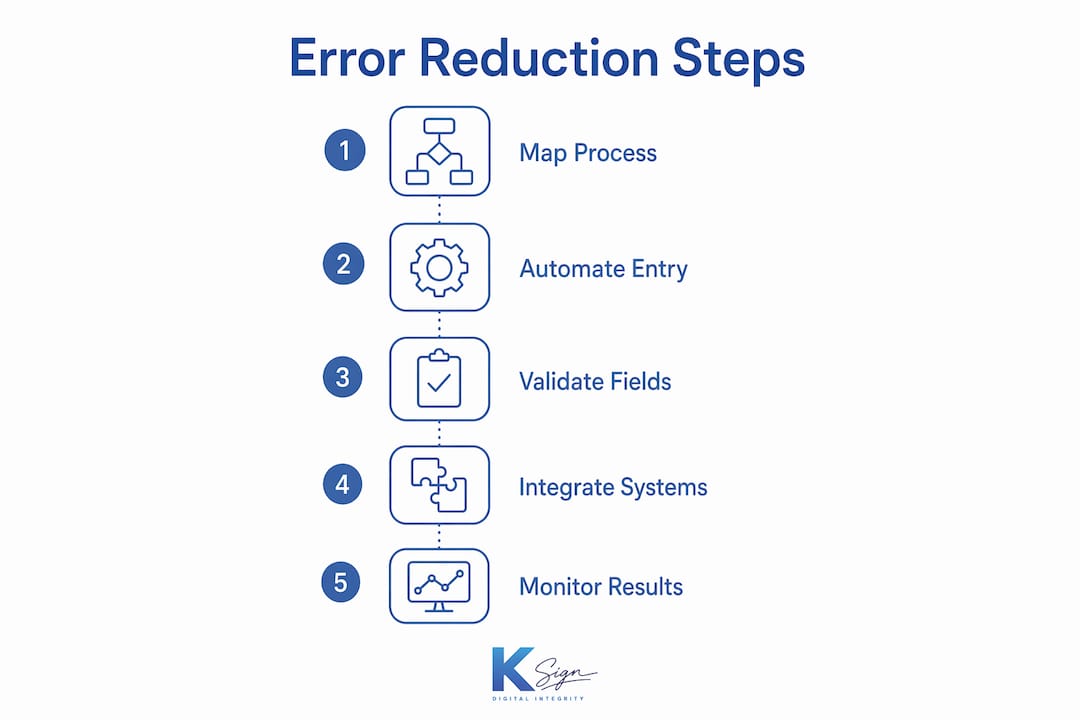
Step 1: Redesign. Map the current transaction end-to-end. Document who enters what data, at which point, and where errors are found downstream. Remove redundant steps: merge duplicate forms, eliminate approval loops that add no verification value, and identify fields that are collected twice across different documents.
Step 2: Automate. Deploy intelligent capture and integrated form-to-contract-to-signature-to-payment flows only where inputs are stable and outputs are defined. Start with one document type. A tenant intake form that generates a lease, triggers an e-signature, and captures the bond payment is a contained, measurable pilot.
Step 3: Protect. Add point-of-action checklists for the human judgements that remain. Keep them short (five fields or fewer per check), assign a named owner to each, and define what happens when a check fails. Workflows that include validation routers and exception channels prevent incorrect data from propagating across systems.
60-day pilot timeline:
- Week 0: Measure baseline KPIs (error rate per field, rework hours, time-to-sign).
- Weeks 1–2: Build the dynamic form, configure conditional logic, connect to CRM and payment gateway.
- Weeks 3–8: Run the live pilot on new transactions only; log all exceptions.
- Weeks 9–10: Measure post-pilot KPIs, categorise exceptions, iterate the form logic.
Pro Tip: Define data ownership before you go live. Nominate one person responsible for exception review, set a response SLA (e.g. same business day), and log every correction. Those corrections feed back into the capture model and reduce future exceptions over time.
Common mistakes that erase the gains you expected
The most expensive mistake is automating before redesigning. A digital form built on top of a process that already has redundant fields, inconsistent naming conventions, and no single source of truth will produce structured errors faster than manual entry produced unstructured ones. The errors are now consistent and systematic, which makes them harder to detect.
Overlong checklists are the second trap. When staff face a 15-point verification list on every transaction, they stop reading it. A five-field point-of-action check with a named owner and a clear failure response is followed. A comprehensive audit checklist attached to an email is not.
Input instability is underestimated. Conditional logic and field validation work when the document type is consistent. Variable formats (handwritten notes, non-standard PDF layouts, scanned documents with poor resolution) require human classification before intelligent capture can extract reliably. Keep those document types in a human-review queue rather than forcing them through automated extraction.
Integration half-measures create a different category of error: duplicated source-of-truth records. If your digital form writes to one database and your property management platform writes to another, with no API link between them, you have not eliminated re-keying. You have just moved it downstream. Real estate automation that genuinely reduces errors requires a single propagation path from form entry to every downstream system.
Change management failures are quieter but equally costly. Staff who do not understand why the check exists, or who have no documented response for when it fails, will route around it. Training must cover not just how to use the form, but what to do when the form flags an anomaly.
Which real-estate workflows benefit most from digital forms
Tenant applications and new-tenant onboarding are the highest-priority pilot target. A dynamic form with conditional logic prevents missing identity documents, catches mis-typed names against a verified field, enforces consistent contact-detail formats, and flags duplicate tenant records before they enter the system. Digitising property management agreement signing in Australia follows the same pattern: structured intake, automated document generation, e-signature, and stored audit trail.
Lease and contract generation eliminates the most consequential error category: manual transcription of price, date, and clause data from a form into a Word template. When the contract is generated directly from form data, a mistyped weekly rent figure cannot survive into the executed document. Missing signatures become structurally impossible when the e-signature step is embedded in the workflow rather than sent as a separate email attachment.
Inspection and maintenance reports benefit from enforced structured fields. Free-text condition notes produce ambiguous records that generate disputes at end-of-tenancy. A digital inspection form with predefined condition ratings, mandatory photo capture, and timestamped submission creates a verifiable record that reduces both rework and claims disputes. Handling practical completion sign-offs electronically applies the same principle to property handovers.
Bond and deposit collection is where payment errors concentrate. Integrating payment capture with contract sign-off means the bond amount recorded in the form, stated in the contract, and collected in the payment are the same figure from the same source. Duplicate refunds and mismatched amounts become structurally prevented rather than manually reconciled.
How to measure error reduction and calculate ROI
Measurement starts before implementation. Run a 30-day baseline on your chosen document type, recording the five core KPIs for every transaction.
| Metric | Baseline (30 days) | Pilot (60 days) |
|---|---|---|
| Error rate per field | Record manually | Record via form analytics |
| Records with ≥1 error | Count from rework log | Count from exception log |
| Avg time per transaction | Minutes from intake to signed | Minutes from form open to signed |
| Rework hours per week | Log staff time on corrections | Log exception-handling time |
| Cost per month (errors) | Hours × hourly rate | Hours × hourly rate |
The ROI calculation is straightforward: cost saved equals (baseline error count minus pilot error count) multiplied by cost per error, plus the time saving from faster processing. For a business where each rework event costs 45 minutes of staff time at $45/hour, reducing rework from 12 events per week to 2 events per week saves $337.50 per week, or roughly $17,550 per year, before accounting for the downstream compliance and dispute-avoidance value.
Track these KPIs from day one:
- Error rate per field (form analytics or manual audit)
- Percentage of records containing at least one error
- Time-to-sign (form open to executed contract)
- Rework hours per week
- Payment failure or mismatch rate
A property manager’s pilot: from email intake to form-to-contract workflow
A small property management business managing 85 residential properties replaced its email-and-spreadsheet tenant intake process with a conditional digital form that generated contract metadata, triggered an e-signature request, and captured the bond payment in a single workflow.
The mapping phase revealed that tenant names were entered in three separate places across two spreadsheets and one Word template, with no validation between them. The pilot form consolidated all three into a single verified entry that propagated to every downstream document.
After eight weeks, the business recorded a reduction from an 18% critical-field error rate (pre-automation baseline from comparable deployments) to approximately 0.1% per field on the fields covered by the form. Transaction coordinator rework time dropped, and average time-to-move-in shortened because the lease was generated and signed within the same session as the application.
The lessons were consistent with the redesign-first principle: the form logic required two iterations before it handled all edge cases correctly, and the exceptions flagged in weeks 3–4 of the pilot directly informed those revisions. Starting with one document type, measuring the five KPIs, and feeding corrections back into the form logic produced compounding accuracy gains across the pilot period.
Key takeaways
Integrated digital forms, built with conditional logic and connected to contract generation, e-signature, and payment collection, reduce real-estate transaction errors by an order of magnitude and recover measurable staff time within a 60-day pilot.
| Point | Details |
|---|---|
| Error rate reduction | Human-in-the-loop processing cuts field-level errors from 1–5% (manual) to approximately 0.1% per field. |
| Sequence matters | Always redesign the process first, then automate, then protect remaining human steps with short checklists. |
| Pilot the right document | Start with tenant applications or lease intake: high-volume, structured, and fast to measure. |
| Measure five KPIs | Track error rate per field, records with ≥1 error, time-to-sign, rework hours, and payment failure rate. |
| Ksign for the workflow | Ksign’s form builder, contract automation, e-signatures, and embedded payments support the full form-to-signed-agreement pilot in one platform. |
The case for starting now, not later
There is a tendency in small real-estate businesses to treat digital forms as a PDF replacement: same fields, same layout, just on a screen. That framing misses the entire value proposition. The accuracy gains described in this guide do not come from digitising a paper form. They come from redesigning the form as a structured data-capture instrument with conditional logic, validation rules, and a direct path to contract generation and payment.
The broader digital transformation in real estate is moving toward integrated operational tools that centralise asset and transaction data, reduce labour costs, and enable predictive analytics. Form-native workflows are the foundation layer of that shift, not a peripheral admin upgrade. Businesses that build that foundation now, with clean structured data flowing from intake to contract to payment, will have the data integrity required to benefit from every subsequent layer of automation and analytics.
The 0.1% per-field error rate is achievable with current tools. The redesign-first sequence is proven. The 60-day pilot is low-risk. The question is not whether to move, but which document type to start with.
Ksign gives you a practical pilot path, not a theory
For small real-estate businesses ready to move from insight to implementation, Ksign provides the complete form-to-contract-to-signature-to-payment workflow in one platform, without the complexity or per-envelope pricing of enterprise tools.

Ksign’s form builder supports conditional logic, field masks, and validation rules out of the box. Contract automation merges verified form data directly into your lease or agreement template, eliminating manual transcription entirely. Built-in e-signatures and embedded payments complete the workflow in a single session, with a full audit trail stored against every transaction. The platform is mobile-first and supports Australian electronic contract requirements, making it practical for field use as well as office-based property management.
Start your 60-day pilot using Ksign’s tenant intake or lease generation templates, connect to your existing CRM or property platform via the Ksign API, and measure the five KPIs from day one. Current promotional pricing is available at 50% off all e-signature plans, making the entry cost for a pilot genuinely low-risk.