
For small-to-medium builders managing site crews and in-house admin, Ksign is the recommended pick for variation approval workflows. It combines mobile-first guided forms, automatic contract generation, legally binding e-signature, and payment collection in a single flow — purpose-built for the field-to-finance handoff that breaks down on most Australian construction sites. For larger teams or those needing project-based boards, status triggers, or multi-level conditional approvals, options like Wrike or Approval Center may be better suited; the real guidance depends on builder size and complexity.
Pro Tip: Set mandatory cost-impact and supplier-evidence fields on your variation form before the workflow routes to the client. This single change stops undocumented variations reaching the approval stage.
Key takeaways
The strongest variation approval workflows for Australian builders combine mandatory structured data capture with automated routing, timestamped sign-offs, and a direct link to invoicing — Ksign delivers all of this in a single mobile-first flow.
| Point | Details |
|---|---|
| Structured data capture first | Enforce mandatory cost, scope, and evidence fields before the approval path opens to prevent undocumented variations. |
| Status tracking closes the margin gap | Draft to Approved states with automated notifications stop the approval-to-invoicing delay that causes most margin leakage. |
| Audit trail is a legal requirement | Australian electronic signature law requires timestamped, tamper-evident records; confirm your tool exports a full sign-off log. |
| Integrate with Xero or MYOB | Approved variations should trigger invoice drafts automatically; manual re-entry between tools is where errors and delays accumulate. |
| Ksign for builders | Ksign’s form-to-contract workflow covers variation request, e-signature, payment collection, and audit trail in one mobile-ready platform. |
Table of Contents
- Why audit trails and timestamped sign-offs matter for builders
- How conditional routing handles multi-level approvals
- Australian legal requirements for electronic variation approvals
- Integrations with Australian accounting and project management tools
- Security and data privacy standards relevant in Australia
- Support and training for Australian builders
- What Australian builders report about variation workflow tools
- The real cost of a broken variation workflow
- Ksign gives builders a complete variation approval workflow
- Sources
Why audit trails and timestamped sign-offs matter for builders
Every signed variation record needs a verifiable chain of custody. Without it, a disputed scope change becomes a he-said-she-said argument at practical completion. A proper audit trail captures who saw the document, when they opened it, and the exact timestamp of each signature — creating non-repudiation that holds up under scrutiny.
Aproove’s compliance-focused platform demonstrates how page-level version control and exhaustive sign-off records protect regulated workflows. The same principle applies to construction: every revision to a variation document should carry a version number, and every approval transition should emit a timestamped event log. Velt’s approval engine formalises this further with signed webhooks and per-step audit logs so that no transition is unverifiable.
For builders, the practical requirement is simpler: the signed record must show the variation description, the agreed cost, the date of client approval, and the identity of the approving party.
How conditional routing handles multi-level approvals
Not every variation needs the same approval path. A $500 material substitution warrants a single site-manager sign-off; a $15,000 structural change needs the principal contractor, the client, and possibly the certifier. Conditional routing handles this automatically by checking cost thresholds, role assignments, or variation type before deciding who receives the approval request.
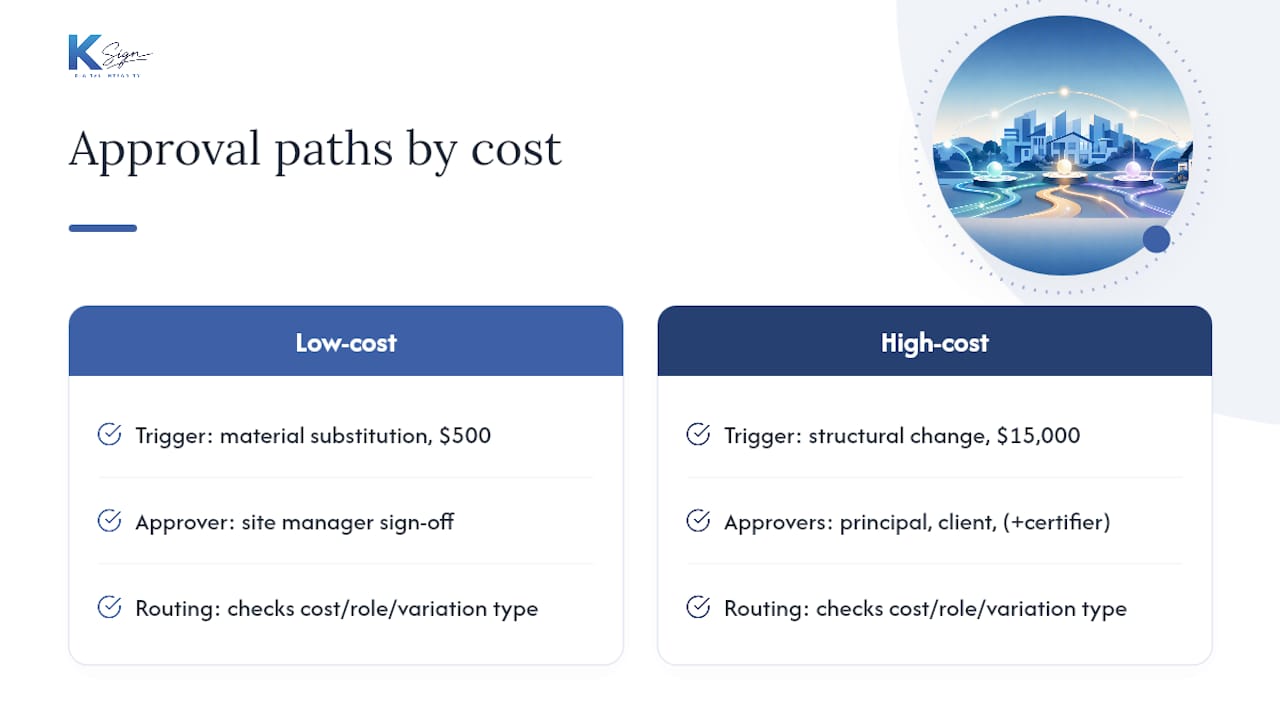
Wrike’s approval workflows show how automated status transitions and dynamic request forms route the right stakeholders without manual intervention. Jotform Workflows takes a no-code approach: drag-and-drop conditional logic routes form submissions into the correct approval chain based on field values. For developer-led products, Velt’s versioned JSON workflow definitions allow teams to update routing logic without breaking in-flight approvals.
The builder checklist for this capability: does the tool let you set cost thresholds that trigger a second approver? Can you assign roles (site manager, project manager, client) independently per variation type?
Australian legal requirements for electronic variation approvals
Electronic signatures on construction variation documents are governed by Australian electronic transactions law and its state equivalents. A variation approval signed electronically is legally binding provided the signatory consented to electronic signing, the signature method reliably identifies the person, and the record is stored in a form that remains accessible. Most Australian states also impose specific requirements under their building legislation — in New South Wales, for example, legislation creates obligations around documentation of variations to regulated designs.
Builders should confirm that any variation approval tool stores signed records with a tamper-evident audit trail, captures IP address and timestamp data, and can export the full record for dispute resolution or regulatory audit. This is general information; confirm current requirements with a qualified construction lawyer or your state’s building regulator.
Integrations with Australian accounting and project management tools
The variation approval workflow only delivers full value when approved records flow automatically into your accounting system. Manual re-entry between a variation tool and Xero or MYOB is where margin leakage happens. Australian builder workflows consistently recommend capturing variation data once, linking it to the relevant trade or task, and handing claim timing directly to the bookkeeper inside the accounting system.
Wrike connects to project management boards and can trigger status changes that feed downstream reporting. Jotform Workflows integrates with Zapier, enabling connections to Xero, MYOB, and Procore. Ksign’s API and integration layer supports webhook-based connections to finance and CRM tools, so an approved variation can trigger an invoice draft in Xero without manual steps. For builders already using Procore, grouping potential variations into a single variation request before routing for approval reduces duplication.
Security and data privacy standards relevant in Australia
Any platform storing signed construction documents must comply with Australian privacy laws, including the Privacy Act and the Australian Privacy Principles. For cloud-hosted tools, confirm that data is stored on Australian or adequately protected offshore servers, that access is role-based, and that the vendor publishes a clear data retention and deletion policy.
Canto’s Approval Hub illustrates how centralised proofing with version compare and automated reminders reduces the risk of unapproved document versions circulating. The same discipline applies to variation records: only the current approved version should be accessible to site crews, with prior versions locked to administrators. Encryption in transit (TLS) and at rest, combined with multi-factor authentication, are the baseline expectations for any tool handling contractual records.
Support and training for Australian builders
Platform support matters most during the first two weeks of a new workflow. Look for vendors that offer onboarding assistance in Australian business hours, not just a help-centre article. Construction-specific templates and pre-built variation workflows cut setup time from days to hours.
Ksign’s construction industry page provides templates and workflow guidance tailored to Australian trades and builders. For teams embedding approval engines into their own products, Velt’s developer documentation covers JSON workflow setup in detail. Jotform offers a broad template library and live chat support, though its construction-specific templates are generic rather than Australian-market-specific.
What Australian builders report about variation workflow tools
Published case material from Australian construction software providers points to a consistent pattern: the biggest gains come not from the approval tool itself, but from enforcing structured data capture at the point of raising the variation. BuildPass’s variation module records both sell impact and cost impact on a single record, making margin visible before approval rather than after. Planyard’s change order workflow automatically updates contract and project budgets when a variation is approved, eliminating the manual reconciliation step that typically delays progress claims by days.
The common thread: builders who standardise their variation request template — mandatory cost fields, scope description, timeline impact, and photo evidence — report faster client approvals and fewer disputed claims at project close.
The real cost of a broken variation workflow
Most builders know variations are where margin goes missing. What’s less obvious is exactly where in the handoff it disappears: not usually at the client approval stage, but in the gap between approval and invoicing.
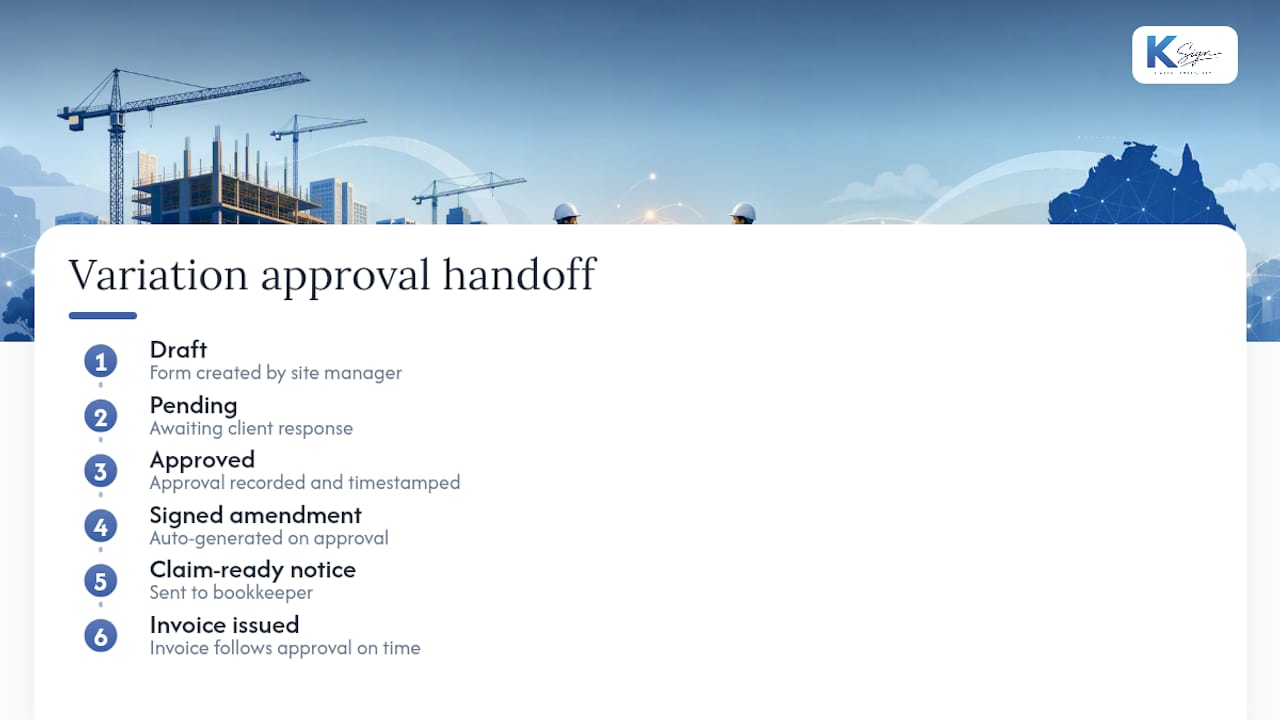
A site manager approves a variation verbally or via a text message. The admin team finds out a week later, reconstructs the scope from memory, and raises a progress claim that the client disputes because they never saw a formal document. The variation was real. The margin was real. The paperwork wasn’t.
Status tracking from Draft through Pending to Approved, with automated notifications to both client and finance, closes that gap. When the approval triggers a signed contract amendment and a claim-ready notification to the bookkeeper, the handoff is verifiable and the invoice goes out on time. Ksign’s practical completion workflows show how this plays out on real jobs: the signed record exists, the timestamp is there, and the claim follows the approval rather than chasing it.
Trial a form-to-contract workflow on one active job. Pick a variation type you raise frequently — a material substitution or a scope addition — build the form, set the routing, and run it live for two weeks. The approval-to-claim-ready time is the KPI to watch.
Ksign gives builders a complete variation approval workflow
Variation approvals don’t need to be complex. They need to be fast, documented, and connected to invoicing. Ksign’s contract automation turns a guided mobile form into a signed variation amendment in one workflow: the client receives the variation document, signs electronically, and the approved record lands in your dashboard with a full audit trail.
Embedded payments mean a deposit or staged payment can be collected at the moment of approval — no separate payment link, no chasing. Setup for a small builder typically takes one to two hours: configure the variation form, set cost-threshold routing, connect to Xero via webhook, and run a test approval. By week two, the workflow is live on active jobs and the approval-to-claim-ready cycle is measurable. Start with the product overview or go directly to the approval workflows page to begin a trial.
Sources
- Approval Flows | Velt
- Aproove platform
Statistic callout: Freyr’s Via agent demonstrates that structured, explainable decisioning with traceable rationale can cut assessment time by up to 80% in high-complexity classification workflows — a signal of how much time structured data capture and automated routing can recover in any approval-heavy process.
This article is general information, not a substitute for advice from a qualified lawyer. Consult a qualified legal professional about your own circumstances before acting on anything here.